Feeds:
Posts
Comments

Posts Tagged ‘academia’

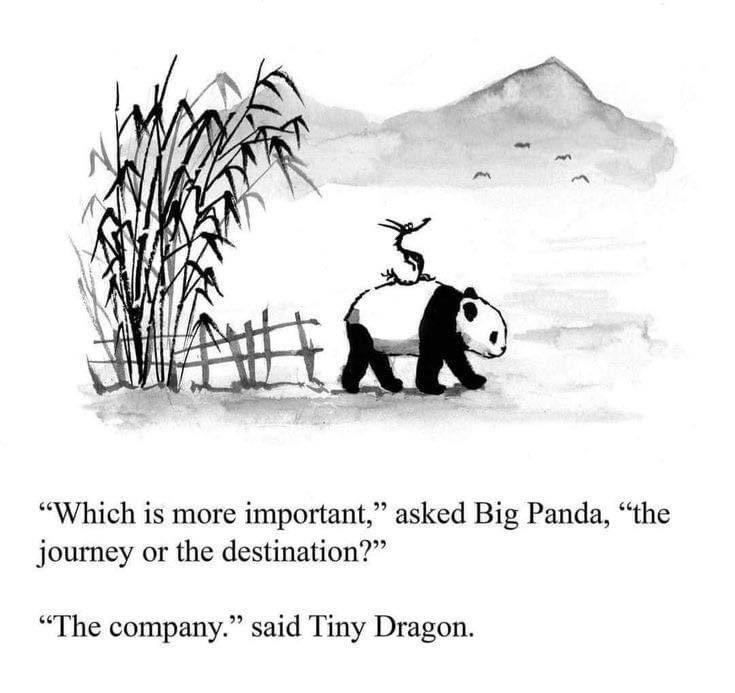
“Which is more important? The journey or the destination?” asked Big Panda

“The company.” said the Tiny Dragon


Backstory

In September 2021 (as a 33 year old), I moved to (South) Germany with my wife and son – and joined the then newly formed Computational Biology (‘gCBDS’ in short) Department of Boehringer Ingelheim (BI) as a ‘Senior Scientist’ (and ‘Product Owner’ afterwards for ~20 months). I was <20th hire of the department (incl. leadership team), which went on to hire >100 in a short space of time. So I didn’t get much of a chance to loiter and had to learn quickly to be helpful to the ‘new hires’. The Human Genetics team was an even newer team within gCBDS and designed to be a truly cross-cutting one – so we dealt with all therapeutic areas (there was six at the time: Cardio-Metabolic, Immunology & Respiratory, CNS, Cancer Immunology & Immunomodulation, Cancer Research, and Research Beyond Borders – which was ‘everything else’). It was very challenging at first – especially as there were colleagues who didn’t believe in the power of human genetics/omics in drug target ID/validation/repurposing – but gave me the chance to:
(i) meet colleagues who are experts in different fields and learn a lot about different diseases and their molecular causes/master mechanisms – and tweak my analysis pipelines and visualisations to their needs (published quiet a few papers with them too e.g. Jones et al., 2024; Kousathanas et al., 2024; Noyvert, Erzurumluoglu, Drichel, Omland & Andlauer et al., 2023; Qiu et al., 2024), and
(ii) lead (or co-lead) important initiatives such as the Digital Innovation Unit (DIU)’s Biobank Project where I would come up with ‘solutions’ as Product Owner (PO) to make the biobank data that BI invests heavily in more ‘accessible’ to the CompBio and wet-lab colleagues and ultimately impact the portfolio – pitching for funding to the leadership team (obtaining >450k euros in ~1.5 years), presenting ‘business value’ (e.g. making certain analysis pipelines >25% faster and cheaper, pushing targets to portfolio), scouting/interviewing CROs, and leading subteams/project managers as part of my PO role. We were also one of the earliest users of the UKB RAP (UK Biobank) and Sandbox (FinnGen) platforms, and helped shape the Our Future Health genotyping array. Having a bit of influence in the External Innovation camp also helped with bringing Dr Richard Allen – a leading scientist in the genetics of Idiopathic Pulmonary Fibrosis (NB: BI has a blockbuster drug called Ofev used in treating IPF patients) – to Biberach for a week.
I am proud of what we were able to achieve and I probably wouldn’t be able to do most of these at this stage of my career if I was to stay in academia or had joined Pharma companies with more established CompBio/Human Genetics departments e.g. GSK, AZ, and Regeneron.

As a family, we learned, saw and grew a lot as individuals, so I wanted to jot down a few sentences to share our experiences for Comp. Biologists curious about a move to (South) Germany and/or Boehringer Ingelheim.

As always, happy to take any questions directly and/or in the comments section!


Looking back

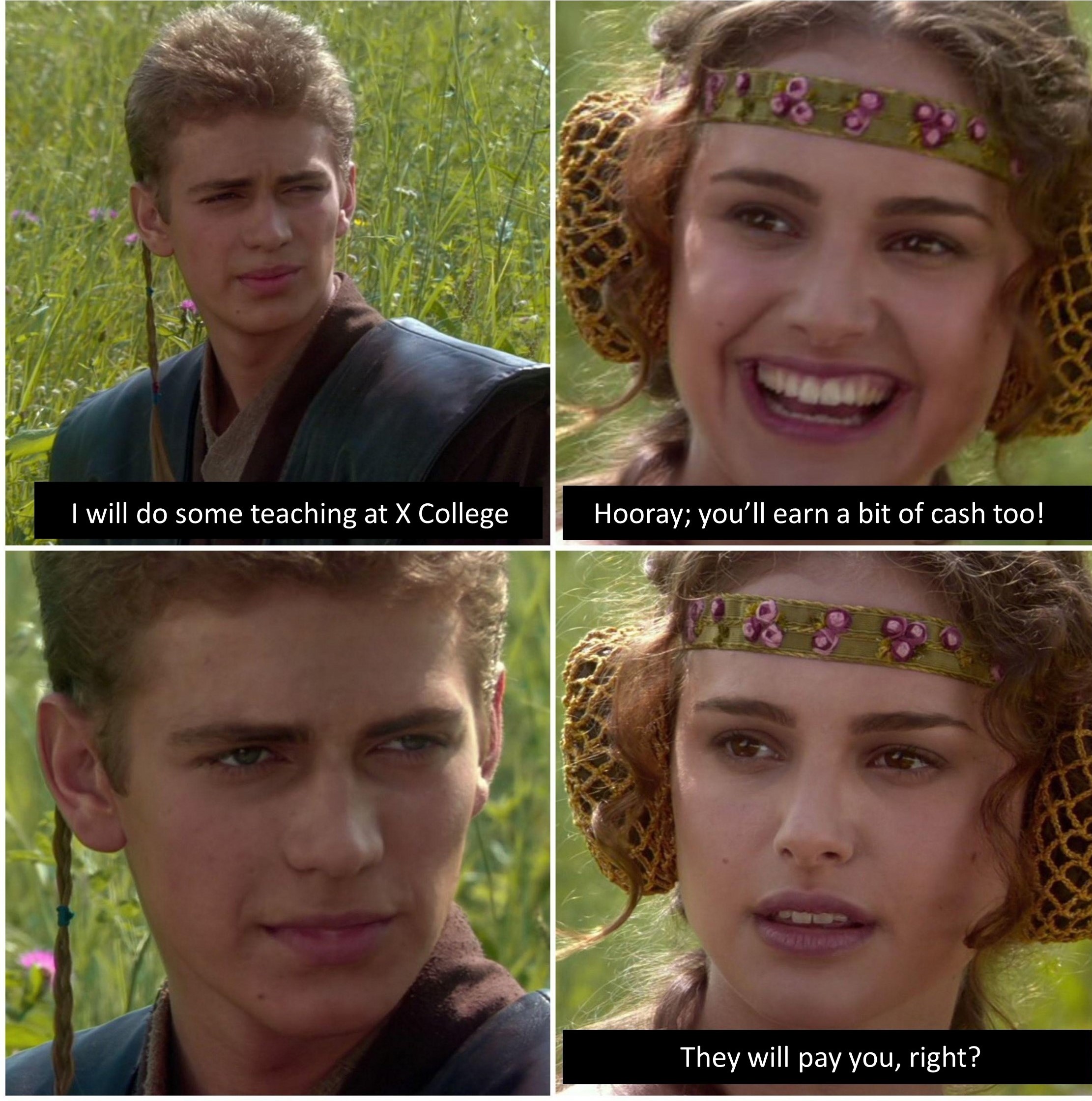
I want to start with the ‘goodbye’ email I sent (with the above picture from ‘Big Panda and Tiny Dragon’) to my colleagues on my last day – which summarised my feelings:

Dear all,
I spent an action packed ~3 years as a fellow gCBDSer! Looking back, I not only learned so much as a scientist but also as a person. It would be too long to list the cultural, social, and emotional impact moving to Biberach/Germany had on me and my family, but we will never forget the teary eyes of many of our friends, neighbours, and Isaac’s kindergarden teachers/friends – we also shed a few tears to say the least. We enjoyed (almost!) every second of our time here and will be recommending BI as a great employer wherever we go. On this end, I thank Till (Andlauer) for contacting/encouraging me to join BI and the Human Genetics team – learned a lot from him.
I was fortunate enough to help shape the Human Genetics Team from its early days – most notably, championing Mendelian Randomisation to virtually all the therapeutic areas (TAs) – but also be Product Owner (PO) of the DIU’s Biobank project, where we* graduated three solutions to make the Biobank data FAIRer (via self-service tools/algorithms, and integration with NTC Studio) and more impactful. We pinpointed that at least 27 targets (across 5 TAs) that entered portfolio were significantly supported by this data in the ~1.5 years I was PO. I also want to underline that we helped with the deprioritisation of even more – which I believe can be as important as validating a target.
My family’s moved back to the UK last month as my wife started as a Lecturer at Warwick University and my son started school in Leicester. I will join a biotech after a little break (details will be shared on social media when I formally start).
If you’re ever in the UK, we would be very happy to host you and/or catch up over a kebab, fish & chips, or a curry – on me as usual 😉
Mach’s gut!
Mesut (on behalf of Fatma, Isaac & Newton)

*Too many people to thank but special thanks to Dr Boris Bartholdy, Dr Julio C. Bolivar-Lopez, Dr Johann de Jong, and Dr Hanati Tuoken – the Project Managers whom (co)led the solutions proposed to the DIU leadership team


Pros & Cons

Going back to the beginning: It was not an easy decision to leave our ‘comfort zone’ in Leicester (where I lived most of my life; see blog post for details) but we couldn’t pass up the chance to move to a country like (the South of) Germany, learn a new culture/language, and meet lots of new people – in addition to working for a ‘Big Pharma’ company (see my blog post when I was about to join BI). We decided to live in Biberach an der Riss from ‘Day 1’ (when many colleagues suggested living in nearby Ulm – the birthplace of Einstein) – and this small town with a population of ~40k grew on us quickly. You’re left amazed at how clean, safe, and economically productive the town is with the presence of large companies such as Liebherr, Handtmann, KaVo, and Baur – in addition to BI’s largest research centre (with >6k employees) being located here.

Let me summarise the ‘Pros’ first:
1- BI pays well (and provides a lot of benefits) – even for German standards (which is higher than UK standards!). The company is also quiet special in that it’s the largest private pharma company in the world – so the way things work are bit different than other ‘Big Pharma’ companies. So you can certainly ‘learn and earn’ well here!
2- The German system supports families well e.g. child benefit/kindergeld is ~250 euros per child and the tax class is (usually) lower, and kindergartens (in South Germany) are of very good quality and cheap compared to the UK (at least Leicester!).
3- South Germany is beautiful with lots to do. It’s also at the heart of continental Europe, so flights are very cheap (check Ryanair flights from Memmingen Airport) and a lot of places (incl. Eastern France, Switzerland, Austria, Northern Italy, Czechia) are within driving-distance. There are also a lot of unique festivals (big and small) and fantastic Christmas Markets, which are worth attending at least once (see tweets below)

It’s not easy to pinpoint the challenges you personally might face at the Biberach site – as everyone’s context is different – but I’ll list the ones I personally struggled with (at least for some time):

Watch out for:
1- You’d need to learn a bit of German to get along with the older generation in South Germany – as they get annoyed if you talk English to them directly. Try learning at least basic German – then they also try to help and speak English with you if needed
2- Rent and living costs are high in Biberach (and Ulm). Thinking of buying a decent house? Better have a massive budget or forget about it! Housing market is even worse than the UK!
3- Do not argue with the police/government officials – or appeal their decisions (see ‘Anecdotes’ section below too). You will likely get double the fine with nowhere to complain. Things are a bit devoid of common sense when it comes to state matters. As an example from my own experience, an officer suddenly puts up a sign on our street to state that there’s no parking for a certain amount of time. But the sign that says ‘Residents only/free’ was still up there. So I had parked my car on my usual spot. I see the officer writing a ticket and go over to him to ask what was happening. He explains the situation and I apologise, show him the sign that confused me, also noting that I was new here. I assumed he hadn’t issued the ticket – but of course I was wrong. I then appealed the ticket to explain the situation (with photo evidence of the signs) but it was rejected – and this time with twice the fee. Another example: During the pandemic, my wife and son were made to queue outside for some time to let other passengers through. My (4 year old) son was about to burst and needed the toilet but the police didn’t allow him – no matter how many times she asked. This would almost never happen in the UK
4- Non-German take-aways/restaurants aren’t at the same level as the UK (at least nowhere near Leicester!). It can also get boring in the evenings and Sundays as most places are closed (see below to see what we were up to).
5- The turnover in BI’s CompBio department is high (a huge waste of resources unfortunately!), so get ready for many ‘welcomes’ and ‘goodbyes’. This is partially due to company/HR (e.g. miscommunication, false promises before joining, not allowed to live far from Biberach) and/or the leadership team-related issues (e.g. lack of empathy/care and/or power to keep ‘junior’ talent happy) but not always – and colleagues have cited a variety of other reasons (e.g. spouses struggling to find jobs, weather, not being able to integrate to South German society).

Why did I leave?

I resigned mostly due to family reasons – as my wife (who has a PhD in Law) was not able to find a job for >2 years in/near Biberach that also allowed hybrid or remote work. BI – which I believe will change for the better in this regard (but too late for me and family!) – doesn’t allow even Computational Biologists to live too far away from Biberach, which made it much harder for her as there were nice opportunities at international Law firms in/near Frankfurt and Berlin. Before I signed, we were reassured by an HR colleague that BI’s Legal Team should be able to find something but unfortunately not much came out of my wife’s endeavours. In addition to the disappointment regarding the lack of help from HR, Legal Team members, and my own boss(es) regarding my wife’s situation, I also wasn’t very happy with the direction of the team/department and – although I didn’t ‘downtool’ – it made it easier for me to leave my well-paying permanent position and look elsewhere.

Once my wife found a job at a prestigious university in the UK, I also looked around for UK-based posts that fit my skillset, ambitions and (were likely to have) met my minimum salary and flexibility expectations. After two rejections at the panel interview stage for senior roles (i.e. at Director and Assoc. Director level) at Big Pharma companies, and four strong applications not concluding due to
(i) cancellations (e.g. the interview process took >5 months in one application and the company/HR changed hiring priorities due to people leaving; another post was closed due to relocation to the US),
(ii) potential conflict of interest as they had signed recent contracts with BI or
(iii) ‘being overqualified’ and/or ‘being expensive’ (note that I wouldn’t have applied if I wasn’t happy with the title/role and/or salary), I decided to push different buttons and try to revive my data science/infrastructure business ‘data muse’ (datamuse.co.uk) – which I had initially set up with my sister (a successful businesswomen/data engineer) during the pandemic and then stepped down when I got hired by BI. I thought it was a good time for me to explore different sectors and it turned out to be a good decision (in the short term) as I widened my UK-based network and forged alliances with a Cambridge-based biotech (working as their Lead Comp. Biologist in ‘stealth mode’) and two SMEs (incl. a consultant role). However, I also had several applications progressing (incl. a Team Lead position at a very prestigious Aerospace company) and one biotech really ticked all the boxes for me: Bicycle Therapeutics – a biotech with fantastic potential (see their pipeline), nice culture/people, very good benefits and where I can learn a lot (e.g. had never worked with ‘bicycles’ before). I will (handover hands-on responsibilities at data muse and) formally start in January 2025.

Conclusion & Anecdotes

Long story short, I not only learned and travelled a lot (in Continental Europe, LA & South East Asia) but also earned/saved enough money during my ~3 years at Boehringer to (be in a position to) buy a house in a nice neighbourhood in my home town (i.e. Leicester). I also got to use the Agile/Atlassian Project and Team Management tools (e.g. Jira, Confluence), which I also utilised at data muse. As a family, we made many lifelong friends, which I see as the biggest gain.

I would certainly advise anyone to give BI at least a try should the right opportunity arise.

I want to finish with three (tragicomical) anecdotes – showing the good, the bad and the ugly side of ‘our journey’:
1- Although I was headhunted for the position at BI and had a very nice chat with Till Andlauer (1st hire and very senior member of the Human Genetics team – who persuaded me to apply), my initial application was rejected by HR. After two days of feeling betrayed (I was naïve at the time), I reached out to Till to ask why I was rejected and he told me there must have been a mistake. The same day HR writes back to say they made a mistake and I will be invited for a panel interview soon.

It was a good lesson on how ‘diligent’ and coordinated HR can be with some of these applications – and how much role luck (and making your own luck) can play!

2- For our arrival to Germany, our assistant had purchased a ticket to Munich airport from London. When we arrived, all the rental cars were gone (rent before arrival!). So we decided to ask for a taxi. When the taxi driver asked for >300 euros to travel to Biberach, I – still with the ‘Academia/Postdoc mindset’ (and not listening to my wife!) – decided that we would try the Deutsche Bahn/train (which cost ~40 euros). Normally, there would be 3 changes (Airport -> Munich -> Ulm -> Biberach) but we didn’t know/realise there were strikes that day (quite common!), so we ended up in Stuttgart rather than Ulm – which is further away. Took us >5 hours to get to Biberach! It was midnight when we arrived at the Biberach Bahnhof/Train Station and the first thing we see is 7-8 young adults having a serious fight with broken bottles being thrown about (we’ve lived there for 3 years since and never saw anything like it!). I was getting ready to defend my family in case they came close to us but thankfully we quickly found a taxi (driver who knew some English) who took us to our guest apartment. The apartment flat was a bit stuffy, so we opened the windows and (not exaggerating!) hundreds of mosquitos came in (we never had a mosquito problem in Leicester). I spent an hour killing them 😐
When I met my colleagues on my first workday, I asked how they (i.e. the cross-border hires) all travelled to Biberach and every single one said they used the taxi – as they knew the company would reimburse. You learn from these experiences I guess 😀

3- At the time of writing, Blue Card holders (which we were) are entitled to permanent residence in Germany in 27 months if they learn basic German (certified A1 or above) and pass the ‘Leben in Deutschland’ test. There was also a newly created ‘Highly-qualified worker’ visa (Sec 18c ResA), which does not specify any criteria on the website other than having ‘special expertise‘. Although we were planning to leave Germany due to my wife’s situation (no formal resignation yet), because we were very happy and wanted to keep in regular touch with our friends here (and even live here again if the right opportunity arose for both myself and my wife), I decided to go for this visa type – as I didn’t want to wait 4-5 months for a spot to enter the ‘Leben in Deutschland’ test in Biberach (I already had a A1 certificate with a ‘Sehr Gut’ grade from the Goethe Institute). I wrote a cover letter explaining why I wanted to apply and why I was qualified – enclosing my payslips, CV, Tax returns, proof of address, my son’s school details etc.
Turns out I was the first one to apply via this route in Biberach. Of course, this lack of clarity in the criteria created a big dilemma for the case worker and it took some time for her to do her research and get back to me. She then told me that I had to provide documentation that I would be able to sustain myself and family permanently (which is a huge criteria that she/her boss pulled out of thin air). I wasn’t going to reply initially (as I had now formally resigned from Boehringer and was returning to the UK in ~4 months) but later underlined what I wrote in the cover letter (e.g. highly-cited papers in the field, Top 2% earner in Germany, permanent contract) in a last bid to get a permanent visa – of course to no avail.
That was the end of it for me but not for her – and showed a side to German State affairs that we are not used to in the UK: Turns out she contacted BI to find out that I had now resigned and gave my name to the authorities to issue a fine to me (due to not informing the authorities of my resignation). I paid the fine but also wrote her the below email:

I received a letter today, titled ‘Anhorung im Bussgeldverfahren’ from the Biberach Bussgeldstelle. It seems like you told them that I did not inform you/Auslanderstelle regarding my resignation from Boehringer Ingelheim.
I am not sure why you decided to do this without telling me first – as I thought/understood that Boehringer Ingelheim would tell the authorities about my resignation. I hope you understand that I am not fully knowledgeable about the workings of this country – and it would have been kinder if you had informed/warned me first.
The big problem for me is that you treated me like I’m trying to stay here as an illegal immigrant. I am an established scientist whose CV includes highly-cited academic papers in some of the best journals. I was also chosen ‘top performer’ for consecutive years in my group at Boehringer Ingelheim. I had a permanent contract here and I decided to terminate it as we – as a family – found better opportunities in the UK.
You’ll be happy to hear that we are leaving Germany in a month’s time and will deregister as soon as possible.


Biberach an der Riss commemorated on the Arc de Triomphe in Paris – as Biberach was the battleground of two Napoleonic Wars (1796 & 1800). Photo credit: Fatma Nursima Arslan (July 2025)

Notable things about Biberach an der Riss:

-Historical city: Imperial Free City (1281-1803), and battleground of the Thirty Years’ War (1618 -> +30?) & two Napoleonic wars (1796 & 1800 – see photo above)
-The Biberach Donkey (a story by the writer Christoph Martin Wieland; see summary here)
-Birthplace of Heinz H. Engler – who designed the first system tableware in the catering industry (Link)
-Birthplace of Loris Karius – Liverpool’s Goalkeeper in the 2018 Champions League Final (don’t watch the highlights!)
POIs closeby:
(Clustered POIs close to eachother)
-Burrenwald/Kletterwald
-Baltringen (Fossil site)
-Federsee/Wackelwald (Bouncy forest)
-Erwin Hymer (Caravan) Museum/Tannenbuhl/Bad Waldsee
-Öchslebahn
-Kürnbach Museum (watch out for special events)
-Jordanbad (we used to go to this spa almost every weekend with my son)
Nearby cities/POI to visit:
<1.5 hours driving distance:
-Ulm (Einstein’s birthplace, home of the Löwenmensch)
-Ravensburg (birthplace of the Ravensburger puzzles)
-Konstanz/Meersburg
-Lindau/Bregenz
-Breitachklamm/Oberstdorf
-Neuschwanstein Castle/Füssen
-Nördlingen
-Northern Switzerland: Schaffhausen (Rheinfall), Zürich, Basel
-Eastern France: Strasbourg, Colmar/Riquewihr


Related Tweets:

My comedy attempts – inspired by my interactions in Germany 🙂
Read Full Post »

A farmer and his son had a beloved stallion who helped the family earn a living. One day, the horse ran away and their neighbours exclaimed, “Your horse ran away, what terrible luck!”

The farmer replied, “Maybe.”

A few days later, the horse returned home, leading a few wild mares back to the farm as well. The neighbours shouted out, “Your horse has returned, and brought several horses home with him. What great luck!”

The farmer replied, “Maybe.”

Later that week, the farmer’s son was trying to break one of the mares and she threw him to the ground, breaking his leg. The villagers cried, “Your son broke his leg, what terrible luck!”

The farmer replied, “Maybe.”

A few weeks later, soldiers from the national army marched through town, recruiting all the able-bodied boys for the army. They did not take the farmer’s son, still recovering from his injury. Friends shouted, “Your boy is spared, what tremendous luck!”

To which the farmer replied, “Maybe.”

IMPORTANT NOTE: EVERYTHING I WROTE BELOW ARE MY OPINIONS AND REFLECT MY EXPERIENCE IN ACADEMIA (IN THE UK) – AT THE TIME OF WRITING. THEREFORE, THEY PROBABLY WILL NOT APPLY TO YOU. ALSO, PLEASE READ FROM START TO FINISH (INCL. FOOTNOTES) BEFORE POSTING COMMENTS.

Very soon, I’ll be moving to the ‘Human Genetics’ team of Boehringer Ingelheim Pharma (BI; Biberach R&D Centre in South Germany) as a ‘Senior Scientist’. I therefore wanted to look back at my time in academia and share my suggestion and concerns with other PhD students and early-career researchers (ECRs). Any criticism mentioned here is aimed at UK-based (research-intensive) academic institutions and “the system” – and not at any of my past supervisors/colleagues. The below are also going to be views that I have shared in some of my blog posts (e.g. Calculating the worth of an academic; Guide to an academic career in the UK; Bring back the ‘philosophy’ in ‘Natural philosophy’; What is success? YOU know better!) and with my colleagues throughout the years – and not something that I am just mentioning after securing a dream (will elaborate below on why I called it a ‘dream’) job at BI. (NB: See ‘Addendum (23/12/21)’ section, reflecting on my first 4-5 months at BI’s Human Genetics team)

To do my time in academia justice, I’ll get the good things out of the way first: I’ve been doing research for >10 years in UK-based academic institutions – first as a PhD student (Univ. of Bristol 2012-2015), then as a (Sn.) Postdoctoral Research Associate (2015-19 Univ. of Leicester; 2019-2021 Univ. of Cambridge) – and enjoyed almost every second of my time here. I met many world-class scientists but also great personalities whose memories and the things I learned from them will remain with me for the rest of my life. I was lucky to have had supervisors who also gave me the space and time to develop myself and I’d like to think I took good advantage of this. I also got to (i) publish quite a few papers I will always be proud about and (ii) travel to the US and many countries in Europe thanks to funding provided for academic conferences and, needless to say, none of them would have been possible without (4-year PhD) funding from the Medical Research Council (MRC UK) or support of my PhD/postdoc supervisors and colleagues. My time in the beautiful cities of Leicester (see: Life in Leicester), Bristol, and Cambridge was enjoyable too! I therefore would recommend any prospective scientist/researcher to spend at least some time as a ‘Postdoc’ in a research intensive UK-based university.

On top of all this, if you were to ask me 5 years ago, I would have said “I see myself staying in academia for the rest of my life” as I viewed my job as being paid for doing a ‘hobby’ – which was doing research, constantly learning, and rubbing shoulders with brilliant scientists. However, things started to change when I became a father towards the end of 2018, and I slowly began to have a change of heart about working in academia due to the well-known problems of fixed-term contracts/lack of permanent job opportunities, relatively poor* salaries compared to the private sector, and the many hurdles (incl. high workload) you need to overcome if you want to move a tiny bit up the ladder. The only thing keeping me going was my ideals of producing impactful science, my colleagues, and the possibility of pursuing my own ideas (and having PhD students). No one needs my acknowledgement to learn that there is ‘cutting-edge’ and potentially very impactful science being done at universities but the meaning of ‘impact’ for me changed during the COVID-19 pandemic when I was sat at home working on projects which I felt didn’t have much immediate impact and probably will not have much impact in the future either – and if they did, I probably would not be involved in the process as an ECR. On top of this, many of the (mostly COVID-19, and academia-related) analyses I was sharing on my Twitter page and blog were being read by tens of thousands. I was also heavily involved with the crowdfunding campaign of a one-year-old spinal muscular atrophy (type-1) patient (see tweet and news article). And these were both eye-opening and thought provoking! So the problems that I ignored or brushed under the carpet when I was a single, very early-career researcher were suddenly too big to ignore, and enduring through fixed-term jobs, relatively low pay packages* and a steep hierarchy (i.e. much more ‘status’ oriented than ideal) was just not worth it.

One of my biggest disappointments was not being able to move to Cambridge with my family because (i) Cambridge is very expensive relative to Leicester, and (ii) Univ. of Cambridge doesn’t pay their ECRs accordingly – mind you, I was being paid the equivalent of a (starting) ‘Lecturer’ post at the University’s pay scales (Point 49; see ‘Single Salary Spine’), so many of my colleagues were being paid less than myself.


There was also the issue of not having enough ‘independence’ as an ECR to work on different projects that excited me. As a ‘postdoc’, my priority had to be my supervisor’s projects/ideas. If I wanted to pursue my own projects, I had to bring my own salary via fellowship/grant applications – even those would have to be tailored towards the priorities of the funding bodies. Applying for grants/fellowships is not something I like or I’m trained for but I did try… I submitted three (one grant and two fellowship) applications and made it to the interview/final stage every time, however they were all ultimately rejected mostly because I “was not an expert on that respective disease” or “was too ambitious/couldn’t do all these in 3 (or 5) years”. I guess I also laid all my cards on the table and didn’t hide the fact that I was a proud ‘generalist’** and was never going to be a specialist as I am just too curious (and unwilling) to be working on a single disease or method. In addition to these, I had also co-applied (with a Lecturer colleague in the Arts dept. where we had to submit quite a few documents and a short video) for a very small grant (of ~£6000) to organise a conference to discuss the problems of asylum seekers/refugees in the UK, but it was rejected for strange reasons. I acknowledge that there is an element of luck involved and on another day with another panel, I may have been awarded but these rejections were also eye openers. (NB: I believe the ‘all-or-nothing’ nature of fellowship/grant applications should be revised as a colossal amount of researchers’ time and effort – and therefore taxpayers’ money – is being wasted)

But – in line with the story (of the Chinese farmer) I shared at the start – I am now happy that they didn’t work out as it probably would have meant I stayed in academia for longer (i.e. until the end of my fellowship period). I always took the ‘doing my best and not worrying about the outcome‘ approach and this has proven to be a good strategy for me so far.

Although unhappy with the way ‘the system’ took advantage of ECRs, I did try and “play by rules” to ramp up my CV and network by applying to become a ‘Non-stipendiary Junior Research Fellow’ at one of the colleges of the Univ. of Cambridge to increase my chances of securing a permanent lecturer post at a high-calibre university. Although I enjoy teaching and think I am good at explaining concepts, the main reason for applying was to add more teaching experience in my CV and secondly, to be more involved with the community of students and ECRs in Cambridge – which I did not have a chance to do much, mostly as I and my wife decided not to move to Cambridge from Leicester for the reasons mentioned above (underneath the first figure). I made a solid application and got to the interview stage. I thought the interview panel would be delighted to see someone like me who has a relatively good academic CV for an ECR (see my CV) but also does sports, has his own podcast, who tried to be active on social media (I had more followers than the college on Twitter – although they’re very active), who writes highly read blogs (some of my blog posts are read and shared by tens of thousands), led many student groups (incl. the President of Turkish Society at the Univ. of Bristol and Leicester) etc. to join their ‘guild’ but I was very surprised to receive a rejection email a couple of weeks later. I was going to work there for free, but it seems like they didn’t value my skills at all and that there were at least 5 other people who they thought were going to contribute to the College’s environment more than me. This was another eye-opener: Academia is full of (highly talented) ECRs who are just happy to do things for free for the sake of adding stuff to their CV and I realised I was about to do the same. I remember thinking “I dodged a bullet there” – I decided it just wasn’t worth fighting/competing over these things. I knew now that I had to explore options outside of academia more assertively as I could see clearer that universities and the senior members who helped build this system were just taking advantage of ECRs’ idealism and ambitions but also desperation. (BTW: I find it astonishing that non-stipendiary fellowships in Cambridge are even a thing. They state that they don’t expect much from their fellows but they clearly do)

I then shared a 1-page CV in certain job recruitment sites to see what was out there for me and I was surprised to see how valuable* some of my transferable skills were to businesses in different sectors. I had many interviews and pre-interview chats with agents and potential employers (incl. Pharma, other private sectors, and public sector) in the last 6 months but only one ticked all the boxes for me: this ‘Senior scientist’ role at the Human Genetics team of BI – who valued my versatility and expertise in various fields***. Thus, I took time out to fully concentrate on the process and prepared well. I had to go through five interview stages, including an hour-long presentation to a group of experts from different fields, before I was offered the post. Throughout the process I also saw that many of my prospective colleagues at BI had seen the abovementioned problems earlier than I did and made the move. They were all very happy, with many working, and hoping to stay, in the company for a long time. I should also mention I had a Lecturer job lined up at the Univ. of Manchester**** too but the opportunity to work for BI’s ‘Human Genetics’ team was too good to refuse.

I didn’t mean this post to be this long so I’ll stop here. To sum up, I am proud of the things I’ve achieved and the friends I’ve made along the way – and if I was to go back, I wouldn’t change anything – but I believe it is the right time for me to leave academia. I think I’ve been a good servant to the groups I worked in and tried to give all I could. Simultaneously, I grew a lot as a scientist but also as a person – and this was almost all down to the environment we were provided at the universities I worked in. But having reached this stage in my life and career, I now think that (UK) universities don’t treat us (i.e. ECRs) in the right way and provide us with the necessary tools or the empathy to take the next step. I don’t see this changing in the near future either because of the fierce job market. Universities are somehow getting away with it – at least for now. This is not to say other sectors are too different in general but I would strongly recommend exploring the job market outside of academia. You may stumble on a recruiter like BI and a post like the one I have been offered, which matches my skill set and ambitions but also pay well so I can live a decent life with my family – without having to live tens of miles away from my office.

Let me re-iterate before I finish: What I wrote above will most probably not apply to you as I (i) am a UK-based academic/researcher, (ii) am an early-career researcher in a field which also has a strong computational/programming and statistics component – so I have a lot of easy-to-sell transferable skills to the Pharma companies/private sector, (iii) am a ‘generalist’** rather than a ‘specialist’ – so I’m a person major funding bodies currently aren’t really too keen on, (iv) don’t have rich parents or much savings, and am married (to a PhD student) and have a son to look after – and thus, salary*****, living in a decent house/neighbourhood and spending time with my family is an important issue, and (v) am an impatient idealist, who wants to see his research have impact – and as soon as possible. I am also in a position that I can make a move to another country with my family.


Footnotes:

*Contractor jobs usually offer much better pay packages than permanent jobs in the ‘data science’ field e.g. as soon I as put my CV on the market as a ‘health data scientist’, I got contacted by a lot of agents who could find me short-term (3-12 months mainly) contracts with very good pay packages. Just to give one example of the salaries offered, there was one agent who in an apologetic tone said: “I know this is not very good for someone like you but we currently offer £400 a day to our contractors but I can push it to £450 for you.”this is ~3x the daily rate of my salary at the Univ. of Cambridge!

**I’ve always been involved in top groups and ‘cutting-edge’ projects so the jump from academia to Pharma in terms of research quality is not going to be too steep but the possibility of being directly involved in the process of a drug target that we identify go through the stages and maybe even become a drug that’s served to patients is not there for a (32 year old) ECR in academia – maybe, when I’m 45-50 years old. I also like the “skin in the game” and “all in the same boat” mentality in many Pharma/BI posts, which I do not see in academia. The current system incentivises people to be very individualistic in academia; and the repetitive and long process of publishing (at least partially) ‘rushed’ papers to lay claim to a potential discovery are things that have always bothered me. I don’t see how I can further improve myself personally and as a scientist as I don’t think my skills were anywhere near fully appreciated there – the system almost solely cares about publishing more and more papers, and bringing in funding. I have many ‘junior’ and ‘senior’ friends/colleagues who have made the transition from academia to Pharma (incl. Roche, NovoNordisk, GSK, AZ, Pfizer) and virtually all of them are happy to have moved on.

***As you can also see from my Google Scholar profile (and CV), I have worked on different diseases/traits and concepts/methods within the fields of medical genetics (e.g. rare diseases such as primary ciliary dyskinesia and Papillon-Lefevre syndrome), genetic epidemiology (e.g. common diseases such as type-2 diabetes and chronic obstructive pulmonary disease, and related traits such as smoking behaviour and blood pressure), (pure) epidemiology (COVID-19 studies), population genetics (Y-DNA & mtDNA haplogroup studies), and statistical genetics (e.g. LD Hub, HAPRAP) – and this is generally not seen as a ‘good sign’ (even when I’ve published papers in some of the most respectable journals in the respective fields as first/equal-first/prominent author) by some ‘senior academics’ (who review your grant/fellowship applications, and papers submitted to respectable journals) as many have spent their entire careers on a single disease, and sometimes on a single/few genes. It doesn’t mean they are right, but they usually make the final decision – and some like to act as gate keepers.

****I applied to the Univ. of Manchester post in case I would not get the BI job but also because it was a nice opportunity to work at a top university/department with high quality students and great scientists. They were also happy to pay me at the higher end of the ‘Lecturer’ salary scale. I believe I would have been a good lecturer and colleague but I just did not see myself in (UK) academia in its current state.

*****Although I – with my wife and son – was living in a nice neighbourhood and house in Leicester (renting of course!), due to my son’s expenses incl. a private nanny for a couple of days a week as my wife was also busy like me (small matter of writing her PhD thesis!), we were basically living paycheck to paycheck – and that was hard. When there were unexpected expenses, we used my wife’s (small amount of) savings, then asked my brother to help out financially – and that was hard too. It was almost impossible to fully concentrate on my research as I was always on the lookout for investment opportunities using the small amount of money I had on the side. At one point, I even contemplated doing casual work to earn a bit of cash on the side. Needless to say, I am very disappointed with the pay packages in academia – at least a stratified approach according to field, (transferable) skillset, and marriage/child status/other circumstances should be considered in my opinion. I also think, universities should at least provide guidance on solid investment (incl. mortgage) opportunities to their ECRs, so they can potentially earn or save a bit more. I can’t say much about my salary but it is a senior and permanent post, and my pay package also includes many of the perks of academia (e.g. >30 days of paid annual leave, flexible working hours, conference/travel allowance).


Couple of tweets – in addition to the blog posts I shared above – where I complain openly about the state of (UK-based) academia:

1- I don’t know how “no/limited feedback” has been normalised in academia:

2- I think science communication is as important as the papers we publish:

3- Publishing papers for the sake of publishing and inflating h-indexes:


Addendum (23/12/21) Reflecting on my first 4 months at BI’s Human Genetics team:

I was going to write a piece later but decided to add to this post now as I have been/am being invited to many ‘academia v industry/pharma‘ workshops/talks and saw that there is a lot of interest in this subject. I cannot properly respond to all emails or accept all invitations, thus would like to direct people here when needed…

A quick summary of what I’m doing: I’m a ‘Senior Scientist’ in the relatively newly established Human Genetics team of BI – and we’re located at the International Research Centre in the beautiful city of Biberach an der Riss in South Germany. As the Human Genetics team, we’re currently building analysis pipelines to make use of the huge amount of human genetics, proteomics and transcriptomics data that’s available to (in)validate the company’s portfolio of drugs (see below video for details).

A short primer on how I spend my days in the Human Genetics team of Boehringer Ingelheim: Leveraging human genetics data to guide drug target validation – Mesut Erzurumluoglu (Respiration/Solunum conference on 31/10/21)

If I say a few words about BI – which I didn’t know before I joined: BI one of the largest family-owned companies in the world with >20 billion euros revenue per year and >50k employees all around the world of which >8k are researchers (largest R&D centre is in Biberach an der Riss, where we’re also located) – so the company and the Boehringer/Von Baumbach family value R&D a lot. Some family members also attend research days organised within the company – which I find very encouraging as an employee but also a scientist at heart!

The other exciting thing for me is that the company’s currently going through a phase of massive expansion in ‘data driven drug target validation’, so the Comp. Bio/Human Genetics department is getting a lot of investment and are going to hire a lot of people in the near future – and I’m very happy to be involved in this process too.

To get back to my views of ‘working for BI v in academia’, I’ve made a summary table below which compares my experience as a Senior Scientist in BI and my time as an ECR/(Sn.) Postdoc/(Prospective) Lecturer in UK academia. I’ve highlighted in bold where I think one side better was than the other for me.

I believe the above rows are self-explanatory except maybe the bottom 4 rows – so I will provide some details here: (i) I feel like we’re ‘all in the same boat’ in my current team as we – as a group – have certain targets that we need to hit, so any success/breakthrough by any of the team members alleviates the pressure on all of us. This is also true of any success within the company. (ii) Re the next point/row, I just want to give one example: I have seen many papers be published in very high-impact journals by ‘top names’, which would not have made it past the ‘top names’ themselves (as reviewers) had the paper been written by some other group. Most of us also don’t have any editor friends who we can write to so that our ‘desk rejection’ at a high-impact journals is reviewed. The struggle for funding is even worse and I think life’s too short to be spending months on a fellowship or grant application, which is usually rejected for non-research related reasons (e.g. competition, timelines, priorities). (iii) We’re not allowed to work on Sundays at BI, and emails sent to others on Saturdays and after work hours is genuinely discouraged. (iv) Last row: We’re encouraged to produce good science and analysis pipelines by the senior management at BI rather than be in competition with colleagues to be the ‘first’ at something. In contrast, many papers in academia will be published in high-impact journals and be cited by others because they were the ‘first’ and not because they did a good job of strengthening their finding(s) via different lines of evidence. They do not lose anything if this ‘new and shiny’ finding turns out to be just a meaningless correlation 5-6 years down the line (i.e. there’s no “skin in the game”; even worse, they will have collected their grants and awards by then).

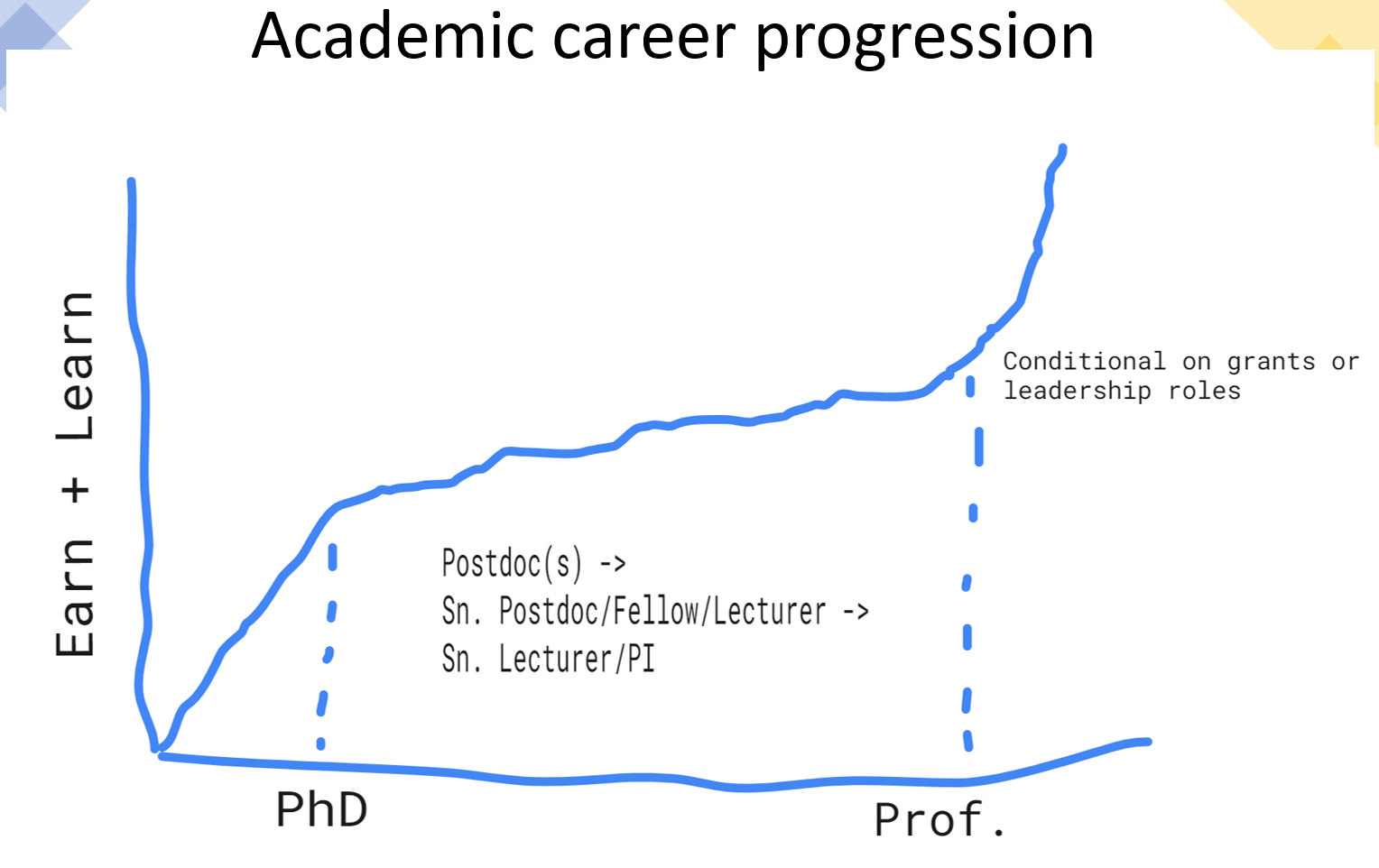
I also want to mention that career progression in UK academia is too slow for my liking (see below figure). I do not want to be treated as an ECR and living ‘paycheck to paycheck’ until I’m 50 – again, I feel like life is too short for this. This is why I wanted to move to a group where I would be respected more but also earning more – so that I can provide a good life for my family whilst fully concentrating on my/the team’s ‘cutting-edge’ research.

I always judged my ‘value’ at a place by adding how much I was earning and learning there. I was very happy during my PhD and first few years as a postdoc as I was learning a lot (from top scientists, attending conferences, giving talks, being provided the time to explore) and had a good salary/scholarship for a person who is single and <30 years of age. Unfortunately, for me, the increase in this regard was just not steep enough after this period. This feeling didn’t change much even after I secured a Lecturer post at the Univ. of Manchester – I just could not beg funders and apply for grants every year until I die. At BI, in addition to a very good salary, I’m also learning a lot from the different groups we are interacting with (e.g. wet-lab researchers/CRISPR screens, drug target research in different disease areas such as respiratory, immunology, oncology, and cardio-metabolic diseases) whilst also taking part in ‘cutting-edge’ research. There are also internal funds to explore your own ideas and a separate programme called ‘Research Beyond Borders’, which is dedicated to looking into other diseases which do not fit the main programmes.

To finish, I again re-iterate that it would be wise for a talented postdoc with data science and statistical skills to have a look around while they’re still comfortable in their current post (i.e. still have >12 months contract). If you have experience working with clinical and genetic data, then Pharma and Biotech companies would also be very interested in you.

I hope this post is of help, but feel free to contact me if you have specific questions that are not answered here.


Addendum (23/12/23) Reflecting on my first ~2.5 years at BI’s Human Genetics team:

Still happy. Family’s happy here. South Germany is very good for families: Very safe. My son’s kindergarten is great; Biberach and surrounding area is great. So much to see and learn.

Happy with the research I’m doing, things I’ve learned/learning, and my impact in the drug target development process at BI.

Also check out our preprint on structural variants – a valuable resource, openly shared with the research community (Note: I had encouraged Boris Noyvert to join our team and now we’ve published this preprint together):

Noyvert B, Erzurumluoglu AM, Drichel D, Omland S, Andlauer TFM et al. 2023. Imputation of structural variants using a multi-ancestry long-read sequencing panel enables identification of disease associations: https://www.medrxiv.org/content/10.1101/2023.12.20.23300308v1

Tweetorial:

Read Full Post »


This blog post first appeared on the Leicester Connect webpage (a platform for University of Leicester Alumni) on the 20th March 2020


Out of all the inspirational quotes on the internet, an old Sufi saying is the one that touches me the most:

“There are as many paths to God as there are souls on Earth.”

Although it is mostly used in a religious (mostly Islamic) setting, for me it carries truths that tower above this narrow meaning. It especially reminds me that we all start from different steps of the ladder, face different challenges along the way, and ultimately end up where we are because of the way we respond to those challenges, the doors that are open to us and the people we meet along the way – with the latter two we mostly cannot control.

I was kindly asked if I could write a blog post after being awarded the Future Leader Award at the 2020 Alumni Awards. I am grateful and honoured to have received the award but also acknowledge that there were at least two more people (my fellow finalists) who deserved it as much as me – if not more.

I would like to start by saying – from my experience in life and academia – that there are no objective criteria which separates those “who made it” versus those who just fell short. I got to meet plenty of people and interview panels who I felt judged me using very narrow and subjective criteria and ignored every other quality I had. It’s always nice to get the job or funding you applied for, however I never dwelled on the outcome if I did my preparation right. I would strongly recommend this approach.

Free yourself from the need for appreciation

Many academics suffer from a condition called Impostor Syndrome – simply put, doubting one’s own accomplishments and constantly fearing being exposed as a “fraud”. I can’t say I ever had it because I always thought of myself as successful in my own way and never sought confirmation from anyone. Although striving to improve myself all the time, I was happy with “just trying to do the right things” – irrespective of the outcome.

I base this belief on the fact that the people who judge us do not know the full story about us. Maybe if they did, they would look at us differently. For example, someone who is born to a middle-class English family will not be able to judge how much of a success it is for an immigrant to learn advanced-level English from scratch, get citizenship and compete for the same positions. Someone who has not had any serious health issues will not be able to comprehend what success is for a disabled person. How about a person who has managed to stay away from crime in a neighbourhood full of ignorance, hate and violence? None of these are mentioned in a CV and no one finds these people and offers them an MBE… or a job. However, this doesn’t change the fact that these people are inspirational and successful. I can only wish more people would realise this and stop treating subjective decisions about themselves or others as objective truths.

I feel privileged to be living in the UK which is a relatively meritocratic country and has a higher quality of life index compared to most. However, this also means that the competition is fiercer for “top jobs” and can mean those from underprivileged backgrounds are affected severely. One must realise this early on and respond to the challenge. The good news is that there are plenty of people out there who are willing to help and share their knowledge and experience when approached.

Believe in yourself but get help. Make friends!

I had to overcome many financial, emotional and visa issues during my undergraduate years which undoubtedly affected my performance. When I somehow graduated from the University of Leicester with a 2.1 in BSc Genetics in 2011, I did not listen to the people who thought I would not be able to make the cut in academia and started applying for PhDs. Before applying, I read all the blogs and papers that were out there about “selling yourself well” and making your CV stand out. I always did my research before taking an important step. Thankfully, I must have been at the right place at the right time as I was very fortunate to be offered a fully-funded studentship at the University of Bristol – I remember even my interview not going that well. The scholarship freed me from the shackles of financial distress as I was embarking on an academic career.

Again, doing my thorough background reading, I quickly realised that the field of Genetic Epidemiology – the field I now found myself in – required a solid foundation in medical statistics, epidemiology, bioinformatics, and programming as well as human genetics. I realised and accepted my limited expertise in these fields and got to work. I got all the help and knowledge I need from my supervisors, friends, online courses, blogs and research papers. I made sure I spent at least 2-3 hours a day on improving myself on top of working on my specific PhD project. Not keeping to myself, I was also supportive and sincere with my “PhD friends” who were on the same boat as me. I’m still close with many of my supervisors/teachers and friends. I couldn’t have achieved what I’ve achieved without their help.

Ultimate success: happiness and self-respect

In this fast-paced world, especially in academia, we continually forget that family and friends are worth more than any academic success. Although my academic papers are important to me – and I can only hope they’ll be useful to someone, somewhere, somehow – I do not spend much time thinking about my papers or PhD thesis. But I’m always longing to spend more time with my family and friends and the fact that I have them is the success of my life.

I want to finish by saying that I was very fortunate to get to where I am and achieve many milestones in the process, but it could have all turned out very differently, very easily. Yes, I tried to do the right things, but many things were out of my control. But as long as I had my friends and family, I’d like to think I would have been happy wherever I ended up.

I wrote all of these to convince you of one thing: do not let others – even senior people – define what success is for you as they do not know you and how you got to where you are. Just keep doing the rights things and, with the help and support of your loved ones, you’ll eventually get through everything in life.

Feel free to contact me!

I blog – in English and Turkish – about my research and other academia and culture-related things…

E.g. a post that may be of interest: An Academic Career in the UK

Download

If you’d like to download the blog post as it appeared on the Leicester Connect website, click the ‘Download’ button below:

Read Full Post »

It is not the strongest of the species that survives, nor the most intelligent that survives. It is the one that is most adaptable to change – attributed to Charles Darwin

“How did you get accepted to Cambridge?”

I saw a tweet a while ago which said something along the lines of: “If you’ve been asked the same question three times, you need to write a blog post about it”. I get asked about how I got my current postdoc job at the University of Cambridge all the time. Therefore, I decided to write this document to provide a bit of a backstory as I did many things over the years which – with a bit of luck – contributed to this ‘achievement’.

It is a long document but hopefully it will be worth reading in full for all foreign PhD students, new Postdocs and undergraduates who want an introduction to the world of academia in the UK. I wish I could write it in other languages (for a Turkish version click here) to make it as easy as I can for you, but I strived to use as less jargon as possible. Although there is some UK-specific information in there, the document is mostly filled with general guidance that will be applicable to not just foreign students or those who want to study in the UK, but all PhD students and new Postdocs.

I can only hope that there are no errors and every section is complete and fully understandable but please do contact me for clarifications, suggestions and/or criticism. I thank you in advance!

To make a connection between academia in the UK and the quote attributed to Darwin above, I would say being very clever/intelligent is definitely an advantage in academia but it is not the be-all and end-all. Learning to adapt with the changing landscape (e.g. sought-after skills, priorities of funders and PIs), keeping a good relationship with your colleagues and supervisors, and being able to sell yourself is as, if not more important. Those who pay attention to this side of academia usually make things easier for themselves.

I hope the below document helps you reach the places you want to reach:

Good luck in your career!


I included this tweet here because Ed was one of my lecturers when I was a first year undergraduate student at the University of Leicester (2007)
I was kindly asked to send in a short video for the 2022 Univ. of Leicester Annual Alumni Dinner

Read Full Post »

evolution_of_intellectual_freedom_cham_phdcomics

Source URL: PhD Comics

Figuratively speaking, what is the ‘worth’ of a certain academic? Between two academics, which one has had more positive academic impact than the other? How do you rank academics? And award grants, promotion, tenure etc. to the best* ones?

I’m not going to answer these questions but would like to chip in with some food for thought and suggestions.

Well; one may say: “It’s easy! Just compare their h-index and total no of citations!

This may be an effective way to go about answering the question. Surely someone with an h-index of 30 has had more positive academic impact than someone with let’s say an h-index of 15 – and is the better candidate?

Maybe – that is if all things are equal regarding the way citations and the h-index works i.e. if both academics:

  • are in similar fields – as papers in certain fields receive more citations overall than papers in other fields,
  • are in similar stages in their careers – as comparing an early-career postdoc with an established “Prof.” wouldn’t be fair,
  • have similar numbers of first/equal-first or last author papers – as an academic with many middle-authorships can have excessively inflated h-indexes,
  • have similar number of co-authors – as it may be easier to be listed as a co-author in some fields than others and/or mean that more people will be presenting and citing the paper as their own, and
  • have a similar distribution of citations across the papers – as the h-index ignores highly influential papers and the total citations can be highly influenced by even just one of these (see figure below).

I may have missed other factors, but I think these are the main ones (please add a comment below).

mesut_erzurumluoglu_h-index_academic_2018

Calculating my h-index: Although problematic (discussed here), the h-index has become the standard metric when measuring the academic output of an academic. It is calculated by sorting the publications of an academic from most to least cited, then checking whether he/she has h papers with h citations e.g. if an academic has 10 papers with ≥10 citations but not 11 papers with ≥11 citations then their h-index will be 10. It was proposed as a way to summarise the number of publications that an academic has and their academic impact (via citations) with a single number. The above citation counts were obtained from my Google Scholar page

As of 31st July 2018, I have 14 published papers – including 5 as first/equal-first author – under my belt. I have a total citation count of 316 and an h-index of 6 (225 and 5 respectively, when excluding publications marked with an asterisk in the above figure). It is fair to say that these numbers are above average for a 29-year-old postdoc. But even I’m not content with my h-index – and many established academics are definitely right not to be. I’ll try and explain why: the figure above shows the citation distribution of my 14 publications sorted by the ‘number of times cited’ from the left (highest) to right (lowest). One can easily see that the h-index (red box) captures only a small portion of the general picture (effectively, 6 x 6 i.e. 36 citations) and ignores the peak (>6 on the y-axis) and tail (>6 on the x-axis) of the publication-citation distribution. I have also included the publication year of each paper and added an asterisk (*) against the publications where I haven’t provided much input e.g. I have done almost nothing for the Warren et al (2017) paper but it constitutes almost a third of my total citations (90/316)**. The ‘ignored peak’ contains three highly cited papers to which I have made significant contributions to and the ‘ignored tail’ contains research papers that (i) I am very proud of (e.g. Erzurumluoglu et al, 2015) or (ii) are just published – thus didn’t have the time to accumulate citations. What is entirely missing from this figure are my (i) non-peer-reviewed publications (e.g. reports, articles in general science magazines), (ii) correspondence/letters to editor (e.g. my reply to a Nature News article), (iii) blog posts where I review papers or explain concepts (e.g. journal clubs), (iv) shared code/analysis pipelines, (v) my PhD thesis with potentially important unpublished results, (vi) other things in my CV (e.g. peer-review reports, some blog posts) – which are all academia-related things I am very proud of. I have seen other people’s contributions in relation to these (e.g. Prof. Graham Coop’s blog) and thought that they were more useful than even some published papers in my field. These contributions should be incorporated into ‘academic output’ measures somehow.

It is also clear that “just compare their h-index and total no of citations!” isn’t going to be fair on academics that (i) do a lot of high-quality supervision at different levels (PhD, postdoc, masters, undergrad project – which all require different skill sets and arrangements), (ii) spend extra time to make their lectures inspiring and as educative as possible to undergrad and Masters students, (iii) present at a lot of conferences, (iv) do ‘admin work’ which benefits early-career researchers (e.g. workshops, discussion sessions), (v) do a lot of blogging to explain concepts, review papers, and offer personal views on field generally, (vi) have a lot of social media presence (e.g. to give examples from my field i.e. Genetic Epidemiology, academics such as Eric Topol, Daniel MacArthur, Sek Kathiresan take time out from their busy schedules to discuss, present and debate latest papers in their fields – which I find intellectually stimulating), (vii) give a lot of interviews (TV, online media, print media) to correct misconceptions, (viii) take part in public engagement events (incl. public talks), (ix) organise (inter-disciplinary) workshops, (x) inspire youngsters to become academics working for the benefit of humankind, (xi) publish reliable reports for the public and/or corporations to use, (x) provide pro bono consultation, (xi) take part in expert panels and try very hard to make the right decisions, (xii) engage in pro bono work, (xiii) do their best to change bad habits in the academic circles (e.g. by sharing code, advocating open access publications, standing up to unfair/bad decisions whether it affects them or not), (xiv) extensively peer-review papers, (xv) help everyone who asks for help and/or reply to emails… The list could go on but I think I’ll stop there…

I acknowledge that some of the above may indirectly help increase the h-index and total citations of an individual but I don’t think any of the above are valued as much as they should be per se by universities – and something needs to change. Academics should not be treated like ‘paper machines’ until the REF*** submission period, and then ‘cash cows’ that continually bring grant money until the next REF submission cycle starts. As a result, many academics have made ‘getting their names into as many papers as possible’ their main aim – it is especially easier for senior academics, many with a tonne of middle-authorships for which they have done virtually nothing****. This is not how science and scientists should work and universities are ultimately disrespecting the tax payers’ and donors’ money. Some of the above-mentioned factors are easier to quantify than others but thought should go into acknowledging work other than (i) published papers, (ii) grant money brought in, and maybe (iii) appearing on national TV channels.

Unless an academic publishes a ‘hot paper’ as first or corresponding author – which very few have the chance and/or luck to do – and he/she becomes very famous in their field, their rank is usually dictated by the h-index and/or total citations. In fact, many scientists who have very high h-indexes (e.g. because of many middle-author papers) put this figure at the top of their publication list to prove that they’re top scientists – and unfortunately, they contribute to the problem.

People have proposed that contributions of each author are explicitly stated on each paper but this is going to present a lot of work when analysing the academic output of tens of applicants – especially when the number of publications an individual has increases. Additionally, in papers with tens or even hundreds of authors, general statements such as “this author contributed to data analysis” are going to be assigned to many authors without explicitly stating what they did to be included as a co-author – thus the utility of this proposition could also be less than expected in reality.

It’s not going to solve all the problems, but I humbly propose that a figure such as the one above be provided by Google Scholar and/or similar bibliometric databases (e.g. SCOPUS, CrossRef, Microsoft Academic, Loop) for all academics, where the papers for which the respective academic is not the first author are marked with an asterisk. The asterisks could then be manually removed by the respective academic on publications where he/she has made significant contributions (i.e. equal-first, corresponding author, equal-last author or other prominent role) but wasn’t the first author. Metrics such as the h-index and total citations could then become better measures by giving funders/decision makers the chance to filter accordingly.

Thanks for reading. Please leave your comments below if you do not agree with anything or would like to make a suggestion.

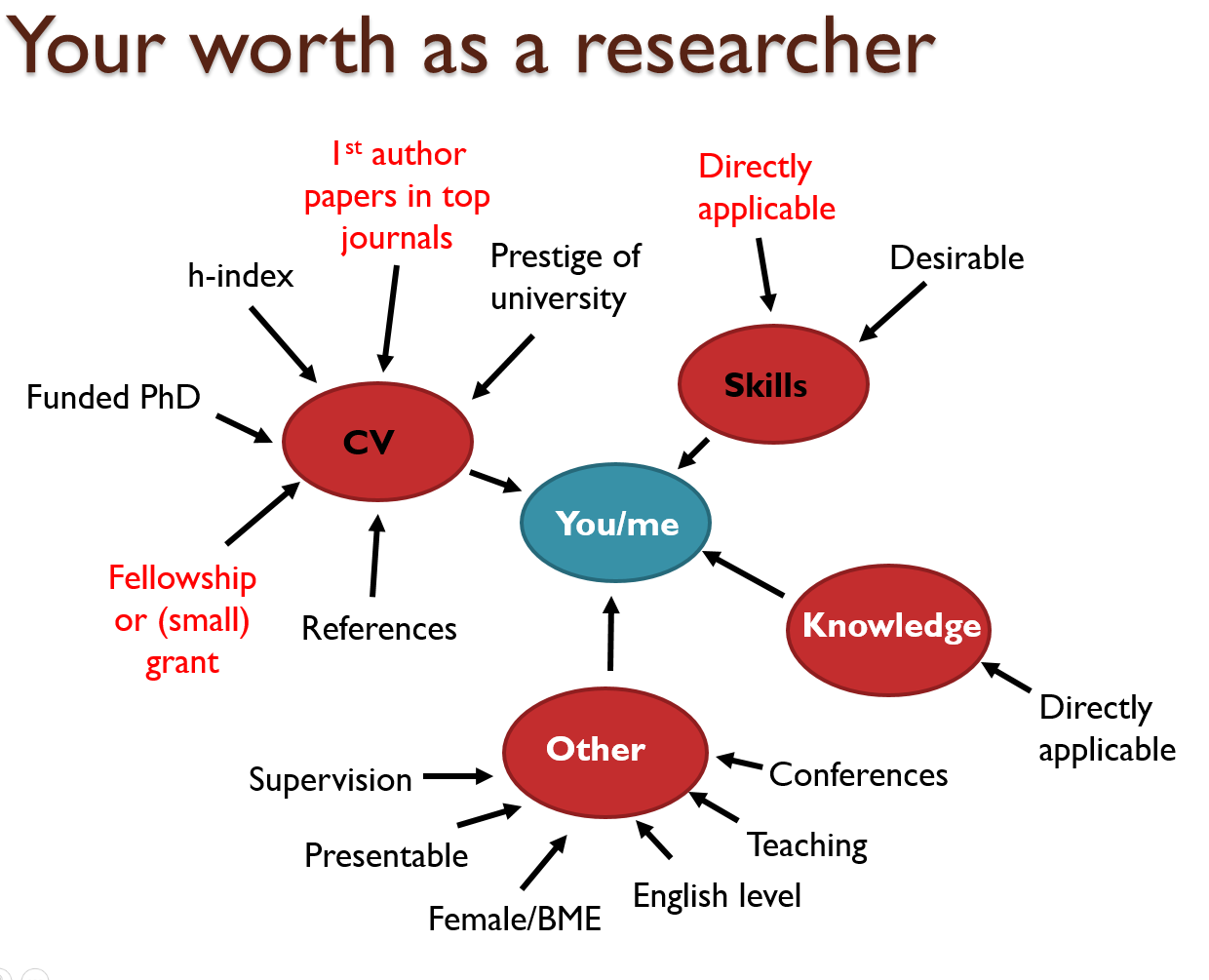
academic_worth_researcher_university_mesut_erzurumluoglu

The heuristic that I think people use when calculating the worth of an early career researcher (but generally applies to all levels): ‘CV’ and ‘Skills’ are the two main contributors, with the factors highlighted in red carrying enormous weight in determining whether someone should get the job/fellowship or not. Virtually no one cares about anything that is outside what is written here – as mentioned in the post. Directly applicable: Some technical skill that the funder/Professor thinks is essential for the job; Prestige of university: where you did your PhD and/or undergrad; Funded PhD: whether your PhD was fully funded or not; Female/BME: being female and/or of BME background – this can be an advantage or a disadvantage depending on the regulations/characteristics of the university/panel, as underrepresented groups can be subjected to both positive and negative discrimination. NB: this is a simplified version and there are many factors that affect outcomes such as “who you know” and “being at the right place at the right time“.


Added on 30/10/18: I just came across ‘No, it’s not The Incentives—it’s you‘ by Tal Yarkoni about the common malpractices in academic circles, and I think it’s well worth a read.


*Making sure there’s a gender balance and that academics from BME backgrounds are not excluded from the process – as they’ve usually had to overcome more obstacles to reach the same heights.

**I have been honest about this in my applications and put this publication under “Other Publications” in my CV.

***REF stands for the ‘Research Excellence Framework’, and is the UK’s system for assessing the quality of research in higher education institutions. The last REF cycle finished in 2014 and the next one will finish in 2021 (every 7 years). Universities start planning for this 3-4 years before the submission dates and the ones ranked high in the list will receive tens of millions of pounds from the government. For example, University of Oxford (1st) received ~£150m and University of Bristol (8th) received ~£80m.

****Sometimes it’s not their fault; people add senior authors on their papers to increase their chances of getting them accepted. It’s then human nature that they’re not going to decline authorship. It sounds nice when one’s introduced in a conference etc. as having “published >100 papers with >10,000 citations” – when in reality they’ve not made significant (if any!) contributions to most of them.


PS: I also propose that acknowledgements at the bottom of papers and PhD theses be screened in some way. I’ve had colleagues who’ve helped me out a lot when learning some concepts who then moved on and did not have the chance to be a co-author on my papers. I have acknowledged them in my PhD thesis and would love to see my comments be helpful to these colleagues in some way when they apply for postdoc jobs or fellowships. Some of them did not publish many papers and acknowledgements like these could show that they not only have the ability to be of help (e.g. statistical, computational expertise), but are also easy to work with and want to help their peers.

Read Full Post »

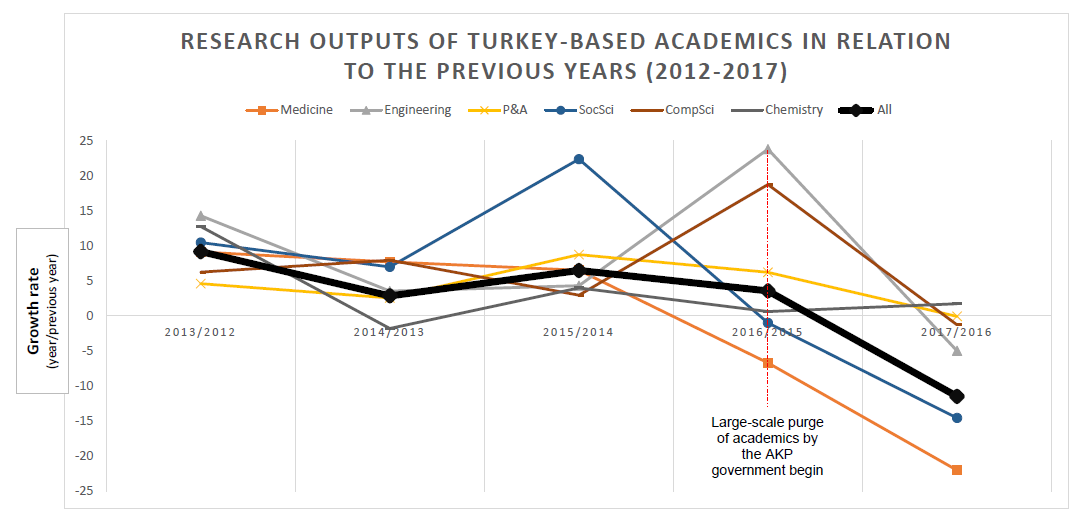
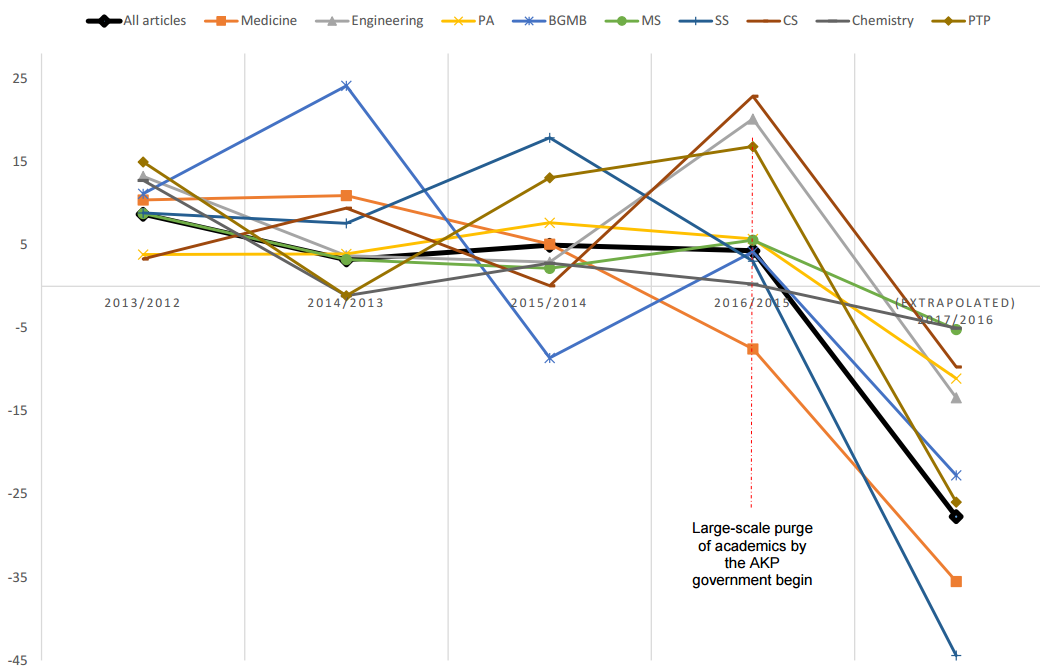
FfA_freedom_for_academia_report_2017_figure_1
Research outputs of Turkey-based academics in relation to the previous year. This Freedom for Academia (FfA) study identified a significant reduction (11.5% on average) in the research output of Turkey-based academics in 2017 compared to 2016. When the average increase of 6.7% per year observed in the research output of Turkey-based academics between 2008 and 2015 is taken into account, this translates to a decrease of over 7,000 papers than the expected figure in 2017 in journals indexed by SCOPUS – a bibliographic database of peer-reviewed literature. Image Source: freedomforacademia.org

Freedom for Academia (website), a group consisting of (incl. myself) “British and Turkish academics/researchers who are willing to lend a helping hand to our colleagues and bring the struggles that they face to the attention of the public and academic circles”, has just published an ‘Annual report 2017’ on the effects of the AKP government’s large-scale purges on the research output of Turkey-based academics, titled:

7,000 papers gone missing: the short-term effects of the large-scale purges carried out by the AKP government on the research output of Turkey-based academics

(click here to access full article with photos, or ‘print friendly’ version from here)

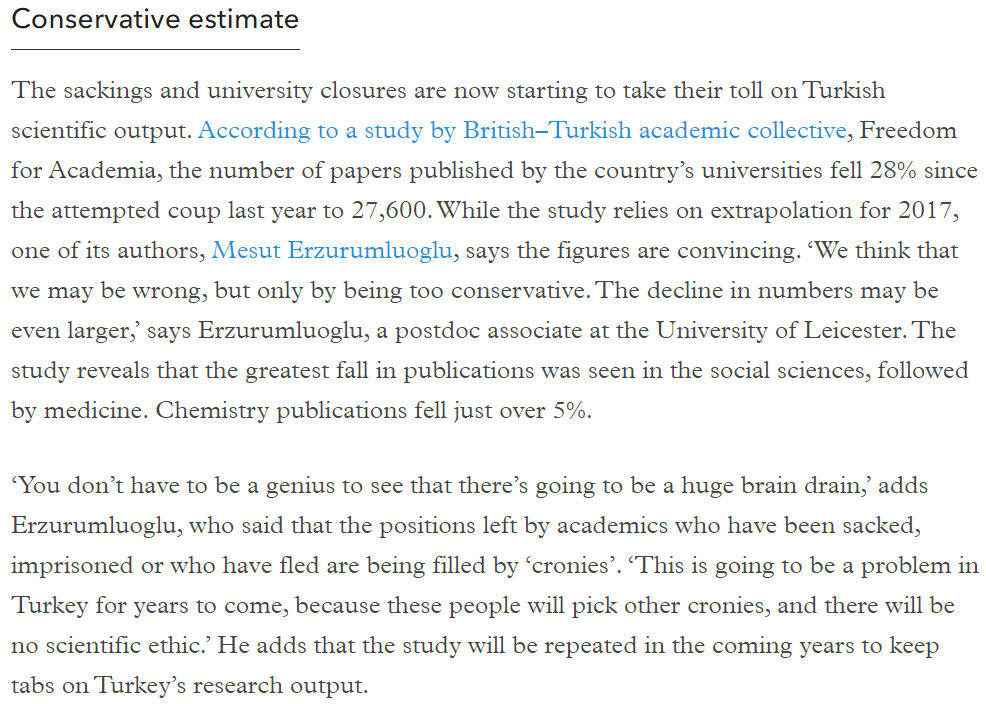
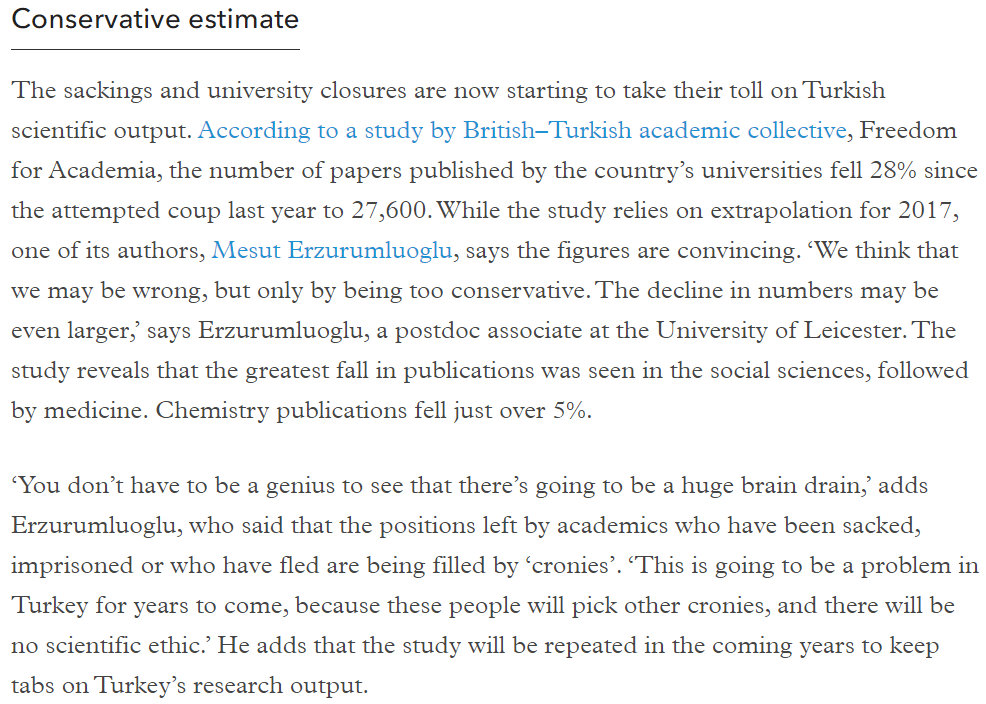
I gave an interview to Santiago Moreno of Chemistry World regarding this report (Source: Turkish crackdown takes toll on academic output. Aug 2017. Chemistry World)

Firstly, as a Turkish citizen living in the UK – who loves his country of origin (also a proud British citizen), I am heartbroken, disappointed and terrified, all at the same time, with what has been going on in Turkey for some time now. Within the last 18 months or so, thousands of academics – as well as tens of thousands of other civil servants – have lost their jobs due to decrees issued by the Turkish government. None of them have been told how they are linked to the “15th July 2016 coup attempt” and what their crime (by international standards) was.

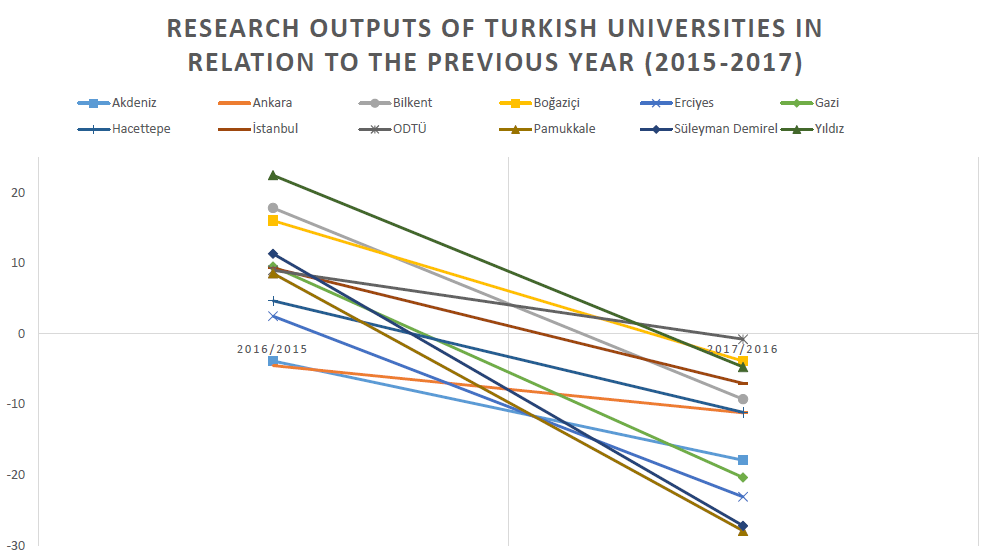
FfA_freedom_for_academia_report_2017_figure_2
The percentage change in research outputs of 12 Turkish universities in relation to the previous year

These large-scale sackings have undoubtedly had an impact on the state of Turkey-based research and academia. The report tries to quantify the relative decreases in the research output of Turkey-based academics in different academic fields, and speculates on the causal factors. They find, on average, a ~12% decrease in the research output of Turkey-based academics in 2017. They also identified substantial decreases in the research outputs of some of Turkey’s top universities such as Bilkent (-9%), Hacettepe (-11%) and Gazi (-20%) in 2017 compared to 2016. Both Süleyman Demirel University and Pamukkale University, which lost nearly 200 academics each to governmental decrees issued by the AKP government, showed nearly a 30% decrease in 2017 compared to 2016.

I believe, a decrease in the number of publications is just one of the ways academia in Turkey has been affected overall. Turkey/Turkish academia wasn’t a place/group necessarily known for its work/scientific ethic and any ethics that was present before these large-scale dismissals has now definitely disappeared as the posts left by the dismissed academics is being filled by cronies (as I had stated in my Chemistry World interview in August 2017). These cronies are then going to hire individuals who are not necessarily good scientists but good bootlickers like themselves, and even if everything became relatively ‘normal’ (e.g. state of emergency lifted, academics in prison are acquitted) today, it would still take tens of years to change the academic circles that have been poisoned because of nepotism/cronyism, governmental suppression and political factionalism. In fact, academics in Turkey are so divided that not many cared when over eight thousand of their colleagues were dismissed as “members of a terrorist organisation”, as they did not belong to their ‘creed’ (e.g. to their ‘Kemalist’ or ‘Nationalist’ or ‘Islamist’ or ‘Pro-Kurdish’ groups). I try and follow many Turkey-based academics, and unfortunately, I barely see them talk about anything other than political issues – not on scientific and/or social advancements as academics/intellectuals should be doing. I tried to make my point in a short letter I wrote to Nature and in a (longer) blog post: Blame anyone but the government (Mar 2017).

Finally, I agree with the conclusions of the report that the sharp decrease of ~18%* in the research outputs of Turkey-based academics in relation to the expected 2017 figures is likely to be due to a combination of factors, especially psychological stresses endured by academics; and not just due to the absolute number of the purged academics (~6% of total), as outlined in the discussion section of the report.

*6.5% average increase every year between 2012 and 2016 + 11.5% decrease in 2017 figures compared to 2016 figures

References

1- FfA contributors. FfA Annual Report 2017. URL: http://www.freedomforacademia.org/ffa-annual-report-2017/. DOI: 10.13140/RG.2.2.16386.02244. Date accessed: 01/03/2018

2- Moreno, SS. Turkish crackdown takes toll on academic output. Chemistry World. 4 Aug 2017. URL: https://www.chemistryworld.com/news/turkish-crackdown-takes-toll-on-academic-output/3007804.article. Date accessed: 01/03/2018

3- Erzurumluoglu, A. Listen to accused Turkish scientists. Nature 543, 491 (2017). https://doi.org/10.1038/543491c

PS: To view a collection of my previous comments about the subject matter, please see my June 2017 post: Effects of the AKP government’s purges on the research output of Turkey-based academics (Jun 2017)

Read Full Post »

AKP_KHK_academic_ffa_report_1_june_2017
Research outputs of Turkey-based academics in relation to the previous year. Image from Freedom for Academia website

Freedom for Academia, a group consisting of “British and Turkish academics/researchers who are willing to lend a helping hand to our colleagues and bring these injustices to the attention of the public and academic circles”, has just published a report on the effects of the AKP government’s purges on the research output of Turkey-based academics, titled: The short-term effects of the large-scale purges carried out by the AKP government on the research output of Turkey-based academics  (click to see full article on a new page).

Firstly, as a Turkish citizen living in the UK (also a proud British citizen), I am heartbroken, disappointed and terrified, all at the same time, with what is going on in Turkey at the moment. Within the last 10 months or so, thousands of academics – as well as tens of thousands of other civil servants – have lost their jobs due to decrees issued by the Turkish government. None of them have been told how they are linked to the “15th July 2016 coup attempt” and what their crime (by international standards) was.

These large-scale sackings have undoubtedly had an impact on the state of Turkey-based research and academia. The report tries to quantify the relative decreases in the research output of Turkey-based academics in different academic fields, and speculates on the causal factors. They find, on average, a ~30% decrease in the research output of Turkey-based academics in 2017 – likely to be an underestimate because of the extrapolation method used (i.e. if there is a downward trajectory in the research outputs of Turkey-based academics – which there clearly is – then multiplying the cumulative figure on the 31st May 2017 by two is going to overestimate the 2017 figures).

Finally, I agree with the conclusions that the sharp decrease in the research outputs of Turkey-based academics in relation to the 2016 figures is likely to be due to a combination of factors, especially psychological stresses endured by academics; and not just due to the absolute number of the purged academics, as outlined in the discussion section of the report.

Addition to post (04/08/17): I gave an interview to Santiago Saez of Chemistry World and shared my views on the struggles academics in Turkey face: Turkish crackdown takes toll on academic output. You can also read my views on the mass-scale purges in my Blame anyone but the government post.

PS: Myself and Dr Firat Batmaz from Loughborough University were invited by Dr. Ismail Sezgin to give two interviews (one in English and one in Turkish) on this report and share our thoughts on the state of Turkey-based academia. You can view these below:

I gave an interview to Santiago Moreno of Chemistry World regarding this report (Source: Turkish crackdown takes toll on academic output. Aug 2017. Chemistry World)

Addition to blog (08/08/2019) – a crude analysis for 2018:

Read Full Post »