Feeds:
Posts
Comments

Posts Tagged ‘foreign’

It is not the strongest of the species that survives, nor the most intelligent that survives. It is the one that is most adaptable to change – attributed to Charles Darwin

“How did you get accepted to Cambridge?”

I saw a tweet a while ago which said something along the lines of: “If you’ve been asked the same question three times, you need to write a blog post about it”. I get asked about how I got my current postdoc job at the University of Cambridge all the time. Therefore, I decided to write this document to provide a bit of a backstory as I did many things over the years which – with a bit of luck – contributed to this ‘achievement’.

It is a long document but hopefully it will be worth reading in full for all foreign PhD students, new Postdocs and undergraduates who want an introduction to the world of academia in the UK. I wish I could write it in other languages (for a Turkish version click here) to make it as easy as I can for you, but I strived to use as less jargon as possible. Although there is some UK-specific information in there, the document is mostly filled with general guidance that will be applicable to not just foreign students or those who want to study in the UK, but all PhD students and new Postdocs.

I can only hope that there are no errors and every section is complete and fully understandable but please do contact me for clarifications, suggestions and/or criticism. I thank you in advance!

To make a connection between academia in the UK and the quote attributed to Darwin above, I would say being very clever/intelligent is definitely an advantage in academia but it is not the be-all and end-all. Learning to adapt with the changing landscape (e.g. sought-after skills, priorities of funders and PIs), keeping a good relationship with your colleagues and supervisors, and being able to sell yourself is as, if not more important. Those who pay attention to this side of academia usually make things easier for themselves.

I hope the below document helps you reach the places you want to reach:

Good luck in your career!

I included this tweet here because Ed was one of my lecturers when I was a first year undergraduate student at the University of Leicester (2007)
I was kindly asked to send in a short video for the 2022 Univ. of Leicester Annual Alumni Dinner

Read Full Post »

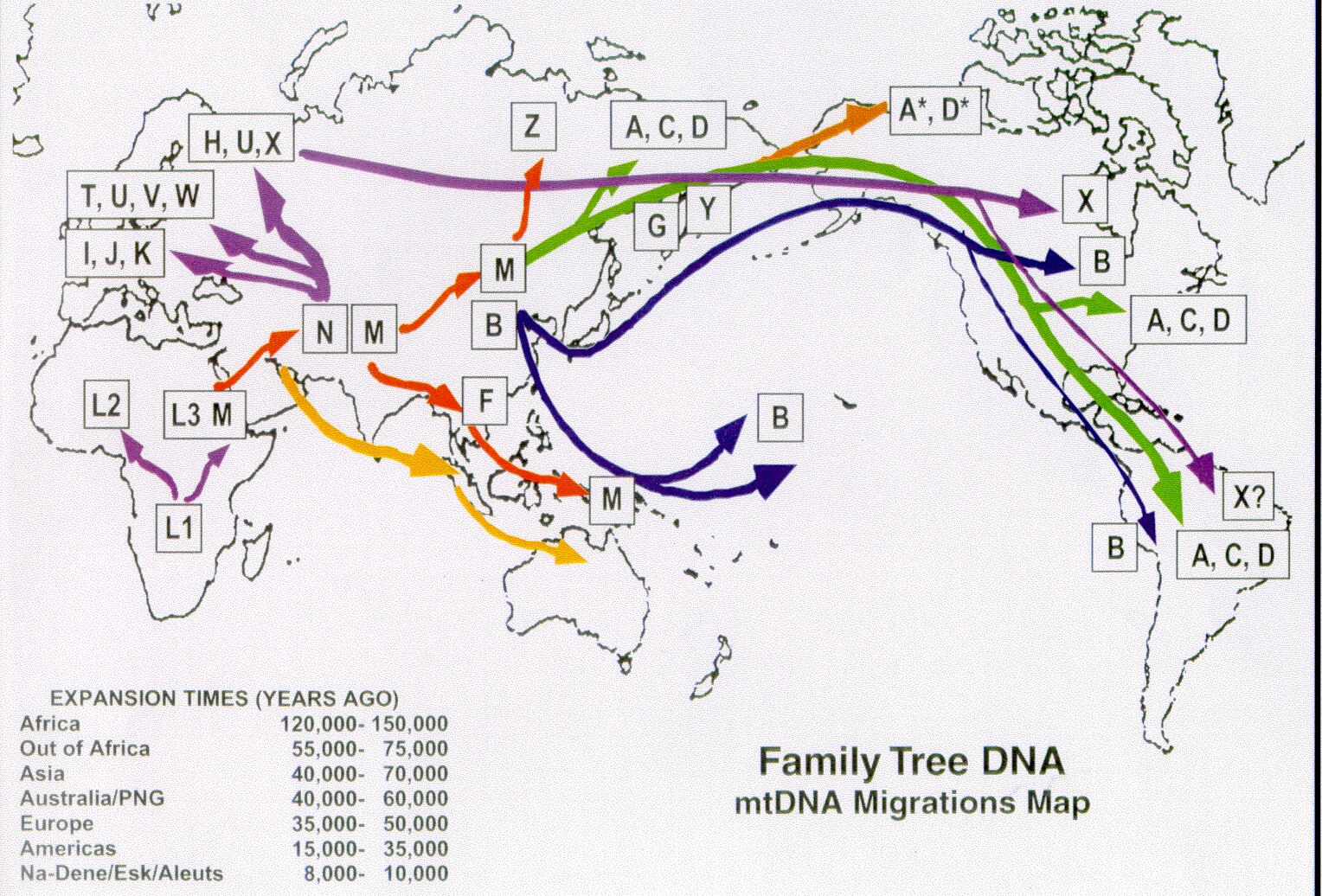
Mitochondrial DNA Migration Map

Mitochondrial DNA Migration Map

If we were to ask a question like this to the public we would probably get an equal split between yes and no. Also many reasons will be given for the explanation of the answers. A question like this is a tough and a broad one; and must be approached by a consortium of Statisticians, Psychologists and Sociologists. However genetics can also have a say on this.

To come straight to the point: Mitochondrial DNA and the non-recombining regions of the Y chromosome can be used to determine the matrilineal and the patrilineal ancestry of an individual respectively. By analysing the variants in these uniparentally inherited DNA molecules people who shared a common ancestor many generations ago can be identified; and these individuals are usually clustered in ‘haplogroups’. Also by analysing the spread and frequency of haplogroups in different regions, we can deduce migrations and special events which occurred in human history.

When the spread of Y-DNA and mitochondrial (mtDNA) haplogroups are compared, we see that mtDNA haplogroups are more spread (and are less associated with a geographic region) than Y-DNA haplogroups indicating that women (who were our ancestors) in the past seems to have married more outside of their ethnic origin compared to males. This could probably be explained by the use of women when strengthening ties with other communities and monarchies in ancient times but the same might by said for males also. So (ancestral human) genetics gives some evidence towards the answer ‘yes’. More evidence from other fields are needed of course.

From what we read from the news, women from the poor parts of the world have a tendency to marry *foreign men for money and better life standards but there isn’t much statistical information on this, so cannot say anything definitive.

I suggest that scientists from different fields (like the above mentioned ones) come together and answer broad questions such as this; otherwise the correct answer will never be arrived at by a single field of science.

For more information about the use of genetics (i.e. mitochondrial DNA and Y chromosome) when deducing maternal and paternal ancestry:

www.eupedia.com/europe/origins_haplogroups_europe.shtml

mesuturkey.wordpress.com/2012/05/24/are-europeans-turkish/


*’Foreign’ not just in terms of ethnicity but in a sense that women have to travel to another region to marry and live with these men.

Read Full Post »