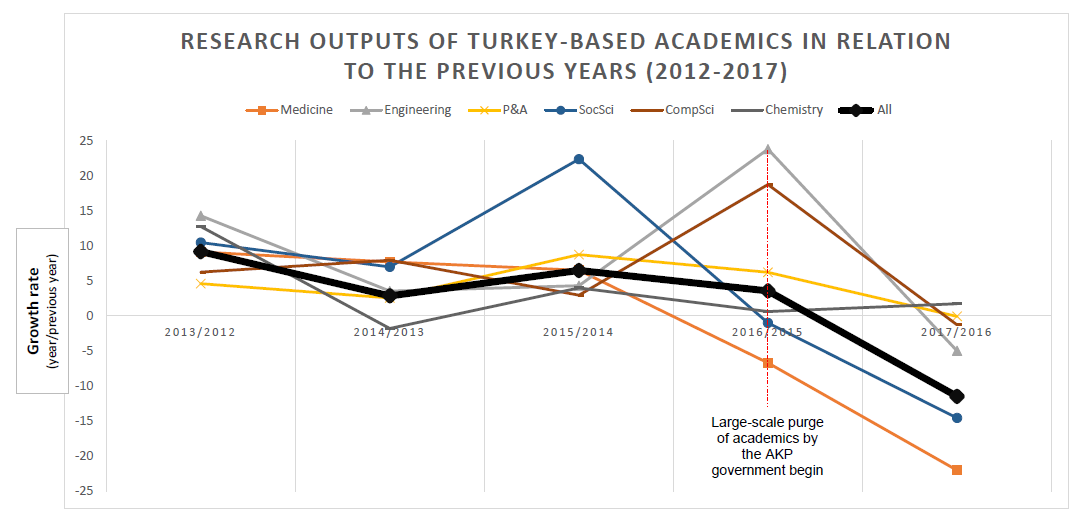
Freedom for Academia (website), a group consisting of (incl. myself) “British and Turkish academics/researchers who are willing to lend a helping hand to our colleagues and bring the struggles that they face to the attention of the public and academic circles”, has just published an ‘Annual report 2017’ on the effects of the AKP government’s large-scale purges on the research output of Turkey-based academics, titled:
7,000 papers gone missing: the short-term effects of the large-scale purges carried out by the AKP government on the research output of Turkey-based academics
(click here to access full article with photos, or ‘print friendly’ version from here)
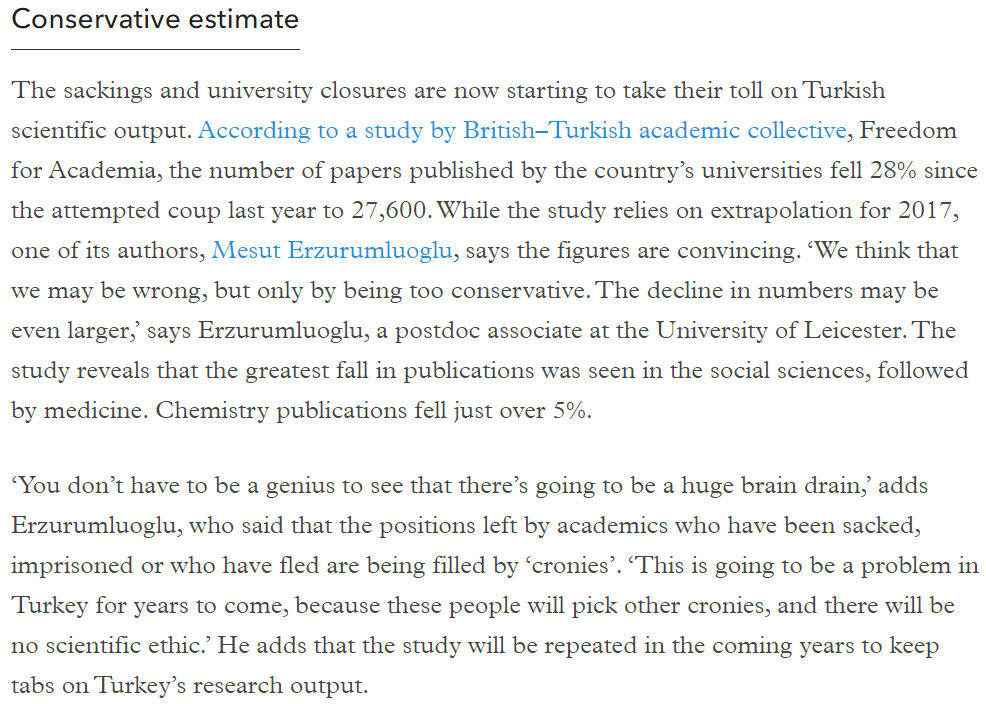
Firstly, as a Turkish citizen living in the UK – who loves his country of origin (also a proud British citizen), I am heartbroken, disappointed and terrified, all at the same time, with what has been going on in Turkey for some time now. Within the last 18 months or so, thousands of academics – as well as tens of thousands of other civil servants – have lost their jobs due to decrees issued by the Turkish government. None of them have been told how they are linked to the “15th July 2016 coup attempt” and what their crime (by international standards) was.
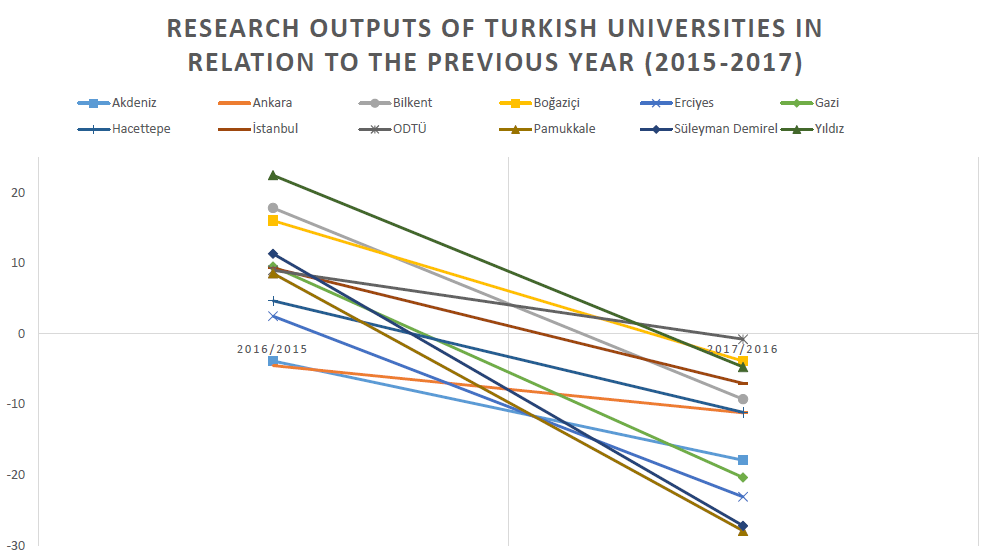
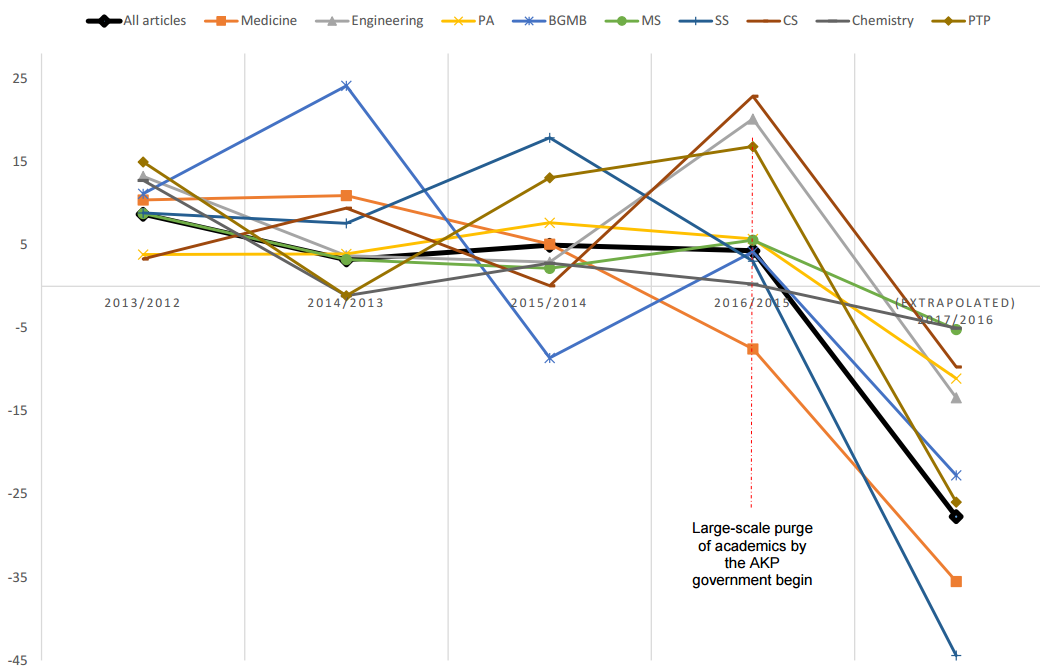
These large-scale sackings have undoubtedly had an impact on the state of Turkey-based research and academia. The report tries to quantify the relative decreases in the research output of Turkey-based academics in different academic fields, and speculates on the causal factors. They find, on average, a ~12% decrease in the research output of Turkey-based academics in 2017. They also identified substantial decreases in the research outputs of some of Turkey’s top universities such as Bilkent (-9%), Hacettepe (-11%) and Gazi (-20%) in 2017 compared to 2016. Both Süleyman Demirel University and Pamukkale University, which lost nearly 200 academics each to governmental decrees issued by the AKP government, showed nearly a 30% decrease in 2017 compared to 2016.
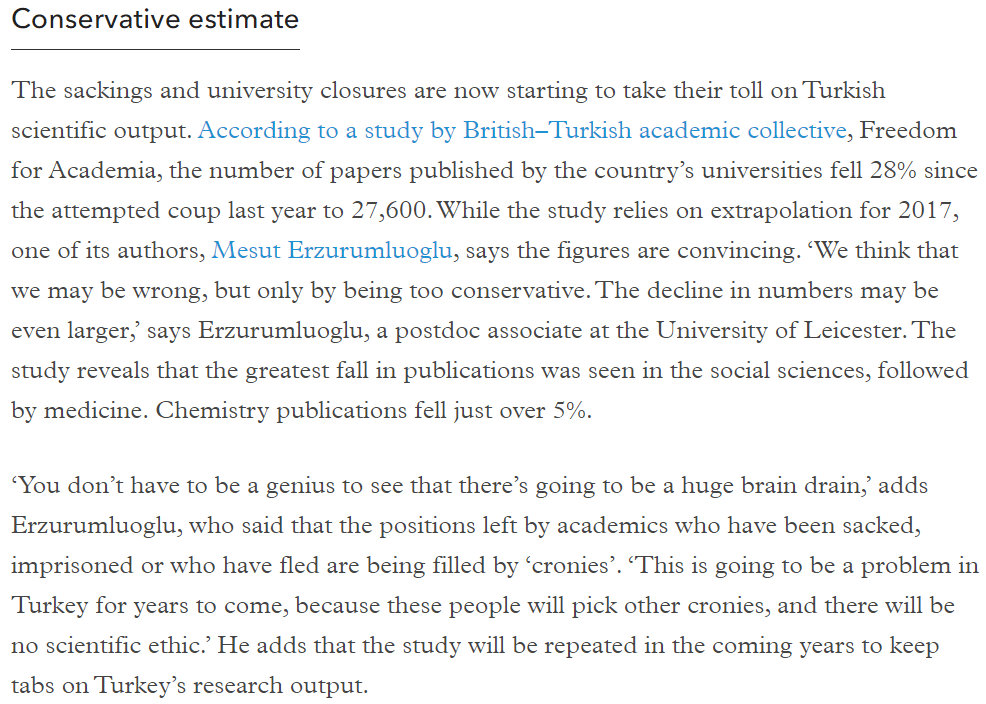
I believe, a decrease in the number of publications is just one of the ways academia in Turkey has been affected overall. Turkey/Turkish academia wasn’t a place/group necessarily known for its work/scientific ethic and any ethics that was present before these large-scale dismissals has now definitely disappeared as the posts left by the dismissed academics is being filled by cronies (as I had stated in my Chemistry World interview in August 2017). These cronies are then going to hire individuals who are not necessarily good scientists but good bootlickers like themselves, and even if everything became relatively ‘normal’ (e.g. state of emergency lifted, academics in prison are acquitted) today, it would still take tens of years to change the academic circles that have been poisoned because of nepotism/cronyism, governmental suppression and political factionalism. In fact, academics in Turkey are so divided that not many cared when over eight thousand of their colleagues were dismissed as “members of a terrorist organisation”, as they did not belong to their ‘creed’ (e.g. to their ‘Kemalist’ or ‘Nationalist’ or ‘Islamist’ or ‘Pro-Kurdish’ groups). I try and follow many Turkey-based academics, and unfortunately, I barely see them talk about anything other than political issues – not on scientific and/or social advancements as academics/intellectuals should be doing. I tried to make my point in a short letter I wrote to Nature and in a (longer) blog post: Blame anyone but the government (Mar 2017).
Finally, I agree with the conclusions of the report that the sharp decrease of ~18%* in the research outputs of Turkey-based academics in relation to the expected 2017 figures is likely to be due to a combination of factors, especially psychological stresses endured by academics; and not just due to the absolute number of the purged academics (~6% of total), as outlined in the discussion section of the report.
*6.5% average increase every year between 2012 and 2016 + 11.5% decrease in 2017 figures compared to 2016 figures
References
1- FfA contributors. FfA Annual Report 2017. URL: http://www.freedomforacademia.org/ffa-annual-report-2017/. DOI: 10.13140/RG.2.2.16386.02244. Date accessed: 01/03/2018
2- Moreno, SS. Turkish crackdown takes toll on academic output. Chemistry World. 4 Aug 2017. URL: https://www.chemistryworld.com/news/turkish-crackdown-takes-toll-on-academic-output/3007804.article. Date accessed: 01/03/2018
3- Erzurumluoglu, A. Listen to accused Turkish scientists. Nature 543, 491 (2017). https://doi.org/10.1038/543491c
PS: To view a collection of my previous comments about the subject matter, please see my June 2017 post: Effects of the AKP government’s purges on the research output of Turkey-based academics (Jun 2017)
 An ordinary blog by an ordinary bloke