Feeds:
Posts
Comments

Posts Tagged ‘istanbul’

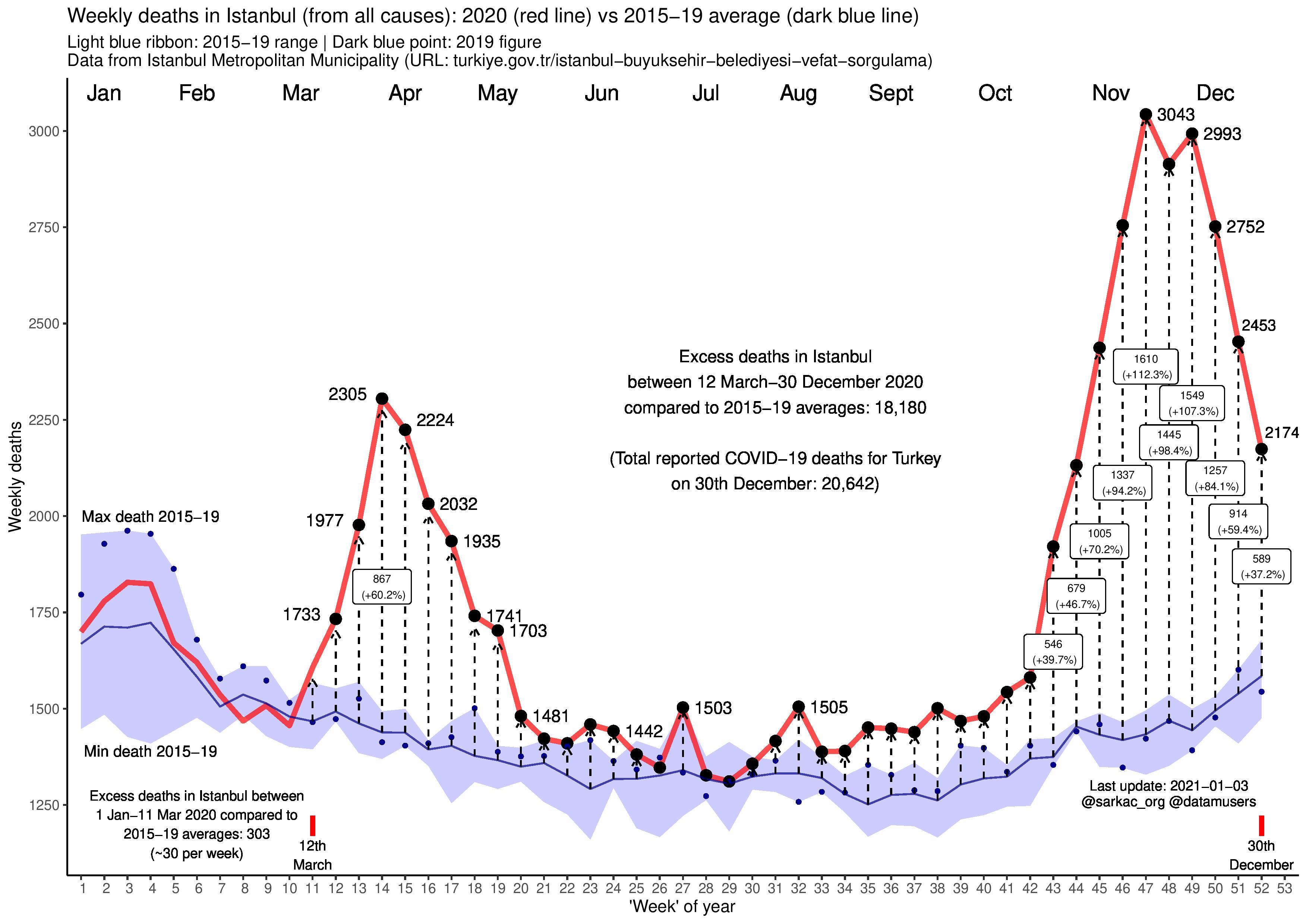
Figure showing excess ‘all-cause’ mortality in Istanbul (Turkey-wide data currently not available) in 2020 compared to 2015-19 averages – up to and including 30th December. We see a sharp increase in the number of excess deaths from week 11 onwards (i.e. 12th March onwards) – the week when the SARS-CoV-2 outbreak seems to have really took off in Istanbul. Reported number of total COVID-19 deaths on 30th December for Turkey was 20,642 (Reported number of total COVID-19 deaths on 25th October for Istanbul was 3,253 – last update; source: Ministry of Health/Sağlık Bakanlığı). But between 12th March and 30th December, we estimate excess deaths in Istanbul alone to be ~18,180 (NB: excess deaths were ~30 per week between 1st January and 12th March). Our estimate most likely points to either/both (i) an underestimation of deaths directly caused by COVID-19 and/or (ii) excessive deaths indirectly related to the current COVID-19 epidemic in Turkey. Both reasons deserve an extensive investigation by the media.

Important notes: This figure will be updated and shared on my Twitter feed every few weeks until the end of 2020 (the commentary below – posted 25th May 2020 will not be updated). The current (red line) plot finishes on the 52nd ‘week’ (i.e. 7-day interval) of 2020 which corresponds to 30th December, but the figures were updated on the 3rd January 2021 because the data provided by Istanbul Metropolitan Municipality is being updated retrospectively – which stabilises after ~7 days
. Further details on Istanbul’s death figures can be found here (Mayor of Istanbul’s statement and additional analysis carried out by Financial Times’ analysts) – including details about the initial confusion on whether these figures are ‘burials in Istanbul’ or ‘all deaths in Istanbul’. Plot wholly generated using the ggplot2 library in R.


An animation showing how the weekly deaths figures in Istanbul change between 2015 and 2020

Prominent newspapers in Turkey (e.g. Cumhuriyet, BirGün, duvaR, T24 – with >1M followers) have picked up on our analysis (incl. commentaries such as: Sınırlı veri, sınırsız pandemi)

Commentary/discussion (25/05/2020)

Excess ‘all-cause mortality’ (that is, deaths from all causes – not just COVID-19) is probably the most informative statistic when comparing countries as there is no standard in reporting COVID-19 deaths between countries (e.g. differential PCR-based testing accuracy, cause of death coded differently e.g. dying with vs due to COVID-19). Premature deaths are also the ultimate outcome to prevent* and easy to measure – making it less likely to be affected by measurement error. Excess all-cause mortality comparisons have their own caveats when comparing all the countries in the world as many countries aren’t transparent even in this regard (e.g. isolated and/or autocratic countries). However, we can still access reliable data from plenty of developed and developing countries – including cities with relatively autonomous local governments (e.g. Istanbul) in countries known to have ‘transparency’ issues.

All-cause mortality statistics can be very useful for a country/government to analyse how good it is tackling the multi-factorial challenges posed by the epidemic. As is shown in the above figure, analysing excess all-cause mortality will point us to deaths directly and indirectly related to the SARS-CoV-2 epidemic in Turkey. The indirect reasons include (not exhaustive): (i) people being scared to go to hospitals when they should have (and therefore died and not tested), and (ii) when they do, they may not have received the treatment they otherwise would have got due to insufficient number of beds, doctors/nurses.

I really like this figure by the Office of National Statistics (ONS; United Kingdom) as it can be very informative in preventing further unnecessary deaths. An analysis like this can point us to the indirect causes of excess deaths due to the epidemic. For example, there seems to be more people dying of Dementia/Alzheimer disease in England in April 2020 compared to the previous years, thus the causes of this spike should be further looked into (e.g. is it misdiagnosis or due to insufficient treatment?). There also seems to be less dying because of ischaemic heart disease, which probably means some of those who would have died in 2020 because of heart disease died due to COVID-19 – which makes sense as most who have died from COVID-19 were >65 aged men. Turkey (and all countries) should also make this data available. Image source: ons.gov.uk

We should note that (i) 2020’s Istanbul is a relatively less lively city than 2015-19’s Istanbul (e.g. less traffic on the roads and people on the streets) as there have been varying lockdown measures in the last couple of months, and (ii) we do not have access to Turkey-wide data to estimate what the total excess death figure in Turkey is. In our analysis we calculate excess deaths in Istanbul by comparing 2020’s results with 2015-10 averages. So, it is possible that the excess deaths are even higher in Istanbul (and most metropolitan cities around the world). This is something the Turkish government needs to be transparent and open to suggestions/improvement about. They clearly need help but only transparency can ensure that there is minimal unnecessary deaths.

The reasons behind excess deaths and whether the government could have done something about them should also be factored into whether a government is successful or not as very high excess all-cause mortality figures will show that they have tried to tackle this multidimensional problem using narrow-minded approaches. Especially the media need to ask the right questions (e.g. why is Turkey-wide data not available? what are the causes of these excess deaths? what is being done about them? who are advising the Turkish government?).

Aside from current excess deaths, long-term strategies should also be carefully taken – as although current excess deaths maybe low now for some countries (possibly including Turkey – we don’t know for sure), it may end up being as bad as other ‘poorly’ performing countries come the end of 2020 (with the additional ‘double whammy’ of destroying the economy of the country due to stricter lockdown measures). I therefore do not share the view of many academics who are repeatedly calling some countries ‘very successful’ as I think it’s too early to call any country ‘successful’ now. For me, there can only be ‘unsuccessful’ countries at the moment (e.g. Brazil seems to be a clear example of this – unless there are huge changes in policy by the government).

Finally, I value this exercise as I don’t think the media in Turkey is doing a good job of looking into what is causing these additional deaths. I will stop contributing to these analyses once I feel this issue is being properly looked in to by the government and the media**.

I am open to suggestions and criticism regarding these analyses. I am also happy – with appropriate attribution – for anyone to use the figure or the contents of this blog post (including direct Turkish translations).

Thanks for reading!

I’m happy to have contributed to this BBC World article by Becky Dale and Nassos Stylianou

Twitter thread I posted on the 25th May: (I posted my first such tweet on the 20th April)

Footnotes:

*If I was to provide an extreme example just to prove the point, imagine if whole of the UK was infected (e.g. due there were no lockdowns imposed or the lockdowns didn’t work at all, no education of the public regarding the spread) but there was no deaths from COVID-19 in the country because of world-class treatment provided to all those who were hospitalised, then we could safely say that the UK government/country was very successful. And vice-versa, if the total number of cases was only 100,000 in the whole country but all 100,000 died, then we could easily say – although the lockdowns etc. have worked – that government/country did a terrible job of handling the epidemic.

**There is criticism from some of my Turkish followers on why I’m not doing a similar analysis for the UK (my country of residence). However, similar – and better – analyses have been/are being carried out by scientists and the media professionals for the UK. Needless to say, the media, academia/intelligentsia and civil society in the UK is (i) more inquisitive, and (ii) have considerably more ‘know-how’ than their Turkish counterparts.

PS: Turkish version of the figure will appear on Sarkaç’s Twitter page (@sarkac_org) and blog every week – without the above commentary, as this is solely mine and does not necessarily reflect the views of Sarkaç.

PPS: I’m very concerned about a lack of preparation for an impending (large) earthquake in/near Istanbul. Combining this with more people being at home due to the epidemic, I fear the worst. The government and media must get on this matter as soon as possible.

Read Full Post »

King and his Jester jokes are also a common theme in Turkish caricatures

King and Jester jokes/stories are also a common theme in Turkish caricatures. In this example, the jester’s provoking/fooling the king by saying: “you can defeat your enemies blindfolded”.

Turkish sense of humour – just as with most cultures – has been shaped by past events and influential figures. However we Turks do not like to make fun of ourselves (e.g. like the English), therefore we create (semi*)fictional characters and make fun of them. We take ourselves too seriously…

However we still managed to obtain a great sense of humour with all sorts of jokes/funny stories. They include stories/jokes from religious figures such as Nasreddin Hodja, naive and funny figures such as Temel and Dursun, and stingy but funny figures (e.g. People of Kayseri are famous for being successful businessmen but also for being tight with money, therefore these types of jokes are attributed to them).

We also generally – for some reason – hold this belief that a joke should make you think as well as make you laugh, therefore a lot of our jokes have a moral story behind it. Although I am not against the ‘make you think’ part, I believe that the primary aim of a joke is to make you laugh and relax the mind, therefore the focus should be on being funny. Sometimes the primary goal has been forgotten, therefore we have many jokes which do not even make you smile, let alone make you laugh 🙂

You can find English translations of Temel and Dursun jokes, and Nasreddin Hodja stories all over the internet. Google them, or you may wish to click the hyperlinks for some chosen examples…


Less known (in English) are the ‘People of Kayseri’ jokes. A couple of examples are below:

Father and Son

Son asks his father: “Could you lend me 50 lire dad?”

Father replies: “40 lire? What do you need 30 lire for? Isn’t 20 enough? Here’s 10.”

And he takes out a 5 lira note and gives it to his son.

The son goes: “I needed 5 lira anyway…”

Father: “You naughty boy! Nearly had me if I hadn’t given you fake money”

On his death bed

A man from Kayseri is on his death bed. He asks: “My dear wife, are you here?”

Wife: “Yes, right next to you”

Man: “My sons Mehmet and Ahmet, are you here?”

Mehmet and Ahmet: “Yes, father”

Man: “My beautiful daughter Fatma?”

Fatma: “Yes, my dear father”

The man gets up rapidly and shouts furiously: “If you’re all here, who’s looking after the shop!?”


* I say “semi” because it is not hard to see that we have living Temels and Dursuns scattered around the streets. Turkey is a fun place with a plethora of funny (or tragicomic) characters which you can easily observe in daily life. Sometimes as you’re walking to work, you yourself are involved in or come across a few jokes/funny events 🙂

An example would be: You might ask where “so and so café” is. You shouldn’t surprised if you get a reply like: “I don’t know, where is it?”; or “Are you blind? Can’t you see it’s right there!” (I wouldn’t have asked if I’d seen it!)

Read Full Post »

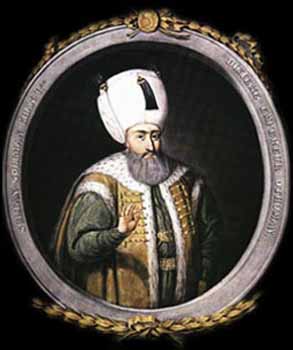
Sultan Suleiman 'The Magnificent'

Sultan Suleiman ‘The Magnificent’

This is a conversation which is known to be have happened between Yahya efendi (a well-known Islamic scholar of the time; ‘Efendi’ means ‘respected master’ in Turkish) and Sultan Suleiman ‘The Magnificent’ (Ottoman sultan):


During Sultan Suleiman’s reign, the Ottomans were undoubtedly ‘the superpower’ at the time. However he was also curious about the future of the state (I do not like calling the Ottomans an ’empire’ so I will keep calling them ‘state’) and wonders whether the Ottomans will also decline just like all the other great civilisations, states and/or empires before it.

He always asked scholars for their opinions if he had a question, so he took the matters to Yahya efendi through his messengers. Some time later he received an answer through his messenger and it was very short:

Oh Sultan, “I don’t care” is the answer

The Sultan was shocked. However he knew that Yahya efendi was a man of wisdom, so he travelled to his place to learn the meaning of his answer.

Brother, please do take my question seriously. I am curious about the answer.

Another short answer from Yahya efendi:

Oh my Sultan. How can I ignore you? I did give you an answer. And it was “I don’t care”

However the Sultan still couldn’t make sense of his answers.

I still don’t understand

Well my Sultan. Whenever corruption, oppression/cruelty and thievery runs loose within a society; and the ones who see it turn a blind eye towards them and say “I don’t care”, this will be end of that state and society.


Great lessons to be learnt from the past… I hope the politicians in our countries take notice; if they ‘care’ that is!

Turkcesi icin buraya tiklayin

Read Full Post »

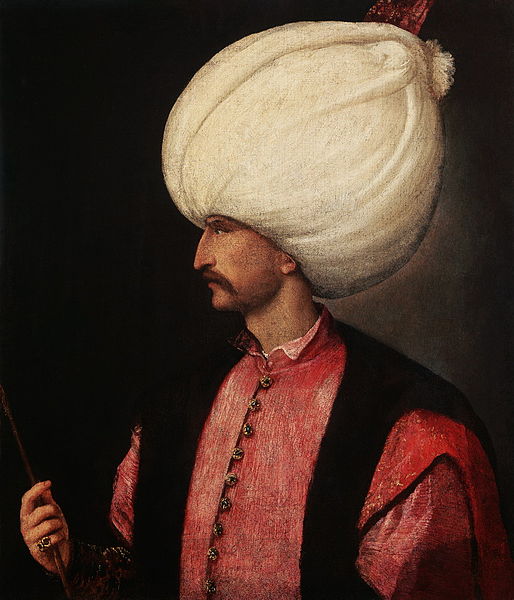
Suleiman 'The Magnificent'

Suleiman ‘The Magnificent’

One day, the famous Ottoman Sultan Suleiman (aka ‘The Magnificent’) was taking a breather in one of the gardens of Topkapi Palace. Whilst observing the trees and contemplating about them (e.g. what a miracle of God they were!), he realised that one of them was surrounded by ants. He did not like the idea of ants feeding on his trees and thought of poisoning them. However he was a wise man and knew never to act in a hurry; thus he would always seek advice from the Sheikh-ul Islam of the time, Ebussuud Efendi. He expressed his intentions with a short poem (get a Turkish friend to read it for you):


Suleiman:

Meyve ağaçlarını sarınca karınca (When ants invade a tree)

Günah var mı karıncayı kırınca? (Is there permission to kill them?)

His advisor Ebussuud Efendi replied with this:

Yarın Hakk’ın divanına varınca (When the time to meet the Lord comes)

Süleyman’dan hakkın alır karınca. (Suleiman will be made to pay)


And the result was Suleiman, the greatest ruler at the time, could not kill the ants due to his fear of God Almighty. Today, some groups kill innocent people in the name Islam – I guess they understand Islam better than the Ottoman rulers and their advisors. Certainly not! They are deluded people being used by dark forces who want to bring chaos in to countries they’re interested in, serving their ultimate aim of stealing their underground resources and treasures.

Also Suleiman once said: I am God’s slave; and Sultan of this World! Ottoman Sultans took enormous pride from being a devout servant of God. We should take them as role models and not the individuals many teenagers look upon as ‘idols’ nowadays.

Click here to learn something new about another Ottoman Sultan…

Read Full Post »

« Newer Posts