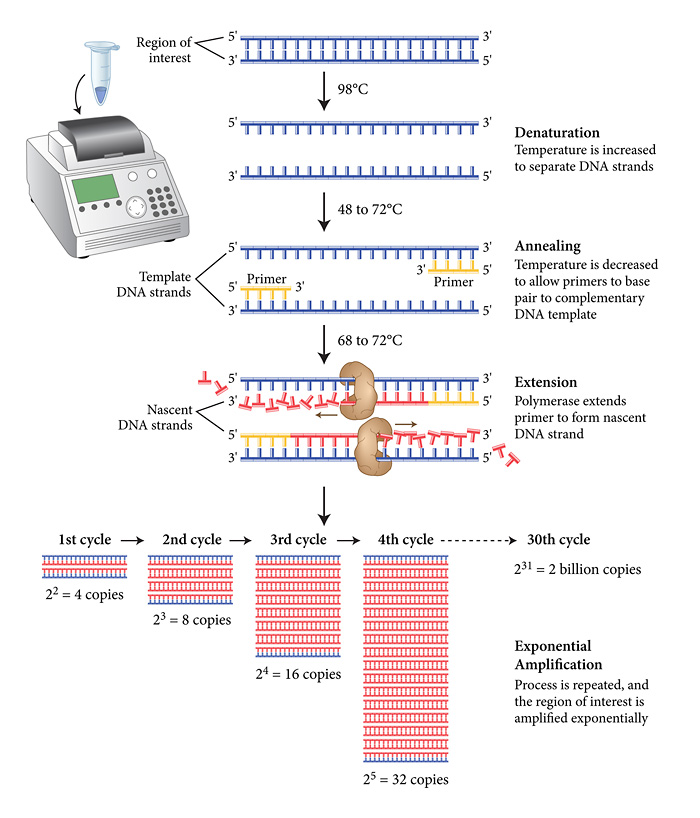
Schematic of the PCR (Polymerase Chain Reaction) process – a technique used to amplify a specific region of DNA. Source URL: http://www.neb.com
This is a very quick guide to designing a primer for PCR (Polymerase Chain Reaction) which will be used to amplify a region of interest. The produced amplicons can then be sent to companies such as GATC-Biotech (located in Germany) to be sequenced. I have seen many blogs with this title but none of them guide you in the way you would expect them to. So I decided to write my own to hopefully make things easier for you:
(i) To design a primer, first click on the link below:
(ii) On the Primer Blast page, you will come across the ‘PCR Template’ box at the top. Enter the ‘Accession ID’ of your transcript of interest from RefSeq if you’re working with mRNA.
If you’re interested in amplifying a genomic region then use Ensembl by (i) searching for your gene of interest on the Ensembl homepage; (ii) then clicking on your gene of interest in the results; (iii) then in the ‘Gene’ view, clicking on the ‘Sequence’ in the ‘Gene-based display’ on the left; and (iv) then by copying the ‘Marked-up sequence’ in FASTA format and pasting it into the ‘PCR Template’ box.
Calculate where your variant of interest is located in the FASTA sequence (Ensembl) or in the transcript (RefSeq mRNA) you pasted and fill in ‘Forward Primer’ and ‘Reverse Primer’ accordingly. I’d advise having a flanking region of ~150bp on both sides of your variant (e.g. if your variant is located at position 500 in your FASTA sequence, then type 350 into ‘From’ in ‘Forward Primer’ and 650 into ‘To’ in ‘Reverse Primer’, leave the other two empty).
(iii) In Primer Parameters:
To get the amplicon sent and sequenced at a company, keep the PCR product size manageable (e.g. 150bp to 300bp).
(iv) If working with human genomic data, change ‘Database’ to ‘Genome (reference assembly from selected organisms)’ and select ‘Homo sapiens’ as ‘Organism’ in ‘Primer Pair Specificity Checking Parameters’.
Click ‘Advanced parameters’.
(v) Change ‘Primer Size’ in ‘Primer Parameters’ to 18 (min), 22 and 25 (max) respectively.
Change ‘Primer GC Content (%)’ to 40.0 and 60.0 respectively.
Change ‘GC Clamp’ to 1.
Change ‘Max Poly-X’ to 3.
Tick the ‘SNP handling’ box (important!).
(vi) Scroll to bottom and click ‘Show results in a new window’ before clicking ‘Get Primers’.
(vii) Wait for results and select a couple* of primer pairs and test them in an in-silico PCR software (e.g. UCSC In-Silico PCR) – designing at least two primer pairs is important; in case one fails, the other one usually works.
(*check that the GC content of the forward and reverse primers are similar to each other for each primer pair.)
Once you’re happy with the amplicons produced in the in-silico PCR program (e.g. your variant** of interest is located towards the centre of the amplicon as desired) then check for hairpin formation (both for forward and reverse primer, separately) using a software such as OligoCalc.
(**if your gene of interest is on the reverse strand, then you would have to use software such as Reverse Complement to change the sequence of your amplicon to its complement so that it matches the Ensembl gene sequence that you’re comparing it against – where you obtained the sequence in FASTA format in step ii).
Once your primer pairs pass all these tests, order them from a company such as Eurofins.
When performing PCR, choosing the annealing temperature may not be straightforward. Although there is a formula for calculating optimum annealing temperature (Ta; see link), (for primers with no unintended targets***) I usually set it 6-7 Celsius below the melting temperature (Tm; you should have received this info from the company that you ordered the primer from) of the primer with lowest Tm. However Ta and MgCl2 gradients/titration may be needed sometimes if PCR doesn’t seem to work for both of the primers you designed earlier.
Sometimes the polymerase used may also need to be changed. So if conventional Taq polymerase doesn’t seem to work (or produces too many unwanted targets), trying a Hot Start activated polymerase (which is way more expensive) could be the answer.
(***if there are other unwanted bands in the gel, try increasing Tm as this will allow the primer to hybridize to the perfectly matching DNA sequence and not to the other unintended regions (which will hopefully be the region you wanted, if you designed the primer well)…
Hope it helps. I’m happy to answer any questions you may have. PCR is a dark art and anything can go wrong! Just need to keep trying 😉

10 Tips for successful PCR primer designing (by Life Technologies)
PS: I have no conflicts of interest and have no connections to either Eurofins or GATC-Biotech
References:
A. Mesut Erzurumluoglu, 2016. Population and family based studies of consanguinity: Genetic and Computational approaches. PhD thesis. University of Bristol.

 An ordinary blog by an ordinary bloke