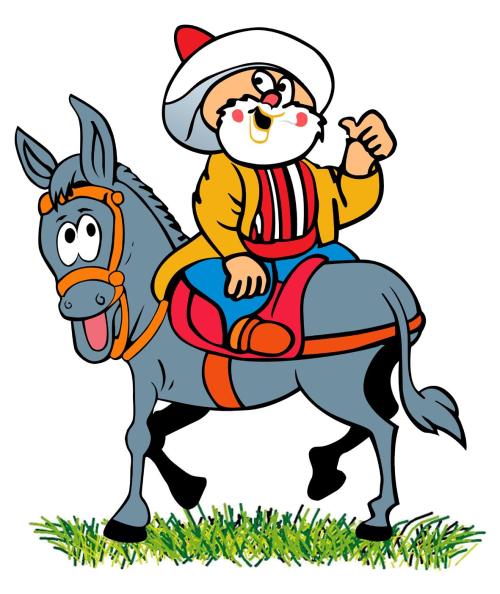
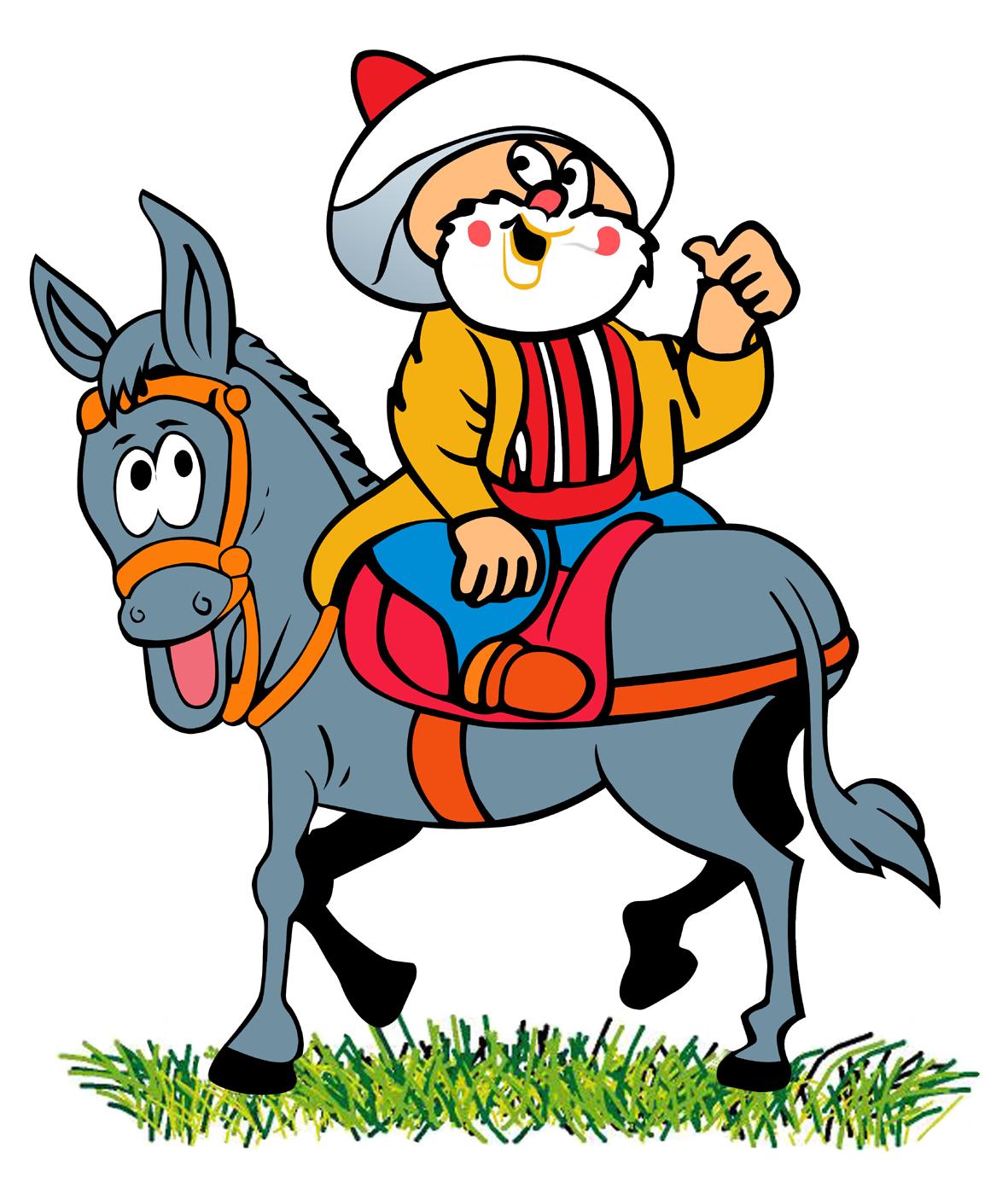
Nasreddin Hodja’s Famous Caricature – Sitting backwards on his Donkey, telling the people who questioned why this was the case: “I do not want to be seen as a person who’s following the same path as a donkey”
Nasreddin Hoca (read Hodja, which means ‘scholar’ or ‘teacher’ in Turkish) is a popular historical (13th century) figure and an imam known for his wit, wisdom and courage. By means of humour, he wanted to bring the vices that were widespread in the community (e.g. backbiting/slander, stealing, corruption) to the attention of the people -which he was very successful in doing. Therefore many of his quotes/experiences were passed down the ages. However, as time passed, many stories which fit the characteristics mentioned above, whether it belongs to him or not, were associated with him. Click for a selection of his stories in English: (i) Tales of the Turkish Trickster* (ii) Other stories attributed to him. Click for Wikipedia page.
* I disagree with the word ‘trickster’ in title but the website itself is very good…
PS: We need more of his kind today… Especially in the ‘Muslim’ world!
A peek at some of his stories that I translated:
The cauldron that died
Nasreddin Hodja, needing a large pot to cook a stew, borrowed his neighbor’s copper cauldron (a large pot), then returned it in a timely manner the next day.
“What is this?” asked his neighbor upon, examining the returned cauldron. “There is a small pot inside my cauldron.”
“Oh!” responded the Hodja. “I forgot to tell you. While the cauldron was in my care, it gave birth to a little one. Because you’re the owner of the mother cauldron, it is only right that you should keep its baby. And in any event, it would not be right to separate the child from its mother at such a young age.”
The neighbor, thinking that the Hodja had gone quite mad, did not argue. The neighbor had a nice little pot and he was happy with the outcome.
Some time later the Hodja asked to borrow the cauldron again.
“Why not?” Perhaps there will be another little pot inside when he returns it.” thought the neighbour to himself.
But this time the Hodja did not return the cauldron. After many days had passed, the neighbor went to the Hodja and asked for the return of the borrowed cauldron.
“My dear friend!” replied the Hodja. “I forgot to tell you but I have bad news. Your cauldron has died.”
“What are you saying?” shouted the neighbor. “A cauldron does not live, and it cannot die. Return it to me at once!”
“I’m sorry!” answered the Hodja. “But this is the same cauldron that gave birth to a child, a child that is still in your possession. If a cauldron can give birth, then it also can die.”
And the neighbor had no answer to this. He never again saw his cauldron again 🙂
Moral of the story: There are many things that we can take from this story but the main one is that we shouldn’t lie our way into tricking others for our personal gain as it can come back to haunt us.
Eat, my coat, Eat!
The Hodja was invited to a banquet. Not wanting to be pretentious, he wore his everyday clothes – only to discover that everyone ignored him, including the host. So he went back home and put on his fanciest coat, and then returned. Now he was greeted cordially by everyone and invited to sit down and eat and drink.
When the soup was served to him he dunked the sleeve of his stylish coat into the bowl and said, “Eat, my coat, eat!”
The startled host asked the Hodja to explain his strange behavior.
“When I arrived here wearing my other clothes,” explained the Hodja, “no one offered me anything to eat or drink. But when I returned wearing this fine coat, I was immediately offered the best of everything, so I can only assume that it was the coat and not myself who was invited to your banquet.”
Moral of the story: He powerfully presents that it’s the person that should be valued and not the fancy things that one owns.
Walnuts and Pumpkins
Nasreddin Hodja was lying in the shade of a walnut tree. His body was at rest, but, befitting his calling as an imam and scholar, his mind did not relax. He started contemplating; looking up into the mighty tree, he considered the greatness and wisdom of Allah/God.
“Allah is great and is most wise” said the Hodja, “but was it indeed wise that such a great tree as this be created to bear only tiny walnuts as fruit? Behold the stout stem and strong limbs! They could easily carry the pumpkins that grow from spindly vines in the fields, vines that cannot bear the weight of their own fruit. Should not walnuts grow on weakly vines and pumpkins on sturdy trees?”
After a while the Hodja dozed off, only to be awakened by a walnut that fell from the tree, striking him on his forehead.
“Allah be praised!” he exclaimed, seeing what had happened. “If the world had been created according to my meager wisdom, it would have been a pumpkin that fell from the tree and hit me on the head. It would have killed me for sure! Allah is great! Allah is most wise!”
Moral of the story: We shouldn’t question the wisdom of God/Allah – or things/phenomenon that we cannot fully grasp.
The battle of wits
In old times wise men would travel around the country, extensively searching for facts or ideas to support their newly-formed theories. Three such men one day arrived in Aksehir, and calling on the governor, asked him to summon the most learned man of the district to be present at the market place the next day – so that they would see whether they could profit from his wisdom. As the most wise man of Aksehir, Nasreddin Hodja was duly informed and the next day he was there and ready for, what proved to be, a battle of wits. Quite a crowd had gathered for the occasion.
Before holding discussions with him, they wanted to test his wit. One of the wise men stepped forward and asked the following question to Hodja:
“Could you tell us the exact location of the centre of the world?”
“Yes, I can,” replied the Hoca. “It is just under the left hind leg of my donkey.”
“Well, maybe! But do you have any proof?”
“If you doubt my word, you are welcome to measure and see.”
There was nothing more to be said, so the first wise man withdrew.
“Let me ask you this,” said the second learned man, stepping forward.
“Can you tell us how many stars there are in the heavens?”
“As many as the hairs on my donkey’s back,” was the ready reply.
“What proof have you in support of this statement?”
“If you doubt my word, you are welcome to count them all and find out.”
“Come now, Hodja!” said the second learned man. “How can anyone count the hairs on your donkey’s back?”
“Well, when it comes to that, how can anyone count the stars in the skies?”
This silenced the second wise man, upon whose withdrawal the third one stepped forward.
“Since you seem so well acquainted with your donkey,” said the third man sarcastically.
“Can you tell us how many hairs there are on the tail of the beast?”
“Certainly,” replied the Hoca, “as many as the hairs in your beard.”
“And how can you prove that?”
“Very easily, if you have no objection. I will pull one hair from your beard, and you will pull one out of my donkey’s tail. If both do not finish at the same time, then I will admit that I have been mistaken.”
Needless to say the third wise man had no desire to try the experiment, they realised the greatness of Hodja.
Moral of the story: As we say in Turkey, “akıl akıldan üstündür” which means (with a lot lost in translation): Two heads are better than one. There’s always someone out there whose wisdom is useful. We should always search for them to make better decisions.
Read Full Post »


 An ordinary blog by an ordinary bloke