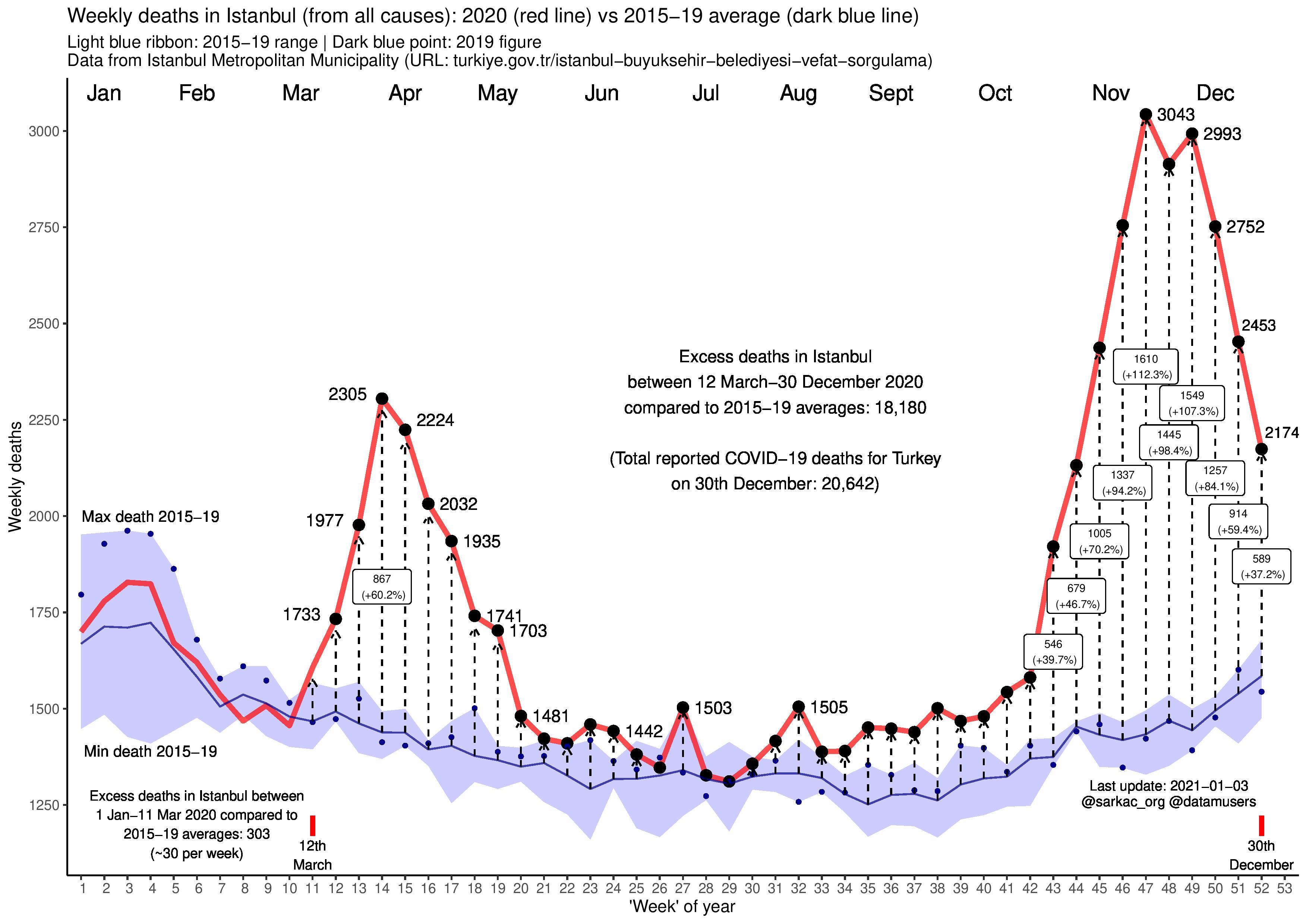
Important notes: This figure will be updated and shared on my Twitter feed every few weeks until the end of 2020 (the commentary below – posted 25th May 2020 – will not be updated). The current (red line) plot finishes on the 52nd ‘week’ (i.e. 7-day interval) of 2020 which corresponds to 30th December, but the figures were updated on the 3rd January 2021 because the data provided by Istanbul Metropolitan Municipality is being updated retrospectively – which stabilises after ~7 days. Further details on Istanbul’s death figures can be found here (Mayor of Istanbul’s statement and additional analysis carried out by Financial Times’ analysts) – including details about the initial confusion on whether these figures are ‘burials in Istanbul’ or ‘all deaths in Istanbul’. Plot wholly generated using the ggplot2 library in R.

Commentary/discussion (25/05/2020)
Excess ‘all-cause mortality’ (that is, deaths from all causes – not just COVID-19) is probably the most informative statistic when comparing countries as there is no standard in reporting COVID-19 deaths between countries (e.g. differential PCR-based testing accuracy, cause of death coded differently e.g. dying with vs due to COVID-19). Premature deaths are also the ultimate outcome to prevent* and easy to measure – making it less likely to be affected by measurement error. Excess all-cause mortality comparisons have their own caveats when comparing all the countries in the world as many countries aren’t transparent even in this regard (e.g. isolated and/or autocratic countries). However, we can still access reliable data from plenty of developed and developing countries – including cities with relatively autonomous local governments (e.g. Istanbul) in countries known to have ‘transparency’ issues.
All-cause mortality statistics can be very useful for a country/government to analyse how good it is tackling the multi-factorial challenges posed by the epidemic. As is shown in the above figure, analysing excess all-cause mortality will point us to deaths directly and indirectly related to the SARS-CoV-2 epidemic in Turkey. The indirect reasons include (not exhaustive): (i) people being scared to go to hospitals when they should have (and therefore died and not tested), and (ii) when they do, they may not have received the treatment they otherwise would have got due to insufficient number of beds, doctors/nurses.

We should note that (i) 2020’s Istanbul is a relatively less lively city than 2015-19’s Istanbul (e.g. less traffic on the roads and people on the streets) as there have been varying lockdown measures in the last couple of months, and (ii) we do not have access to Turkey-wide data to estimate what the total excess death figure in Turkey is. In our analysis we calculate excess deaths in Istanbul by comparing 2020’s results with 2015-10 averages. So, it is possible that the excess deaths are even higher in Istanbul (and most metropolitan cities around the world). This is something the Turkish government needs to be transparent and open to suggestions/improvement about. They clearly need help but only transparency can ensure that there is minimal unnecessary deaths.
The reasons behind excess deaths and whether the government could have done something about them should also be factored into whether a government is successful or not as very high excess all-cause mortality figures will show that they have tried to tackle this multidimensional problem using narrow-minded approaches. Especially the media need to ask the right questions (e.g. why is Turkey-wide data not available? what are the causes of these excess deaths? what is being done about them? who are advising the Turkish government?).
Aside from current excess deaths, long-term strategies should also be carefully taken – as although current excess deaths maybe low now for some countries (possibly including Turkey – we don’t know for sure), it may end up being as bad as other ‘poorly’ performing countries come the end of 2020 (with the additional ‘double whammy’ of destroying the economy of the country due to stricter lockdown measures). I therefore do not share the view of many academics who are repeatedly calling some countries ‘very successful’ as I think it’s too early to call any country ‘successful’ now. For me, there can only be ‘unsuccessful’ countries at the moment (e.g. Brazil seems to be a clear example of this – unless there are huge changes in policy by the government).
Finally, I value this exercise as I don’t think the media in Turkey is doing a good job of looking into what is causing these additional deaths. I will stop contributing to these analyses once I feel this issue is being properly looked in to by the government and the media**.
I am open to suggestions and criticism regarding these analyses. I am also happy – with appropriate attribution – for anyone to use the figure or the contents of this blog post (including direct Turkish translations).
Thanks for reading!
Twitter thread I posted on the 25th May: (I posted my first such tweet on the 20th April)
Footnotes:
*If I was to provide an extreme example just to prove the point, imagine if whole of the UK was infected (e.g. due there were no lockdowns imposed or the lockdowns didn’t work at all, no education of the public regarding the spread) but there was no deaths from COVID-19 in the country because of world-class treatment provided to all those who were hospitalised, then we could safely say that the UK government/country was very successful. And vice-versa, if the total number of cases was only 100,000 in the whole country but all 100,000 died, then we could easily say – although the lockdowns etc. have worked – that government/country did a terrible job of handling the epidemic.
**There is criticism from some of my Turkish followers on why I’m not doing a similar analysis for the UK (my country of residence). However, similar – and better – analyses have been/are being carried out by scientists and the media professionals for the UK. Needless to say, the media, academia/intelligentsia and civil society in the UK is (i) more inquisitive, and (ii) have considerably more ‘know-how’ than their Turkish counterparts.
PS: Turkish version of the figure will appear on Sarkaç’s Twitter page (@sarkac_org) and blog every week – without the above commentary, as this is solely mine and does not necessarily reflect the views of Sarkaç.
PPS: I’m very concerned about a lack of preparation for an impending (large) earthquake in/near Istanbul. Combining this with more people being at home due to the epidemic, I fear the worst. The government and media must get on this matter as soon as possible.

 An ordinary blog by an ordinary bloke
