by Dr A. Mesut Erzurumluoğlu | Principal Bioinformatician at Bicycle Therapeutics (formerly at Boehringer Ingelheim, and Univs. of Cambridge, Leicester & Bristol) – blogging since 2006. All views mine unless stated otherwise
Gönül muhabbet ister podcast bahane! 🙂 Genelde, başarılı, bilgili ve ‘cool’ insanlarla hafif konularda muhabbet ediyoruz. Twitter’da #AzIsCokLaf hashtagini kullanarak öneride bulunabilirsiniz. (Not: Yavaş konuştuğumuzu düşündüğünüz bölümlerde Spotify ya da Youtube’un 1.2x hızlandırma özelliğini kullanabilirsiniz)
Az İş Çok Laf – Bölüm 28:Osmanlı Irak’ı Tarihi ve Pul koleksiyonculuğu üzerine – Oral Avcı (23/03/2023)
Bu bölümde Tezhip ve Hat Sanatçısı, Pul Koleksiyoncusu, Mühendis ve İş Adamı Oral Avcı’yı ağırladık – ve kendisiyle pul koleksiyonculuğu ve ‘İngiliz İşgali Döneminde Osmanlı Irak’ının Posta Tarihi‘ adlı eseri üzerine konuştuk.
Tavsiyeler:
1- Oral Avcı’nın (okul arkadaşı ve Yıldız Holding CEO’su) Murat Ülker’e verdiği ropörtaj: Tarihin Habercileri: Pullar!
Gönül muhabbet ister podcast bahane! 🙂 Genelde, başarılı, bilgili ve ‘cool’ insanlarla hafif konularda muhabbet ediyoruz. Twitter’da #AzIsCokLaf hashtagini kullanarak öneride bulunabilirsiniz. (Not: Yavaş konuştuğumuzu düşündüğünüz bölümlerde Spotify ya da Youtube’un 1.2x hızlandırma özelliğini kullanabilirsiniz)
Az İş Çok Laf – Bölüm 27: Depresyonla ilgili bilinen yanlışlar – Dr Muzaffer Kaşer (21/11/2022)
Bu bölümde Psikiyatrist ve Cambridge Üniversitesinde depresyonun sebep, sonuç ve tedavileri üzerine akademik çalışmalar yürüten Dr Muzaffer Kaşer’i ağırladık – ve kendisiyle akademik serüveni ve çalışmaları, ve depresyonla ilgili bilinen yanlışlar hakkında konuştuk.
Not: Muzaffer Hocanın Academy of Medical Science tarafından düzenlenen ve çok ilgi gören (21/11/22 itibarı ile ~140k izlenme; ingilizce) sunumu için tıklayın: Modafinil benefits for depression
Podcast’te kullanılan terminoloji:
Cohort (‘kohort’ diye okunur): Epidemiyoloji alanında kullanılan ‘Cohort’lar, yüzlerce, binlerce, bazen yüzbinlerce (bkz: UK Biobank) insanın sağlık verisinin sistematik bir şekilde toplandığı ve bilim dünyasına sunulduğu grup çalışmalarıdır.
Meta-analiz (meta-analysis): Belirli bir konuda yapılmış fakat birbirinden bağımsız birden birçok (genelde küçük çapta) çalışmanın sonuçlarını birleştirerek (daha büyük) istatistiksel analiz yapmaktır
Gönül muhabbet ister podcast bahane! 🙂 Genelde, başarılı, bilgili ve ‘cool’ insanlarla hafif konularda muhabbet ediyoruz. Twitter’da #AzIsCokLaf hashtagini kullanarak öneride bulunabilirsiniz. (Not: Yavaş konuştuğumuzu düşündüğünüz bölümlerde Spotify ya da Youtube’un 1.2x hızlandırma özelliğini kullanabilirsiniz)
Az İş Çok Laf – Bölüm 25: Ilginç futbol terimleri ve ‘Terim’ üzerine – Kerem Aydın (22/09/2022)
Bu bölümde Bilkent Universitesi Endüstri mühendisliği mezunu ve arkadaşları arasında ‘futbol almanağı‘ olarak tanınan Kerem Aydın’ı ağırladık ve kendisiyle ilginç futbol terimleri ve Netflix’in ‘Terim’ belgeseli hakkında konuştuk.
Not: Kerem’i konuk aldığımız ilk podcast bölümü olan Bölüm 3 için tıklayın
Not 2: Yayında bahsettiğimiz Beşiktaş v Dinamo Kiev (2011) maçı son saniyeleri için tıklayın
Gönül muhabbet ister podcast bahane! 🙂 Genelde, başarılı, bilgili ve ‘cool’ insanlarla hafif konularda muhabbet ediyoruz. Twitter’da #AzIsCokLaf hashtagini kullanarak öneride bulunabilirsiniz. (Not: Yavaş konuştuğumuzu düşündüğünüz bölümlerde Spotify ya da Youtube’un 1.2x hızlandırma özelliğini kullanabilirsiniz)
Az İş Çok Laf – Bölüm 24: Suriyeli mülteciler üzerine – Ahmet Utku Akbıyık(17/06/2022)
Bu bölümde, Harvard Üniversitesi’nde doktora yapan Ahmet Utku Akbıyık’la Türkiye ve dünyadaki Suriyeli mültecilerin sosyal medya kullanımı ve sorunları üzerine konuştuk.Akbıyık aynı zamanda bir popüler kültür ve bilim dergisi olan Mesail‘de yazılar kaleme alıyor.
Gönül muhabbet ister podcast bahane! 🙂 Genelde, başarılı, bilgili ve ‘cool’ insanlarla hafif konularda muhabbet ediyoruz. Twitter’da #AzIsCokLaf hashtagini kullanarak öneride bulunabilirsiniz. (Not: Yavaş konuştuğumuzu düşündüğünüz bölümlerde Spotify ya da Youtube’un 1.2x hızlandırma özelliğini kullanabilirsiniz)
Az İş Çok Laf – Bölüm 23: Türkiye’nin mülteci krizi üzerine – Sümeyye Açıkgöz(21/05/2022)
Bu bölümde, bir yardım ve araştırma kuruluşu Epic Migrations‘ın kurucusu olan ve İstanbul Medeniyet Üniversitesi’nde doktora yapan Sümeyye Açıkgöz’le Türkiye’deki mülteci krizi ve etkileri üzerine konuştuk.
Gönül muhabbet ister podcast bahane! 🙂 Genelde, başarılı, bilgilive ‘cool’ insanlarla hafif konularda muhabbet ediyoruz. Twitter’da #AzIsCokLaf hashtagini kullanarak öneride bulunabilirsiniz. (Not: Yavaş konuştuğumuzu düşündüğünüz bölümlerde Spotify ya da Youtube’un 1.2x hızlandırma özelliğini kullanabilirsiniz)
Az İş Çok Laf – Bölüm 22: Akademik hayatta otizmli olmak – IşınAltınkaya (12/02/2022)
Bu bölümde, Kopenhag Üniversitesi’nde Evrimsel biyoloji ve biyoinformatik alanında burslu doktora yapan Işın Altınkaya’yı ağırladık ve otizmin özel ve akademik hayatındaki etkileri hakkında konuştuk.
A farmer and his son had a beloved stallion who helped the family earn a living. One day, the horse ran away and their neighbours exclaimed, “Your horse ran away, what terrible luck!”
The farmer replied, “Maybe.”
A few days later, the horse returned home, leading a few wild mares back to the farm as well. The neighbours shouted out, “Your horse has returned, and brought several horses home with him. What great luck!”
The farmer replied, “Maybe.”
Later that week, the farmer’s son was trying to break one of the mares and she threw him to the ground, breaking his leg. The villagers cried, “Your son broke his leg, what terrible luck!”
The farmer replied, “Maybe.”
A few weeks later, soldiers from the national army marched through town, recruiting all the able-bodied boys for the army. They did not take the farmer’s son, still recovering from his injury. Friends shouted, “Your boy is spared, what tremendous luck!”
To which the farmer replied, “Maybe.”
IMPORTANT NOTE: EVERYTHING I WROTE BELOW ARE MY OPINIONS AND REFLECT MY EXPERIENCE IN ACADEMIA (IN THE UK) – AT THE TIME OF WRITING. THEREFORE, THEY PROBABLY WILL NOT APPLY TO YOU. ALSO, PLEASE READ FROM START TO FINISH (INCL. FOOTNOTES) BEFORE POSTING COMMENTS.
I'm delighted to announce that I'll be joining @Boehringer's (Biberach/Germany campus) Human Genetics team as a 'Senior Scientist' in September.
— A. Mesut Erzurumluoğlu (@mesuturkiye) June 21, 2021
Very soon, I’ll be moving to the ‘Human Genetics’ team of Boehringer Ingelheim Pharma (BI; Biberach R&D Centre in South Germany) as a ‘Senior Scientist’. I therefore wanted to look back at my time in academia and share my suggestion and concerns with other PhD students and early-career researchers (ECRs). Any criticism mentioned here is aimed at UK-based (research-intensive) academic institutions and “the system” – and not at any of my past supervisors/colleagues. The below are also going to be views that I have shared in some of my blog posts (e.g. Calculating the worth of an academic; Guide to an academic career in the UK; Bring back the ‘philosophy’ in ‘Natural philosophy’; What is success? YOU know better!) and with my colleagues throughout the years – and not something that I am just mentioning after securing a dream (will elaborate below on why I called it a ‘dream’) job at BI. (NB: See ‘Addendum (23/12/21)’ section, reflecting on my first 4-5 months at BI’s Human Genetics team)
To do my time in academia justice, I’ll get the good things out of the way first: I’ve been doing research for >10 years in UK-based academic institutions – first as a PhD student (Univ. of Bristol 2012-2015), then as a (Sn.) Postdoctoral Research Associate (2015-19 Univ. of Leicester; 2019-2021 Univ. of Cambridge) – and enjoyed almost every second of my time here. I met many world-class scientists but also great personalities whose memories and the things I learned from them will remain with me for the rest of my life. I was lucky to have had supervisors who also gave me the space and time to develop myself and I’d like to think I took good advantage of this. I also got to (i) publish quite a few papers I will always be proud about and (ii) travel to the US and many countries in Europe thanks to funding provided for academic conferences and, needless to say, none of them would have been possible without (4-year PhD) funding from the Medical Research Council (MRC UK) or support of my PhD/postdoc supervisors and colleagues. My time in the beautiful cities of Leicester (see: Life in Leicester), Bristol, and Cambridge was enjoyable too! I therefore would recommend any prospective scientist/researcher to spend at least some time as a ‘Postdoc’ in a research intensive UK-based university.
On top of all this, if you were to ask me 5 years ago, I would have said “I see myself staying in academia for the rest of my life” as I viewed my job as being paid for doing a ‘hobby’ – which was doing research, constantly learning, and rubbing shoulders with brilliant scientists. However, things started to change when I became a father towards the end of 2018, and I slowly began to have a change of heart about working in academia due to the well-known problems of fixed-term contracts/lack of permanent job opportunities, relatively poor* salaries compared to the private sector, and the many hurdles (incl. high workload) you need to overcome if you want to move a tiny bit up the ladder. The only thing keeping me going was my ideals of producing impactful science, my colleagues, and the possibility of pursuing my own ideas (and having PhD students). No one needs my acknowledgement to learn that there is ‘cutting-edge’ and potentially very impactful science being done at universities but the meaning of ‘impact’ for me changed during the COVID-19 pandemic when I was sat at home working on projects which I felt didn’t have much immediate impact and probably will not have much impact in the future either – and if they did, I probably would not be involved in the process as an ECR. On top of this, many of the (mostly COVID-19, and academia-related) analyses I was sharing on my Twitter page and blog were being read by tens of thousands. I was also heavily involved with the crowdfunding campaign of a one-year-old spinal muscular atrophy (type-1) patient (see tweet and news article). And these were both eye-opening and thought provoking! So the problems that I ignored or brushed under the carpet when I was a single, very early-career researcher were suddenly too big to ignore, and enduring through fixed-term jobs, relatively low pay packages* and a steep hierarchy (i.e. much more ‘status’ oriented than ideal) was just not worth it.
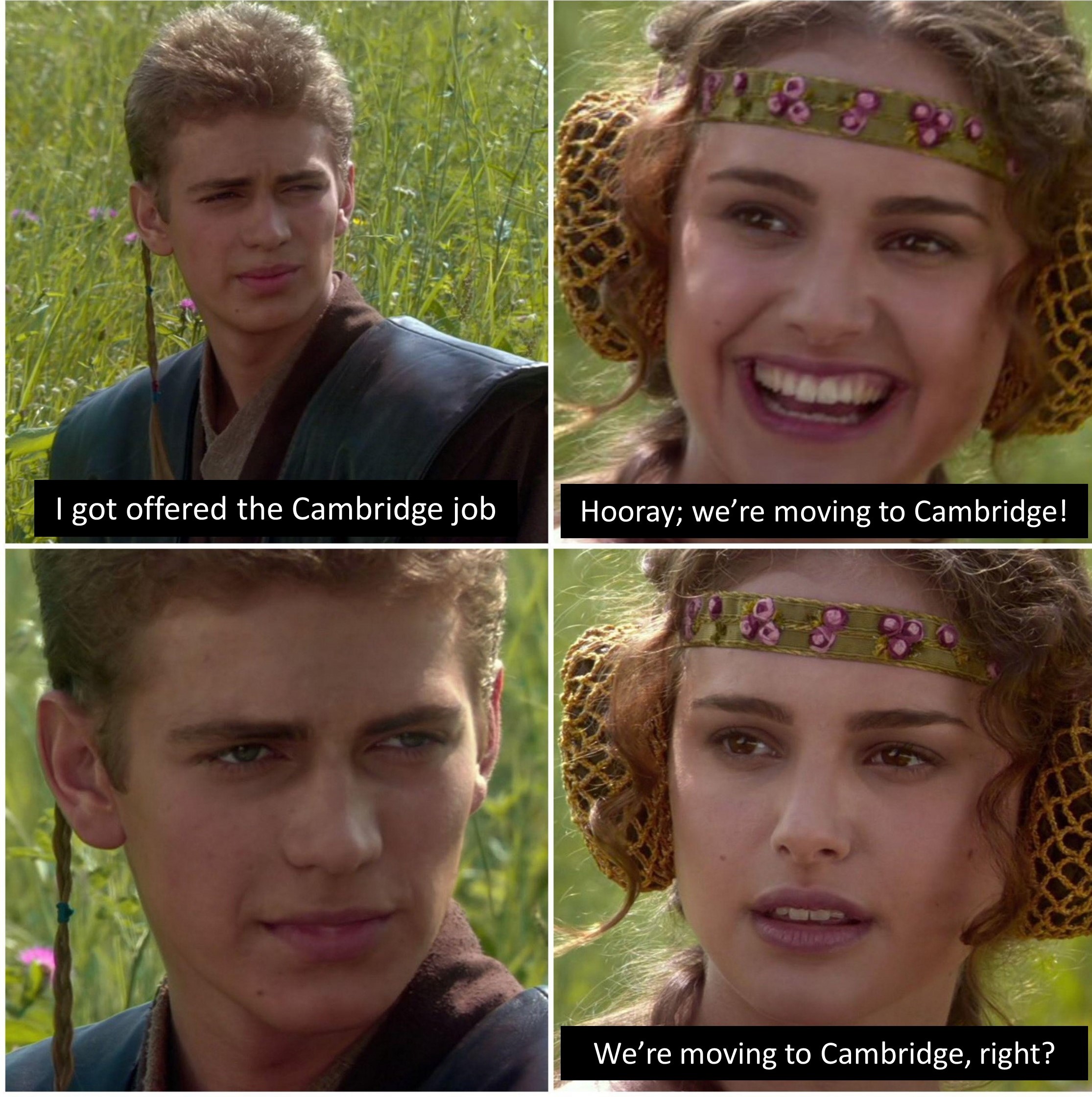
One of my biggest disappointments was not being able to move to Cambridge with my family because (i) Cambridge is very expensive relative to Leicester, and (ii) Univ. of Cambridge doesn’t pay their ECRs accordingly – mind you, I was being paid the equivalent of a (starting) ‘Lecturer’ post at the University’s pay scales (Point 49; see ‘Single Salary Spine’), so many of my colleagues were being paid less than myself.
There was also the issue of not having enough ‘independence’ as an ECR to work on different projects that excited me. As a ‘postdoc’, my priority had to be my supervisor’s projects/ideas. If I wanted to pursue my own projects, I had to bring my own salary via fellowship/grant applications – even those would have to be tailored towards the priorities of the funding bodies. Applying for grants/fellowships is not something I like or I’m trained for but I did try… I submitted three (one grant and two fellowship) applications and made it to the interview/final stage every time, however they were all ultimately rejected mostly because I “was not an expert on that respective disease” or “was too ambitious/couldn’t do all these in 3 (or 5) years”. I guess I also laid all my cards on the table and didn’t hide the fact that I was a proud ‘generalist’** and was never going to be a specialist as I am just too curious (and unwilling) to be working on a single disease or method. In addition to these, I had also co-applied (with a Lecturer colleague in the Arts dept. where we had to submit quite a few documents and a short video) for a very small grant (of ~£6000) to organise a conference to discuss the problems of asylum seekers/refugees in the UK, but it was rejected for strange reasons. I acknowledge that there is an element of luck involved and on another day with another panel, I may have been awarded but these rejections were also eye openers. (NB: I believe the ‘all-or-nothing’ nature of fellowship/grant applications should be revised as a colossal amount of researchers’ time and effort – and therefore taxpayers’ money – is being wasted)
But – in line with the story (of the Chinese farmer) I shared at the start – I am now happy that they didn’t work out as it probably would have meant I stayed in academia for longer (i.e. until the end of my fellowship period). I always took the ‘doing my best and not worrying about the outcome‘ approach and this has proven to be a good strategy for me so far.
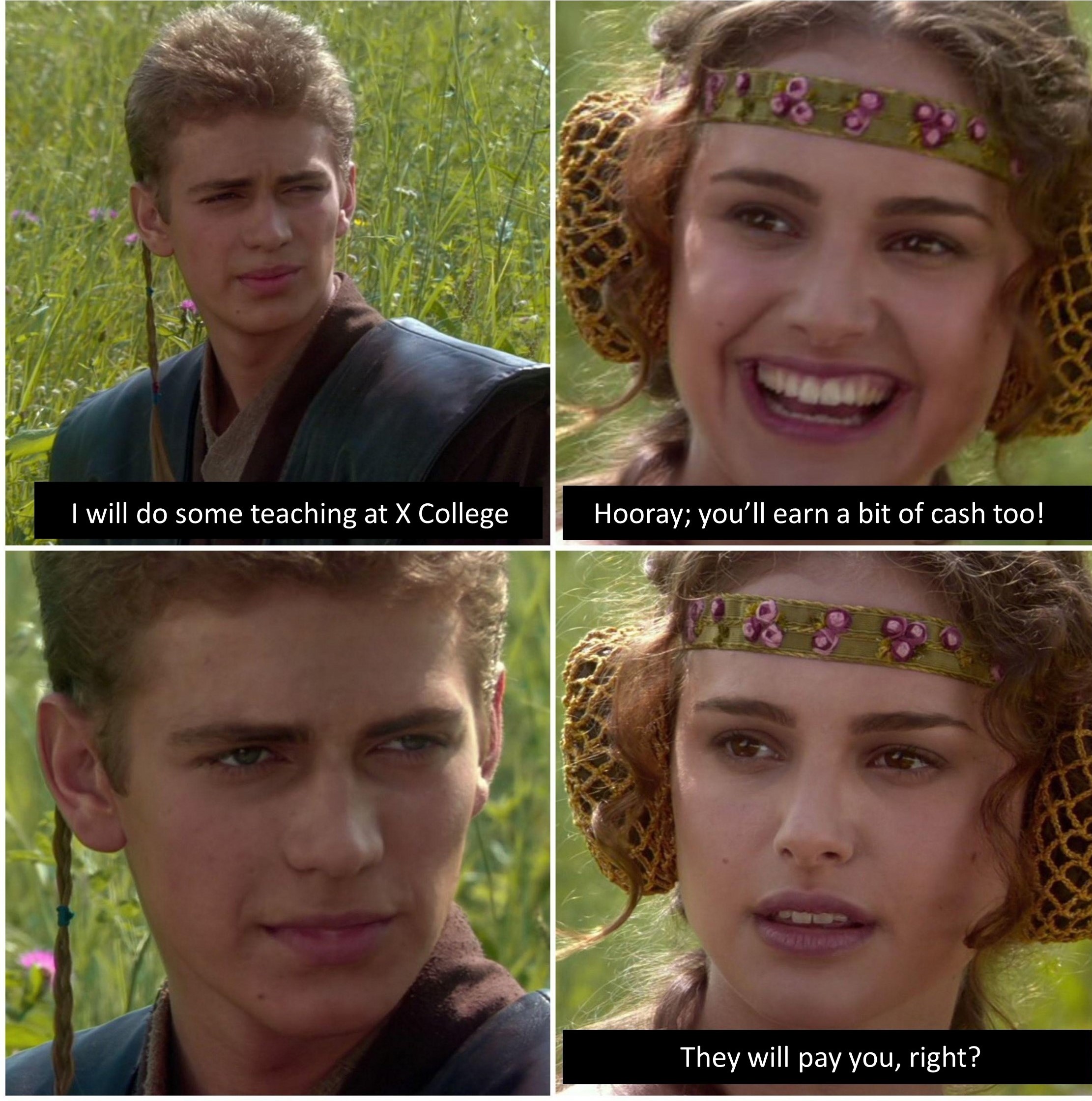
Although unhappy with the way ‘the system’ took advantage of ECRs, I did try and “play by rules” to ramp up my CV and network by applying to become a ‘Non-stipendiary Junior Research Fellow’ at one of the colleges of the Univ. of Cambridge to increase my chances of securing a permanent lecturer post at a high-calibre university. Although I enjoy teaching and think I am good at explaining concepts, the main reason for applying was to add more teaching experience in my CV and secondly, to be more involved with the community of students and ECRs in Cambridge – which I did not have a chance to do much, mostly as I and my wife decided not to move to Cambridge from Leicester for the reasons mentioned above (underneath the first figure). I made a solid application and got to the interview stage. I thought the interview panel would be delighted to see someone like me who has a relatively good academic CV for an ECR (see my CV) but also does sports, has his own podcast, who tried to be active on social media (I had more followers than the college on Twitter – although they’re very active), who writes highly read blogs (some of my blog posts are read and shared by tens of thousands), led many student groups (incl. the President of Turkish Society at the Univ. of Bristol and Leicester) etc. to join their ‘guild’ but I was very surprised to receive a rejection email a couple of weeks later. I was going to work there for free, but it seems like they didn’t value my skills at all and that there were at least 5 other people who they thought were going to contribute to the College’s environment more than me. This was another eye-opener: Academia is full of (highly talented) ECRs who are just happy to do things for free for the sake of adding stuff to their CV and I realised I was about to do the same. I remember thinking “I dodged a bullet there” – I decided it just wasn’t worth fighting/competing over these things. I knew now that I had to explore options outside of academia more assertively as I could see clearer that universities and the senior members who helped build this system were just taking advantage of ECRs’ idealism and ambitions but also desperation. (BTW: I find it astonishing that non-stipendiary fellowships in Cambridge are even a thing. They state that they don’t expect much from their fellows but they clearly do)
I then shared a 1-page CV in certain job recruitment sites to see what was out there for me and I was surprised to see how valuable* some of my transferable skills were to businesses in different sectors. I had many interviews and pre-interview chats with agents and potential employers (incl. Pharma, other private sectors, and public sector) in the last 6 months but only one ticked all the boxes for me: this ‘Senior scientist’ role at the Human Genetics team of BI – who valuedmy versatility and expertise in various fields***. Thus, I took time out to fully concentrate on the process and prepared well. I had to go through five interview stages, including an hour-long presentation to a group of experts from different fields, before I was offered the post. Throughout the process I also saw that many of my prospective colleagues at BI had seen the abovementioned problems earlier than I did and made the move. They were all very happy, with many working, and hoping to stay, in the company for a long time. I should also mention I had a Lecturer job lined up at the Univ. of Manchester**** too but the opportunity to work for BI’s ‘Human Genetics’ team was too good to refuse.
I didn’t mean this post to be this long so I’ll stop here. To sum up, I am proud of the things I’ve achieved and the friends I’ve made along the way – and if I was to go back, I wouldn’t change anything – but I believe it is the right time for me to leave academia. I think I’ve been a good servant to the groups I worked in and tried to give all I could. Simultaneously, I grew a lot as a scientist but also as a person – and this was almost all down to the environment we were provided at the universities I worked in. But having reached this stage in my life and career, I now think that (UK) universities don’t treat us (i.e. ECRs) in the right way and provide us with the necessary tools or the empathy to take the next step. I don’t see this changing in the near future either because of the fierce job market. Universities are somehow getting away with it – at least for now. This is not to say other sectors are too different in general but I would strongly recommend exploring the job market outside of academia. You may stumble on a recruiter like BI and a post like the one I have been offered, which matches my skill set and ambitions but also pay well so I can live a decent life with my family – without having to live tens of miles away from my office.
Let me re-iterate before I finish: What I wrote above will most probably not apply to you as I (i) am a UK-based academic/researcher, (ii) am an early-career researcher in a field which also has a strong computational/programming and statistics component – so I have a lot of easy-to-sell transferable skills to the Pharma companies/private sector, (iii) am a ‘generalist’** rather than a ‘specialist’ – so I’m a person major funding bodies currently aren’t really too keen on, (iv) don’t have rich parents or much savings, and am married (to a PhD student) and have a son to look after – and thus, salary*****, living in a decent house/neighbourhood and spending time with my family is an important issue, and (v) am an impatient idealist, who wants to see his research have impact – and as soon as possible. I am also in a position that I can make a move to another country with my family.
Footnotes:
*Contractor jobs usually offer much better pay packages than permanent jobs in the ‘data science’ field e.g. as soon I as put my CV on the market as a ‘health data scientist’, I got contacted by a lot of agents who could find me short-term (3-12 months mainly) contracts with very good pay packages. Just to give one example of the salaries offered, there was one agent who in an apologetic tone said: “I know this is not very good for someone like you but we currently offer £400 a day to our contractors but I can push it to £450 for you.” – this is ~3x the daily rate of my salary at the Univ. of Cambridge!
**I’ve always been involved in top groups and ‘cutting-edge’ projects so the jump from academia to Pharma in terms of research quality is not going to be too steep but the possibility of being directly involved in the process of a drug target that we identify go through the stages and maybe even become a drug that’s served to patients is not there for a (32 year old) ECR in academia – maybe, when I’m 45-50 years old. I also like the “skin in the game” and “all in the same boat” mentality in many Pharma/BI posts, which I do not see in academia. The current system incentivises people to be very individualistic in academia; and the repetitive and long process of publishing (at least partially) ‘rushed’ papers to lay claim to a potential discovery are things that have always bothered me. I don’t see how I can further improve myself personally and as a scientist as I don’t think my skills were anywhere near fully appreciated there – the system almost solely cares about publishing more and more papers, and bringing in funding. I have many ‘junior’ and ‘senior’ friends/colleagues who have made the transition from academia to Pharma (incl. Roche, NovoNordisk, GSK, AZ, Pfizer) and virtually all of them are happy to have moved on.
***As you can also see from my Google Scholar profile (and CV), I have worked on different diseases/traits and concepts/methods within the fields of medical genetics (e.g. rare diseases such as primary ciliary dyskinesia and Papillon-Lefevre syndrome), genetic epidemiology (e.g. common diseases such as type-2 diabetes and chronic obstructive pulmonary disease, and related traits such as smoking behaviour and blood pressure), (pure) epidemiology (COVID-19 studies), population genetics (Y-DNA & mtDNA haplogroup studies), and statistical genetics (e.g. LD Hub, HAPRAP) – and this is generally not seen as a ‘good sign’ (even when I’ve published papers in some of the most respectable journals in the respective fields as first/equal-first/prominent author) by some ‘senior academics’ (who review your grant/fellowship applications, and papers submitted to respectable journals) as many have spent their entire careers on a single disease, and sometimes on a single/few genes. It doesn’t mean they are right, but they usually make the final decision – and some like to act as gate keepers.
****I applied to the Univ. of Manchester post in case I would not get the BI job but also because it was a nice opportunity to work at a top university/department with high quality students and great scientists. They were also happy to pay me at the higher end of the ‘Lecturer’ salary scale. I believe I would have been a good lecturer and colleague but I just did not see myself in (UK) academia in its current state.
*****Although I – with my wife and son – was living in a nice neighbourhood and house in Leicester (renting of course!), due to my son’s expenses incl. a private nanny for a couple of days a week as my wife was also busy like me (small matter of writing her PhD thesis!), we were basically living paycheck to paycheck – and that was hard. When there were unexpected expenses, we used my wife’s (small amount of) savings, then asked my brother to help out financially – and that was hard too. It was almost impossible to fully concentrate on my research as I was always on the lookout for investment opportunities using the small amount of money I had on the side. At one point, I even contemplated doing casual work to earn a bit of cash on the side. Needless to say, I am very disappointed with the pay packages in academia – at least a stratified approach according to field, (transferable) skillset, and marriage/child status/other circumstances should be considered in my opinion. I also think, universities should at least provide guidance on solid investment (incl. mortgage) opportunities to their ECRs, so they can potentially earn or save a bit more. I can’t say much about my salary but it is a senior and permanent post, and my pay package also includes many of the perks of academia (e.g. >30 days of paid annual leave, flexible working hours, conference/travel allowance).
Couple of tweets – in addition to the blog posts I shared above – where I complain openly about the state of (UK-based) academia:
1- I don’t know how “no/limited feedback” has been normalised in academia:
Good to see 'feedback' also being mentioned.
I spent a few months putting together a @wellcometrust fellowship application; I then got to the interview-stage and spent a few weeks preparing for that – only to ultimately not get the funding but also not a single word of feedback.
2- I think science communication is as important as the papers we publish:
I think we definitely sit down and think what it means to be a scientist, academic and an intellectual – who are we? What is our purpose? Banal I know but we've definitely lost touch with our main aims (and what the taxpayers are expecting from us). https://t.co/eetUElIfTXpic.twitter.com/wdFiOh4zQJ
— A. Mesut Erzurumluoğlu (@mesuturkiye) May 15, 2020
3- Publishing papers for the sake of publishing and inflating h-indexes:
Publishing null/review articles as preprints/blog posts should be normalised esp. for PhD students, so taxpayers' money is not spent on publishing them in (open access) journals.
For more senior researchers, quality over quantity should be encouraged so less papers are published
— A. Mesut Erzurumluoğlu (@mesuturkiye) May 30, 2021
Addendum (23/12/21) –Reflecting on my first 4 months at BI’s Human Genetics team:
I was going to write a piece later but decided to add to this post now as I have been/am being invited to many ‘academia v industry/pharma‘ workshops/talks and saw that there is a lot of interest in this subject. I cannot properly respond to all emails or accept all invitations, thus would like to direct people here when needed…
A quick summary of what I’m doing: I’m a ‘Senior Scientist’ in the relatively newly established Human Genetics team of BI – and we’re located at the International Research Centre in the beautiful city of Biberach an der Riss in South Germany. As the Human Genetics team, we’re currently building analysis pipelines to make use of the huge amount of human genetics, proteomics and transcriptomics data that’s available to (in)validate the company’s portfolio of drugs (see below video for details).
A short primer on how I spend my days in the Human Genetics team of Boehringer Ingelheim: Leveraging human genetics data to guide drug target validation – Mesut Erzurumluoglu (Respiration/Solunum conference on 31/10/21)
If I say a few words about BI – which I didn’t know before I joined: BI one of the largest family-owned companies in the world with >20 billion euros revenue per year and >50k employees all around the world of which >8k are researchers (largest R&D centre is in Biberach an der Riss, where we’re also located) – so the company and the Boehringer/Von Baumbach family value R&D a lot. Some family members also attend research days organised within the company – which I find very encouraging as an employee but also a scientist at heart!
The other exciting thing for me is that the company’s currently going through a phase of massive expansion in ‘data driven drug target validation’, so the Comp. Bio/Human Genetics department is getting a lot of investment and are going to hire a lot of people in the near future – and I’m very happy to be involved in this process too.
To get back to my views of ‘working for BI v in academia’, I’ve made a summary table below which compares my experience as a Senior Scientist in BI and my time as an ECR/(Sn.) Postdoc/(Prospective) Lecturer in UK academia. I’ve highlighted in bold where I think one side better was than the other for me.
I believe the above rows are self-explanatory except maybe the bottom 4 rows – so I will provide some details here: (i) I feel like we’re ‘all in the same boat’ in my current team as we – as a group – have certain targets that we need to hit, so any success/breakthrough by any of the team members alleviates the pressure on all of us. This is also true of any success within the company. (ii) Re the next point/row, I just want to give one example: I have seen many papers be published in very high-impact journals by ‘top names’, which would not have made it past the ‘top names’ themselves (as reviewers) had the paper been written by some other group. Most of us also don’t have any editor friends who we can write to so that our ‘desk rejection’ at a high-impact journals is reviewed. The struggle for funding is even worse and I think life’s too short to be spending months on a fellowship or grant application, which is usually rejected for non-research related reasons (e.g. competition, timelines, priorities). (iii) We’re not allowed to work on Sundays at BI, and emails sent to others on Saturdays and after work hours is genuinely discouraged. (iv) Last row: We’re encouraged to produce good science and analysis pipelines by the senior management at BI rather than be in competition with colleagues to be the ‘first’ at something. In contrast, many papers in academia will be published in high-impact journals and be cited by others because they were the ‘first’ and not because they did a good job of strengthening their finding(s) via different lines of evidence. They do not lose anything if this ‘new and shiny’ finding turns out to be just a meaningless correlation 5-6 years down the line (i.e. there’s no “skin in the game”; even worse, they will have collected their grants and awards by then).
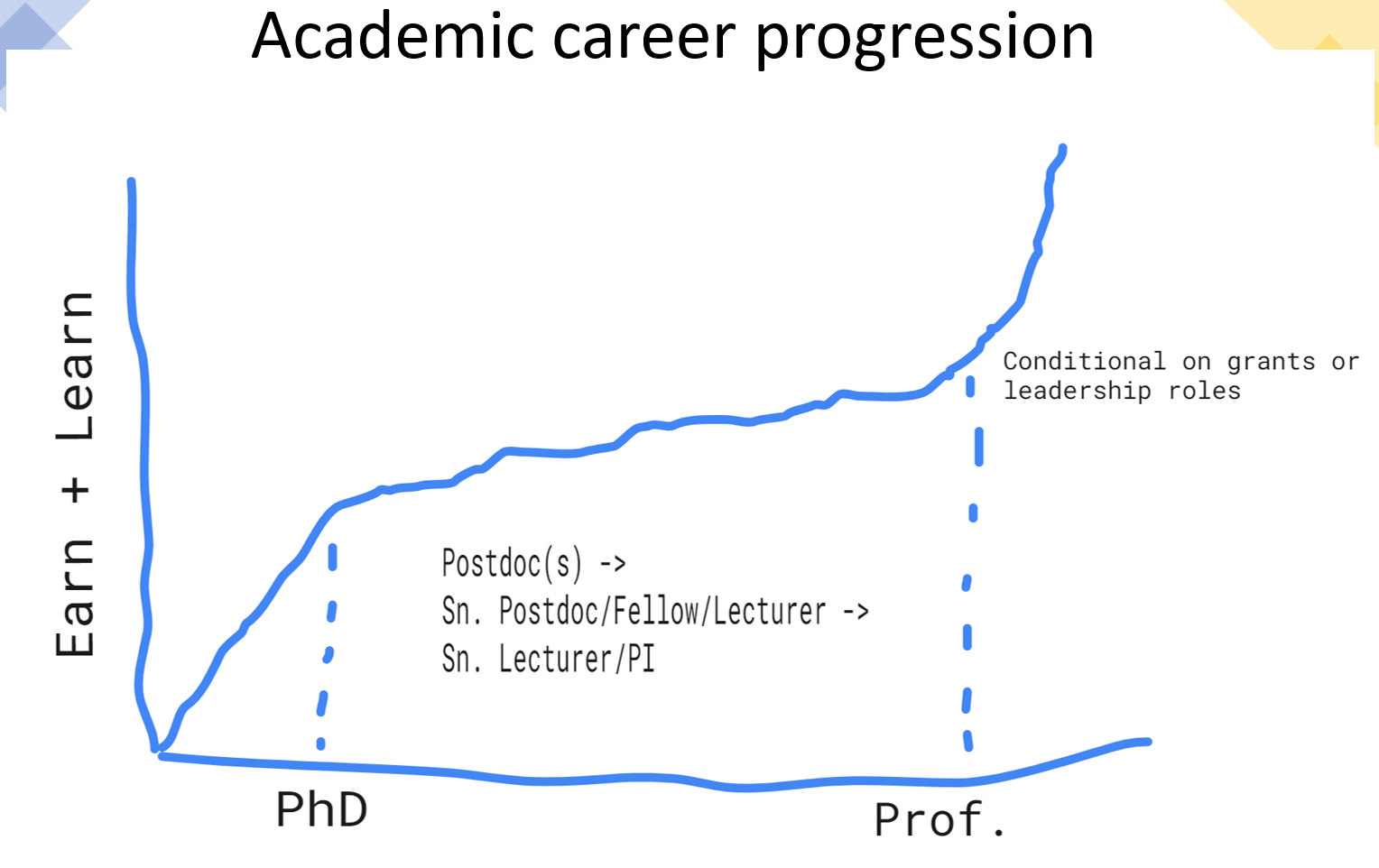
I also want to mention that career progression in UK academia is too slow for my liking (see below figure). I do not want to be treated as an ECR and living ‘paycheck to paycheck’ until I’m 50 – again, I feel like life is too short for this. This is why I wanted to move to a group where I would be respected more but also earning more – so that I can provide a good life for my family whilst fully concentrating on my/the team’s ‘cutting-edge’ research.
I always judged my ‘value’ at a place by adding how much I was earning and learning there. I was very happy during my PhD and first few years as a postdoc as I was learning a lot (from top scientists, attending conferences, giving talks, being provided the time to explore) and had a good salary/scholarship for a person who is single and <30 years of age. Unfortunately, for me, the increase in this regard was just not steep enough after this period. This feeling didn’t change much even after I secured a Lecturer post at the Univ. of Manchester – I just could not beg funders and apply for grants every year until I die. At BI, in addition to a very good salary, I’m also learning a lot from the different groups we are interacting with (e.g. wet-lab researchers/CRISPR screens, drug target research in different disease areas such as respiratory, immunology, oncology, and cardio-metabolic diseases) whilst also taking part in ‘cutting-edge’ research. There are also internal funds to explore your own ideas and a separate programme called ‘Research Beyond Borders’, which is dedicated to looking into other diseases which do not fit the main programmes.
To finish, I again re-iterate that it would be wise for a talented postdoc with data science and statistical skills to have a look around while they’re still comfortable in their current post (i.e. still have >12 months contract). If you have experience working with clinical and genetic data, then Pharma and Biotech companies would also be very interested in you.
I hope this post is of help, but feel free to contact me if you have specific questions that are not answered here.
Addendum (23/12/23) –Reflecting on my first ~2.5 years at BI’s Human Genetics team:
Still happy. Family’s happy here. South Germany is very good for families: Very safe. My son’s kindergarten is great; Biberach and surrounding area is great. So much to see and learn.
Happy with the research I’m doing, things I’ve learned/learning, and my impact in the drug target development process at BI.
Also check out our preprint on structural variants – a valuable resource, openly shared with the research community (Note: I had encouraged Boris Noyvert to join our team and now we’ve published this preprint together):
Noyvert B, Erzurumluoglu AM, Drichel D, Omland S, Andlauer TFM et al. 2023. Imputation of structural variants using a multi-ancestry long-read sequencing panel enables identification of disease associations: https://www.medrxiv.org/content/10.1101/2023.12.20.23300308v1
Tweetorial:
New data and preprint alert! 📀💾
Delighted to share our preprint on the added value of a long-read sequencing-based structural variant* (SV) imputation panel: https://t.co/dt4X10eBRo
It is not the strongest of the species that survives, nor the most intelligent that survives. It is the one that is most adaptable to change – attributed to Charles Darwin
“How did you get accepted to Cambridge?”
I saw a tweet a while ago which said something along the lines of: “If you’ve been asked the same question three times, you need to write a blog post about it”. I get asked about how I got my current postdoc job at the University of Cambridge all the time. Therefore, I decided to write this document to provide a bit of a backstory as I did many things over the years which – with a bit of luck – contributed to this ‘achievement’.
It is a long document but hopefully it will be worth reading in full for all foreign PhD students, newPostdocs and undergraduates who want an introduction to the world of academia in the UK. I wish I could write it in other languages (for a Turkish version click here) to make it as easy as I can for you, but I strived to use as less jargon as possible. Although there is some UK-specific information in there, the document is mostly filled with general guidance that will be applicable to not just foreign students or those who want to study in the UK, but all PhD students and new Postdocs.
I can only hope that there are no errors and every section is complete and fully understandable but please do contact me for clarifications, suggestions and/or criticism. I thank you in advance!
To make a connection between academia in the UK and the quote attributed to Darwin above, I would say being very clever/intelligent is definitely an advantage in academia but it is not the be-all and end-all. Learning to adapt with the changing landscape (e.g. sought-after skills, priorities of funders and PIs), keeping a good relationship with your colleagues and supervisors, and being able to sell yourself is as, if not more important. Those who pay attention to this side of academia usually make things easier for themselves.
I hope the below document helps you reach the places you want to reach:
A really useful document for UK PhD students – particularly those from abroad. It's Mesut's personal take, focused on genepi, but there is some really useful stuff here. https://t.co/V4sEy5vXMQ
Twitter’da gördüm sanırım: “Aynı soru sana üç defa sorulduysa bir blog yazısı yazma vakti gelmiştir”e benzer bir cümleydi. Ben de “Cambridge Üniversitesi’ne nasıl kabul aldın?” ve benzeri sorularla pek çok defa karşılaştıktan sonra birşeyler karalamaya karar verdim. Leicester Üniversitesi’nde çalışırken bunun onda biri dahi sorulmamıştı 😉
Doktoraöğrencilerine, doktorayı yeni bitirenlere ve akademik kariyer düşünen gençlere yönelik uzun bir doküman hazırladım. Az da olsa ingilizce terimler kullandım ama merak eden herkes okuyabilsin diye elimden geldikçe azaltmaya çalıştım (Not: iyi derecede ingilizce bilmeyenlerin iyi üniversitelere girmesi, hasbel-kader girdiyse de oralarda tutunması zor).
Okuyacağınız herşey benim şahsi düşüncelerim ve hiçbirine katılmak zorunda değilsiniz. Eminim yazdıklarımda hatalar ve eksikler olacaktır; bunları da bana bildirirseniz dökümanı hep beraber geliştirmiş oluruz. Katkıda bulunanlara da bir şekilde değineceğim. Şimdiden teşekkürler!
Darwin’e atfedilen yukarıda paylaştığım hakikat dolu sözle bir bağlantı kuracak olursam, evet, bir akademisyen için çok akıllı/zeki olmak bir avantajdır. Ama oyunun kurallarını (örneğin ‘arkadaşlarım/hocalarımla aramı nasıl iyi tutarım?‘, ‘iyi makale nasıl yazılır?‘, ‘nasıl fon getiririm?‘i) öğrenmek ve onlara göre adapte olmak da en az o kadar önemli – özellikle akademide oldugu gibi ‘oyun’un kuralları devamlı degişiyorsa… İşin bu kısımlarına da vakit harcayın.
Aşağıdaki dökümanda “Doktora sürecinde nelere dikkat etmeliyim?”, İngiltere’de akademik kariyer opsiyonları, “CV ve ‘Personal statement’ nasıl hazırlanır?“, ‘mülakat anı, öncesi ve sonrası neler yapmalıyım?‘, tez yazarken dikkat edilecekler, makale yazarken dikkat edilecekler ve prosedür, “Hocanızla ilişkiniz nasıl olmalı?” gibi konularda bilgiler ve tavsiyelerim bulunuyor. Umarım yardımcı olur. İlgileneceğini düşündüğünüz arkadaşlarınıza da yollarsanız sevinirim.
Ben de soranlara "akademik eğitim ve araştırma kariyerimle ilgili geriye dönüp baktığımda, hep kritik anlarda dört ayak üzerine düşmüşüm" diyorum
Doktora ve sonrası tanıştığım arkadaş ve Hocalarımın birçoguyla samimiyim – işim düşse ya da referans istesem anında yardımcı olurlar https://t.co/l2KcyPnxwk
Rafşan Çelik’le Cambridge Üniversitesinde Akademisyen Olmak ve İngiltere’de Yaşam, Kültür ve Akademik Hayat uzerine (Instagram üzerinden*) söyleşi yaptık (3:38’de başlıyor).
Doktora arayan arkadaşlar 'Britanya’da okumak/yaşamak' adlı blog yazımdan "Anladıgım kadarıyla Ingiltere’de burslu kabul almak biraz zor"la başlayan soruya verdiğim cevabı okuyup sonra yukarıda paylaştığım dokümanı bakabilirler – böylece daha yararlı olurhttps://t.co/qzFTK0FYWA
İngiltere'de üniversitelerde bu aralar 'REF' (Research Excellence Framework) sezonu. Her 7 yılda bir İngiliz hükümeti üniversitelere belli kriterlere göre milyonlarca pound para veriyor. Bu seferki 2021'de karara bağlanacak. #ingiltere#doktora#phd#cambridge#oxford
Ingiltere’de üniversiteler – genel kurallara uyma dışında – devletten bağımsızdır. Örneğin hepsi kendi fonunu kendi bulur, yani büyük bir şirket gibi işlerler. Fakat en büyük fon 7 senede bir devletten gelir – üniversitelerin başarı seviyesine göre. Bu da onunla ilgili bir Tweet zinciri
Full house! olan bu sıcak, serbest ve samimi toplantı için teşekkür. Toplantı sonrası, Cambridge Üniversitesi'nden genç akademisyen Mesut Erzurumluoğlu'nun @mesuturkiye "İngiltere'de Akademik Kariyer"yazısı herkese dağıtıldı:https://t.co/iimDL0FkrQ
Kıymetli Prof. Hikmet Geçkil Hocamın da bu dokümanı tavsiye ettiğini gördüm ve mutlu oldum. Umarım faydalı olmuştur
Hocam bu kaynak için teşekkür etmek istiyorum, gerçekten çok faydalı. Ağustosta detaylıca okudum, CVmi ve supportive statement ımı ona göre duzenledikten sonraki başvurularimdan bir kabul aldım, bir de Oxford'tan interview offer aldım.
We – as a group – carried out the largest genome-wide association study to identify genetic variants that are associated with decreased lung function and increased risk of chronic obstructive pulmonary disease. We hope that our findings will ultimately lead to the identification of effective drug targets for COPD. Image source: University of Leicester
I remember reading somewhere that ‘if you get asked the same question three times, then write a blog post about it’. That’s what I’ve been doing so far, and the purpose of this blog post is the same: to try and provide an answer to a commonly asked question. (Important note: my answers are in no way authoritative and only meant for interested non-scientists)
As a ‘Genetic Epidemiologist’, I constantly get asked what I do and what my (replace ‘my’ with ‘our’, as I do everything within a team) research can lead to. Please see my previous post ‘Searching for “Breathtaking” genes. Literally!‘ and My Research page for short answers to these questions. In tandem to these, I am constantly asked ‘why we can’t find a ‘cure’ for (noncommunicable) diseases that affect/will affect most of us such as obesity, diabetes, cancer, COPD – although there are many scientific advancements?’. I looked around for a straight forward example, but couldn’t find one (probably didn’t look hard enough!). So I decided to write my own.
I will first try and put the question into context: We do have ‘therapies’ and ‘preventive measures’ for most diseases and sometimes making that distinction from ‘a cure’ answers their question. For example, coronary heart disease (CHD) is a major cause of death both in the UK and worldwide (see NHS page for details) but we know how we can prevent many CHD cases (e.g. lowering cholesterol, stopping smoking, regular exercise) and treat CHD patients (e.g. statins, aspirin, ACE inhibitors). However, there are currently there are no ‘cures’ for CHD. So once a person is diagnosed with CHD, it is currently impossible to cure them from it, but doctors can offer quite a few options to make their life better.
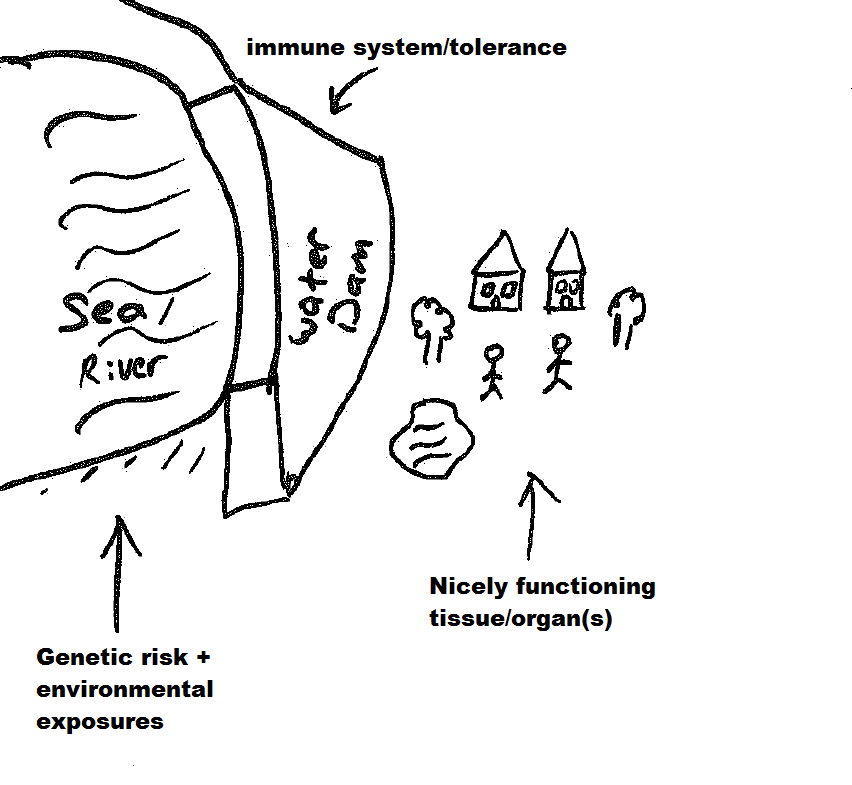
I then gave it some thought about why finding a ‘cure’ was so hard for most diseases, and came up with the below analogy of a river/sea, water dam, and a nicely functioning village/city (excuse my awful drawing!).
The first figure below sets the scene: there’s a water dam that’s keeping the river from flooding and damaging the nice village/city next to it. Now please read the caption of the below figure to make sense of how they’re related to a disease.
The river/sea is the combination of your genetic risk (e.g. you could have inherited genetic variants from your parents that increased your chances of type-2 diabetes) and environmental exposures (e.g. for type-2 diabetes, that would be being obese, eating high sugar content diet, smoking). The water dam is your immune system and/or mechanisms in your body which tame the sea of risk factors to ensure that everything in your body work fine (e.g. pancreatic islet cells have beta cells which produce insulin to lower your glucose levels back to normal levels – which would be damaging to the body’s organs if it stayed high).
So to ‘prevent’ a disease (well, flooding in this case), we could (i) make the water dam taller, (ii) make the dam stronger, and (iii) do regular checks to patch any damage done to the dam. To provide an example, for type-2 diabetes, point (i) could correspond to being ‘fit’ (or playing with your genes, which currently isn’t possible), point (ii) could correspond to staying ‘fit’, and point (iii) could correspond to having regular check-ups to see whether any preventive measures are necessary. Hope that made sense. If not, please stop reading immediately and look for other blog posts on the subject matter 🙂
Using the figure below, I wanted to then move to ‘therapy’. So as you can see, the river has flooded i.e. this individual has the disease (e.g. type-2 diabetes as above). The water dam is now not doing a good job of stopping the river and the city is in danger of being destroyed. But we have treatments: (i) The (badly drawn) water pumping trucks suck up excess water, and (ii) we have now built a second (smaller) dam to protect the houses and/or slow the flow of the water. Again, to provide an example using type-2 diabetes, water pumping trucks could be analogous to insulin or metformin injections, and the smaller dams could be changing current diet to a ‘low sugar’ version. This way we can alleviate the effects of the current and future ‘floods’.
Analogy for therapy/treatment – after being diagnosed with the disease
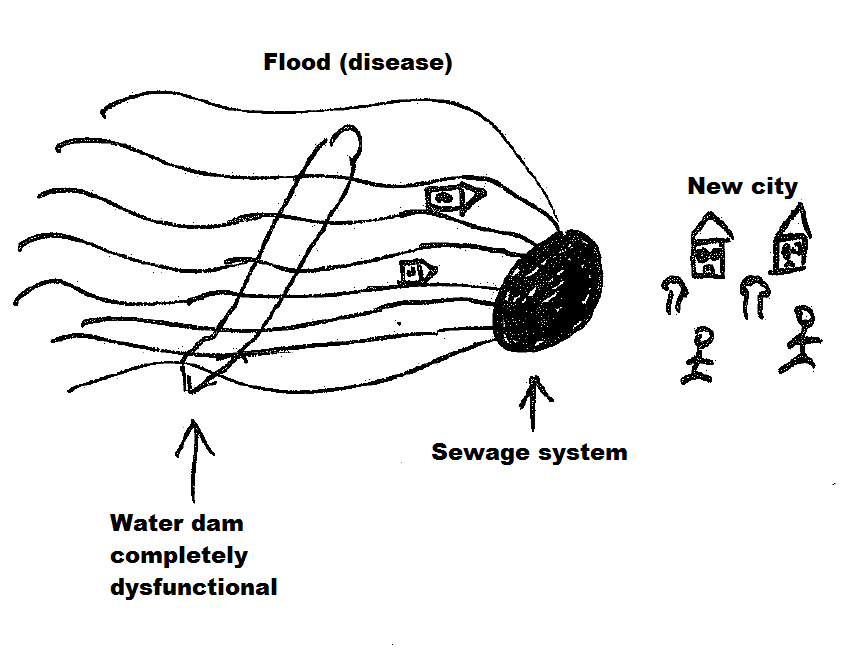
Finally, we move on to our main question: ‘the cure’. Using the same analogy as above, as the water dam is now dysfunctional, the only way to stop future ‘floods’ would be to design a sewage system that can mop up all water that could come towards the city. Of course the water dam and ‘old city’ was destroyed/damaged due to past floods, so we’d need to build a new functioning city to take over the job of the old one. A related real example (off the top of my head) could be to remove the damaged tissues and replace them with new ones. Genetic engineering (using CRISPR/Cas9) and/or stem cell techniques are likely to offer useful options in the future.
Analogy for cure – after being diagnosed with the disease
Hopefully it is now clear that the measures taken to prevent or treat the disease, cannot be used to cure the disease. E.g. you can build another dam in place of the old one, but the city is already destroyed so that’s not going to be of any use in curing the disease.
So to sum up, diseases like obesity, cancer, COPD are very complex diseases – in fact they’re called ‘complex diseases’ in the literature – and understanding their underlying biology is very hard (e.g. hundreds of genes and environmental exposures could combine to cause them). We’re currently identifying many causal variants but turning these findings into ‘cures’ is a challenge that we have not been able to crack yet. However, it is clear that the methods that we currently use to identify preventive measures and therapies cannot be used to identify cures.
I hope that was helpful. I’d be very happy to read your comments/suggestions and share credit with contributing scientists. Thanks for reading!
Ben 12 yaşındayken (2000) ailecek İngiltere'ye taşındık ve ingilizcem neredeyse sıfırdı. Bunu duyan (Karen Holman adında) Sınıf Öğretmenim, kendimi evimde hissedeyim diye tüm arkadaşlarıma Türkçe cümleler dağıtmış. Sınıfa girer-girmez arkadaşlarımın hepsi bana "Hoşgeldin" dediler







 An ordinary blog by an ordinary bloke