Feeds:
Posts
Comments

Posts Tagged ‘research’

A farmer and his son had a beloved stallion who helped the family earn a living. One day, the horse ran away and their neighbours exclaimed, “Your horse ran away, what terrible luck!”

The farmer replied, “Maybe.”

A few days later, the horse returned home, leading a few wild mares back to the farm as well. The neighbours shouted out, “Your horse has returned, and brought several horses home with him. What great luck!”

The farmer replied, “Maybe.”

Later that week, the farmer’s son was trying to break one of the mares and she threw him to the ground, breaking his leg. The villagers cried, “Your son broke his leg, what terrible luck!”

The farmer replied, “Maybe.”

A few weeks later, soldiers from the national army marched through town, recruiting all the able-bodied boys for the army. They did not take the farmer’s son, still recovering from his injury. Friends shouted, “Your boy is spared, what tremendous luck!”

To which the farmer replied, “Maybe.”

IMPORTANT NOTE: EVERYTHING I WROTE BELOW ARE MY OPINIONS AND REFLECT MY EXPERIENCE IN ACADEMIA (IN THE UK) – AT THE TIME OF WRITING. THEREFORE, THEY PROBABLY WILL NOT APPLY TO YOU. ALSO, PLEASE READ FROM START TO FINISH (INCL. FOOTNOTES) BEFORE POSTING COMMENTS.

Very soon, I’ll be moving to the ‘Human Genetics’ team of Boehringer Ingelheim Pharma (BI; Biberach R&D Centre in South Germany) as a ‘Senior Scientist’. I therefore wanted to look back at my time in academia and share my suggestion and concerns with other PhD students and early-career researchers (ECRs). Any criticism mentioned here is aimed at UK-based (research-intensive) academic institutions and “the system” – and not at any of my past supervisors/colleagues. The below are also going to be views that I have shared in some of my blog posts (e.g. Calculating the worth of an academic; Guide to an academic career in the UK; Bring back the ‘philosophy’ in ‘Natural philosophy’; What is success? YOU know better!) and with my colleagues throughout the years – and not something that I am just mentioning after securing a dream (will elaborate below on why I called it a ‘dream’) job at BI. (NB: See ‘Addendum (23/12/21)’ section, reflecting on my first 4-5 months at BI’s Human Genetics team)

To do my time in academia justice, I’ll get the good things out of the way first: I’ve been doing research for >10 years in UK-based academic institutions – first as a PhD student (Univ. of Bristol 2012-2015), then as a (Sn.) Postdoctoral Research Associate (2015-19 Univ. of Leicester; 2019-2021 Univ. of Cambridge) – and enjoyed almost every second of my time here. I met many world-class scientists but also great personalities whose memories and the things I learned from them will remain with me for the rest of my life. I was lucky to have had supervisors who also gave me the space and time to develop myself and I’d like to think I took good advantage of this. I also got to (i) publish quite a few papers I will always be proud about and (ii) travel to the US and many countries in Europe thanks to funding provided for academic conferences and, needless to say, none of them would have been possible without (4-year PhD) funding from the Medical Research Council (MRC UK) or support of my PhD/postdoc supervisors and colleagues. My time in the beautiful cities of Leicester (see: Life in Leicester), Bristol, and Cambridge was enjoyable too! I therefore would recommend any prospective scientist/researcher to spend at least some time as a ‘Postdoc’ in a research intensive UK-based university.

On top of all this, if you were to ask me 5 years ago, I would have said “I see myself staying in academia for the rest of my life” as I viewed my job as being paid for doing a ‘hobby’ – which was doing research, constantly learning, and rubbing shoulders with brilliant scientists. However, things started to change when I became a father towards the end of 2018, and I slowly began to have a change of heart about working in academia due to the well-known problems of fixed-term contracts/lack of permanent job opportunities, relatively poor* salaries compared to the private sector, and the many hurdles (incl. high workload) you need to overcome if you want to move a tiny bit up the ladder. The only thing keeping me going was my ideals of producing impactful science, my colleagues, and the possibility of pursuing my own ideas (and having PhD students). No one needs my acknowledgement to learn that there is ‘cutting-edge’ and potentially very impactful science being done at universities but the meaning of ‘impact’ for me changed during the COVID-19 pandemic when I was sat at home working on projects which I felt didn’t have much immediate impact and probably will not have much impact in the future either – and if they did, I probably would not be involved in the process as an ECR. On top of this, many of the (mostly COVID-19, and academia-related) analyses I was sharing on my Twitter page and blog were being read by tens of thousands. I was also heavily involved with the crowdfunding campaign of a one-year-old spinal muscular atrophy (type-1) patient (see tweet and news article). And these were both eye-opening and thought provoking! So the problems that I ignored or brushed under the carpet when I was a single, very early-career researcher were suddenly too big to ignore, and enduring through fixed-term jobs, relatively low pay packages* and a steep hierarchy (i.e. much more ‘status’ oriented than ideal) was just not worth it.
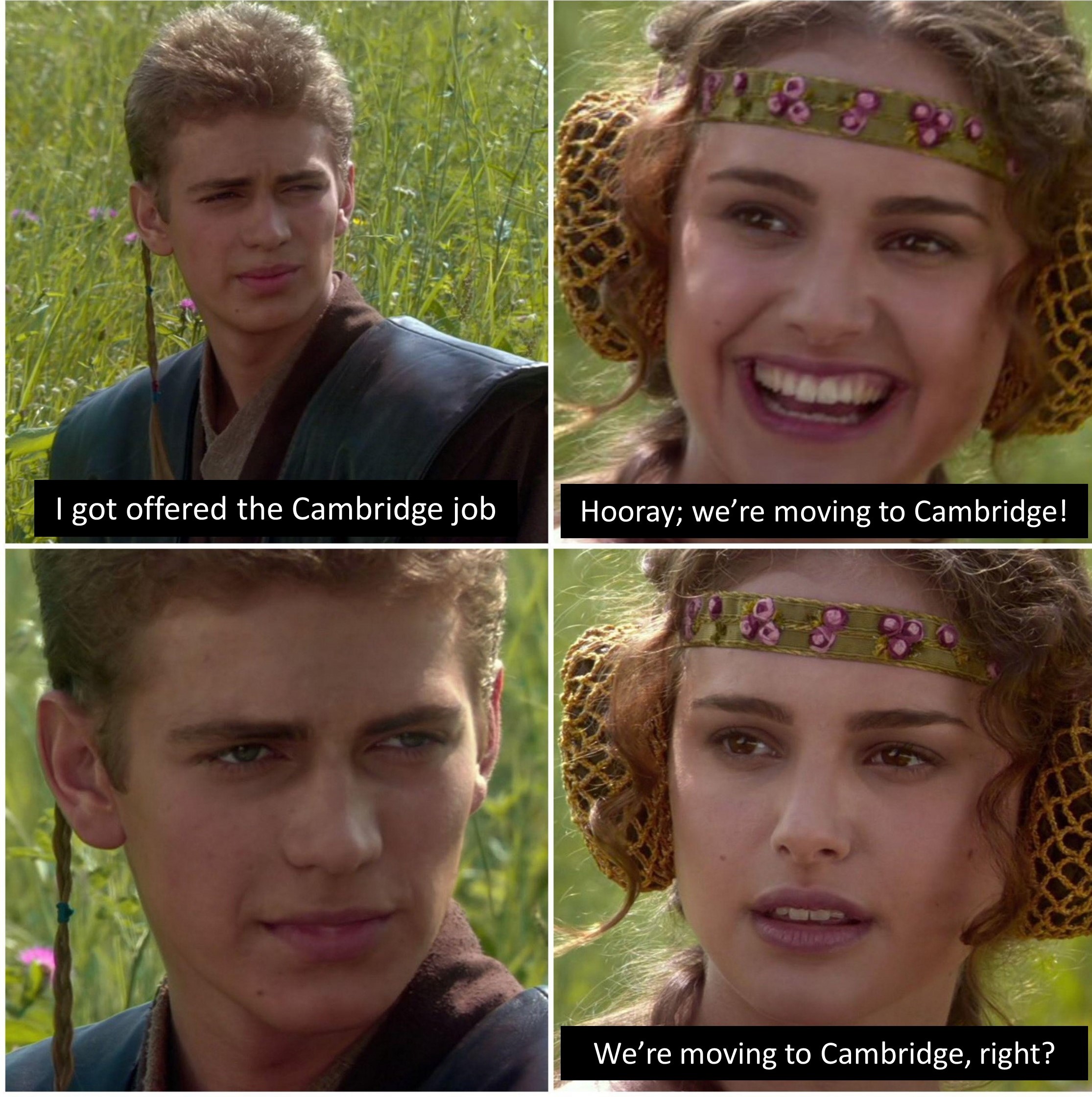
One of my biggest disappointments was not being able to move to Cambridge with my family because (i) Cambridge is very expensive relative to Leicester, and (ii) Univ. of Cambridge doesn’t pay their ECRs accordingly – mind you, I was being paid the equivalent of a (starting) ‘Lecturer’ post at the University’s pay scales (Point 49; see ‘Single Salary Spine’), so many of my colleagues were being paid less than myself.


There was also the issue of not having enough ‘independence’ as an ECR to work on different projects that excited me. As a ‘postdoc’, my priority had to be my supervisor’s projects/ideas. If I wanted to pursue my own projects, I had to bring my own salary via fellowship/grant applications – even those would have to be tailored towards the priorities of the funding bodies. Applying for grants/fellowships is not something I like or I’m trained for but I did try… I submitted three (one grant and two fellowship) applications and made it to the interview/final stage every time, however they were all ultimately rejected mostly because I “was not an expert on that respective disease” or “was too ambitious/couldn’t do all these in 3 (or 5) years”. I guess I also laid all my cards on the table and didn’t hide the fact that I was a proud ‘generalist’** and was never going to be a specialist as I am just too curious (and unwilling) to be working on a single disease or method. In addition to these, I had also co-applied (with a Lecturer colleague in the Arts dept. where we had to submit quite a few documents and a short video) for a very small grant (of ~£6000) to organise a conference to discuss the problems of asylum seekers/refugees in the UK, but it was rejected for strange reasons. I acknowledge that there is an element of luck involved and on another day with another panel, I may have been awarded but these rejections were also eye openers. (NB: I believe the ‘all-or-nothing’ nature of fellowship/grant applications should be revised as a colossal amount of researchers’ time and effort – and therefore taxpayers’ money – is being wasted)

But – in line with the story (of the Chinese farmer) I shared at the start – I am now happy that they didn’t work out as it probably would have meant I stayed in academia for longer (i.e. until the end of my fellowship period). I always took the ‘doing my best and not worrying about the outcome‘ approach and this has proven to be a good strategy for me so far.
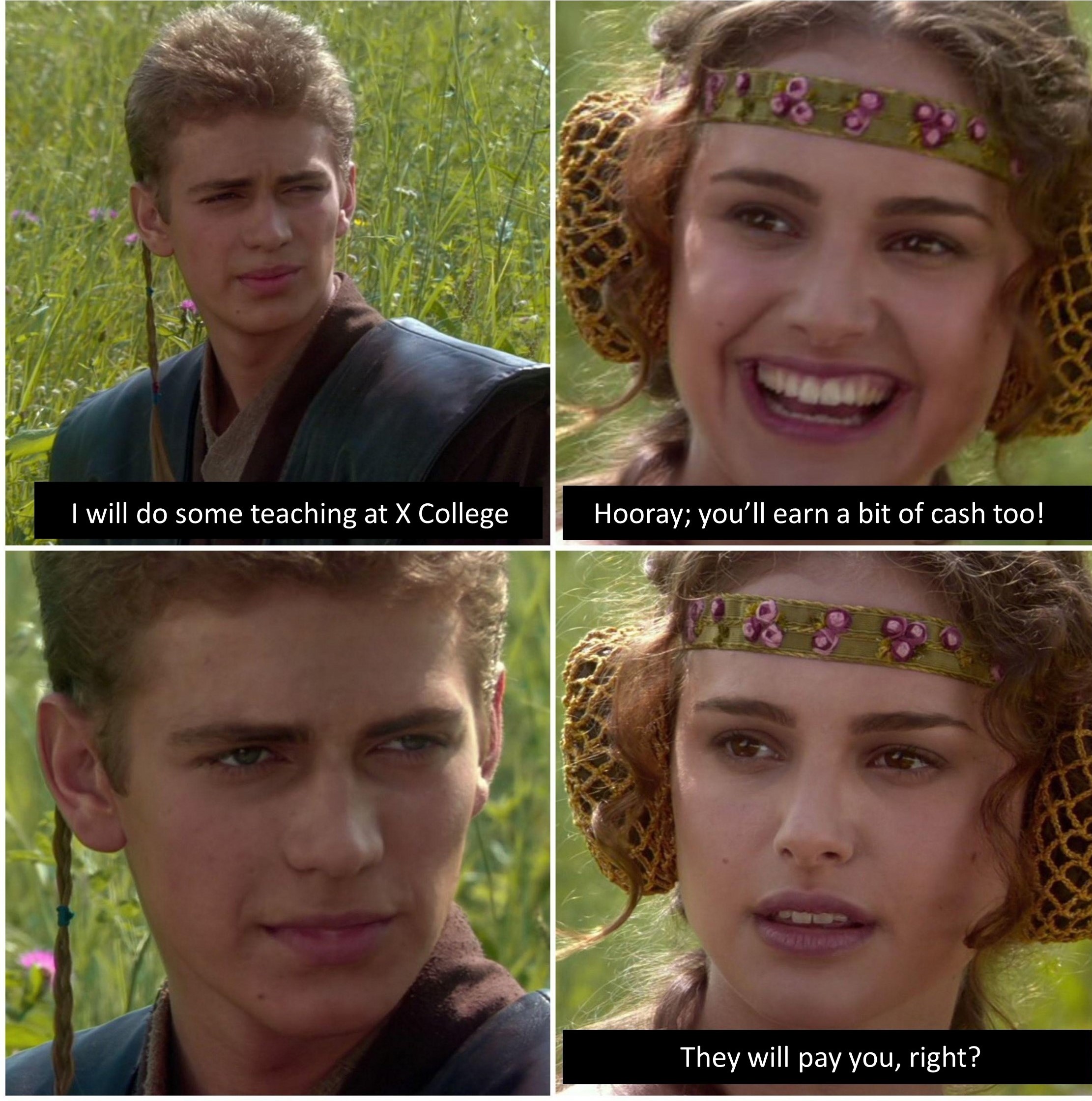
Although unhappy with the way ‘the system’ took advantage of ECRs, I did try and “play by rules” to ramp up my CV and network by applying to become a ‘Non-stipendiary Junior Research Fellow’ at one of the colleges of the Univ. of Cambridge to increase my chances of securing a permanent lecturer post at a high-calibre university. Although I enjoy teaching and think I am good at explaining concepts, the main reason for applying was to add more teaching experience in my CV and secondly, to be more involved with the community of students and ECRs in Cambridge – which I did not have a chance to do much, mostly as I and my wife decided not to move to Cambridge from Leicester for the reasons mentioned above (underneath the first figure). I made a solid application and got to the interview stage. I thought the interview panel would be delighted to see someone like me who has a relatively good academic CV for an ECR (see my CV) but also does sports, has his own podcast, who tried to be active on social media (I had more followers than the college on Twitter – although they’re very active), who writes highly read blogs (some of my blog posts are read and shared by tens of thousands), led many student groups (incl. the President of Turkish Society at the Univ. of Bristol and Leicester) etc. to join their ‘guild’ but I was very surprised to receive a rejection email a couple of weeks later. I was going to work there for free, but it seems like they didn’t value my skills at all and that there were at least 5 other people who they thought were going to contribute to the College’s environment more than me. This was another eye-opener: Academia is full of (highly talented) ECRs who are just happy to do things for free for the sake of adding stuff to their CV and I realised I was about to do the same. I remember thinking “I dodged a bullet there” – I decided it just wasn’t worth fighting/competing over these things. I knew now that I had to explore options outside of academia more assertively as I could see clearer that universities and the senior members who helped build this system were just taking advantage of ECRs’ idealism and ambitions but also desperation. (BTW: I find it astonishing that non-stipendiary fellowships in Cambridge are even a thing. They state that they don’t expect much from their fellows but they clearly do)

I then shared a 1-page CV in certain job recruitment sites to see what was out there for me and I was surprised to see how valuable* some of my transferable skills were to businesses in different sectors. I had many interviews and pre-interview chats with agents and potential employers (incl. Pharma, other private sectors, and public sector) in the last 6 months but only one ticked all the boxes for me: this ‘Senior scientist’ role at the Human Genetics team of BI – who valued my versatility and expertise in various fields***. Thus, I took time out to fully concentrate on the process and prepared well. I had to go through five interview stages, including an hour-long presentation to a group of experts from different fields, before I was offered the post. Throughout the process I also saw that many of my prospective colleagues at BI had seen the abovementioned problems earlier than I did and made the move. They were all very happy, with many working, and hoping to stay, in the company for a long time. I should also mention I had a Lecturer job lined up at the Univ. of Manchester**** too but the opportunity to work for BI’s ‘Human Genetics’ team was too good to refuse.

I didn’t mean this post to be this long so I’ll stop here. To sum up, I am proud of the things I’ve achieved and the friends I’ve made along the way – and if I was to go back, I wouldn’t change anything – but I believe it is the right time for me to leave academia. I think I’ve been a good servant to the groups I worked in and tried to give all I could. Simultaneously, I grew a lot as a scientist but also as a person – and this was almost all down to the environment we were provided at the universities I worked in. But having reached this stage in my life and career, I now think that (UK) universities don’t treat us (i.e. ECRs) in the right way and provide us with the necessary tools or the empathy to take the next step. I don’t see this changing in the near future either because of the fierce job market. Universities are somehow getting away with it – at least for now. This is not to say other sectors are too different in general but I would strongly recommend exploring the job market outside of academia. You may stumble on a recruiter like BI and a post like the one I have been offered, which matches my skill set and ambitions but also pay well so I can live a decent life with my family – without having to live tens of miles away from my office.

Let me re-iterate before I finish: What I wrote above will most probably not apply to you as I (i) am a UK-based academic/researcher, (ii) am an early-career researcher in a field which also has a strong computational/programming and statistics component – so I have a lot of easy-to-sell transferable skills to the Pharma companies/private sector, (iii) am a ‘generalist’** rather than a ‘specialist’ – so I’m a person major funding bodies currently aren’t really too keen on, (iv) don’t have rich parents or much savings, and am married (to a PhD student) and have a son to look after – and thus, salary*****, living in a decent house/neighbourhood and spending time with my family is an important issue, and (v) am an impatient idealist, who wants to see his research have impact – and as soon as possible. I am also in a position that I can make a move to another country with my family.


Footnotes:

*Contractor jobs usually offer much better pay packages than permanent jobs in the ‘data science’ field e.g. as soon I as put my CV on the market as a ‘health data scientist’, I got contacted by a lot of agents who could find me short-term (3-12 months mainly) contracts with very good pay packages. Just to give one example of the salaries offered, there was one agent who in an apologetic tone said: “I know this is not very good for someone like you but we currently offer £400 a day to our contractors but I can push it to £450 for you.”this is ~3x the daily rate of my salary at the Univ. of Cambridge!

**I’ve always been involved in top groups and ‘cutting-edge’ projects so the jump from academia to Pharma in terms of research quality is not going to be too steep but the possibility of being directly involved in the process of a drug target that we identify go through the stages and maybe even become a drug that’s served to patients is not there for a (32 year old) ECR in academia – maybe, when I’m 45-50 years old. I also like the “skin in the game” and “all in the same boat” mentality in many Pharma/BI posts, which I do not see in academia. The current system incentivises people to be very individualistic in academia; and the repetitive and long process of publishing (at least partially) ‘rushed’ papers to lay claim to a potential discovery are things that have always bothered me. I don’t see how I can further improve myself personally and as a scientist as I don’t think my skills were anywhere near fully appreciated there – the system almost solely cares about publishing more and more papers, and bringing in funding. I have many ‘junior’ and ‘senior’ friends/colleagues who have made the transition from academia to Pharma (incl. Roche, NovoNordisk, GSK, AZ, Pfizer) and virtually all of them are happy to have moved on.

***As you can also see from my Google Scholar profile (and CV), I have worked on different diseases/traits and concepts/methods within the fields of medical genetics (e.g. rare diseases such as primary ciliary dyskinesia and Papillon-Lefevre syndrome), genetic epidemiology (e.g. common diseases such as type-2 diabetes and chronic obstructive pulmonary disease, and related traits such as smoking behaviour and blood pressure), (pure) epidemiology (COVID-19 studies), population genetics (Y-DNA & mtDNA haplogroup studies), and statistical genetics (e.g. LD Hub, HAPRAP) – and this is generally not seen as a ‘good sign’ (even when I’ve published papers in some of the most respectable journals in the respective fields as first/equal-first/prominent author) by some ‘senior academics’ (who review your grant/fellowship applications, and papers submitted to respectable journals) as many have spent their entire careers on a single disease, and sometimes on a single/few genes. It doesn’t mean they are right, but they usually make the final decision – and some like to act as gate keepers.

****I applied to the Univ. of Manchester post in case I would not get the BI job but also because it was a nice opportunity to work at a top university/department with high quality students and great scientists. They were also happy to pay me at the higher end of the ‘Lecturer’ salary scale. I believe I would have been a good lecturer and colleague but I just did not see myself in (UK) academia in its current state.

*****Although I – with my wife and son – was living in a nice neighbourhood and house in Leicester (renting of course!), due to my son’s expenses incl. a private nanny for a couple of days a week as my wife was also busy like me (small matter of writing her PhD thesis!), we were basically living paycheck to paycheck – and that was hard. When there were unexpected expenses, we used my wife’s (small amount of) savings, then asked my brother to help out financially – and that was hard too. It was almost impossible to fully concentrate on my research as I was always on the lookout for investment opportunities using the small amount of money I had on the side. At one point, I even contemplated doing casual work to earn a bit of cash on the side. Needless to say, I am very disappointed with the pay packages in academia – at least a stratified approach according to field, (transferable) skillset, and marriage/child status/other circumstances should be considered in my opinion. I also think, universities should at least provide guidance on solid investment (incl. mortgage) opportunities to their ECRs, so they can potentially earn or save a bit more. I can’t say much about my salary but it is a senior and permanent post, and my pay package also includes many of the perks of academia (e.g. >30 days of paid annual leave, flexible working hours, conference/travel allowance).


Couple of tweets – in addition to the blog posts I shared above – where I complain openly about the state of (UK-based) academia:

1- I don’t know how “no/limited feedback” has been normalised in academia:

2- I think science communication is as important as the papers we publish:

3- Publishing papers for the sake of publishing and inflating h-indexes:


Addendum (23/12/21) Reflecting on my first 4 months at BI’s Human Genetics team:

I was going to write a piece later but decided to add to this post now as I have been/am being invited to many ‘academia v industry/pharma‘ workshops/talks and saw that there is a lot of interest in this subject. I cannot properly respond to all emails or accept all invitations, thus would like to direct people here when needed…

A quick summary of what I’m doing: I’m a ‘Senior Scientist’ in the relatively newly established Human Genetics team of BI – and we’re located at the International Research Centre in the beautiful city of Biberach an der Riss in South Germany. As the Human Genetics team, we’re currently building analysis pipelines to make use of the huge amount of human genetics, proteomics and transcriptomics data that’s available to (in)validate the company’s portfolio of drugs (see below video for details).

A short primer on how I spend my days in the Human Genetics team of Boehringer Ingelheim: Leveraging human genetics data to guide drug target validation – Mesut Erzurumluoglu (Respiration/Solunum conference on 31/10/21)

If I say a few words about BI – which I didn’t know before I joined: BI one of the largest family-owned companies in the world with >20 billion euros revenue per year and >50k employees all around the world of which >8k are researchers (largest R&D centre is in Biberach an der Riss, where we’re also located) – so the company and the Boehringer/Von Baumbach family value R&D a lot. Some family members also attend research days organised within the company – which I find very encouraging as an employee but also a scientist at heart!

The other exciting thing for me is that the company’s currently going through a phase of massive expansion in ‘data driven drug target validation’, so the Comp. Bio/Human Genetics department is getting a lot of investment and are going to hire a lot of people in the near future – and I’m very happy to be involved in this process too.

To get back to my views of ‘working for BI v in academia’, I’ve made a summary table below which compares my experience as a Senior Scientist in BI and my time as an ECR/(Sn.) Postdoc/(Prospective) Lecturer in UK academia. I’ve highlighted in bold where I think one side better was than the other for me.

I believe the above rows are self-explanatory except maybe the bottom 4 rows – so I will provide some details here: (i) I feel like we’re ‘all in the same boat’ in my current team as we – as a group – have certain targets that we need to hit, so any success/breakthrough by any of the team members alleviates the pressure on all of us. This is also true of any success within the company. (ii) Re the next point/row, I just want to give one example: I have seen many papers be published in very high-impact journals by ‘top names’, which would not have made it past the ‘top names’ themselves (as reviewers) had the paper been written by some other group. Most of us also don’t have any editor friends who we can write to so that our ‘desk rejection’ at a high-impact journals is reviewed. The struggle for funding is even worse and I think life’s too short to be spending months on a fellowship or grant application, which is usually rejected for non-research related reasons (e.g. competition, timelines, priorities). (iii) We’re not allowed to work on Sundays at BI, and emails sent to others on Saturdays and after work hours is genuinely discouraged. (iv) Last row: We’re encouraged to produce good science and analysis pipelines by the senior management at BI rather than be in competition with colleagues to be the ‘first’ at something. In contrast, many papers in academia will be published in high-impact journals and be cited by others because they were the ‘first’ and not because they did a good job of strengthening their finding(s) via different lines of evidence. They do not lose anything if this ‘new and shiny’ finding turns out to be just a meaningless correlation 5-6 years down the line (i.e. there’s no “skin in the game”; even worse, they will have collected their grants and awards by then).

I also want to mention that career progression in UK academia is too slow for my liking (see below figure). I do not want to be treated as an ECR and living ‘paycheck to paycheck’ until I’m 50 – again, I feel like life is too short for this. This is why I wanted to move to a group where I would be respected more but also earning more – so that I can provide a good life for my family whilst fully concentrating on my/the team’s ‘cutting-edge’ research.
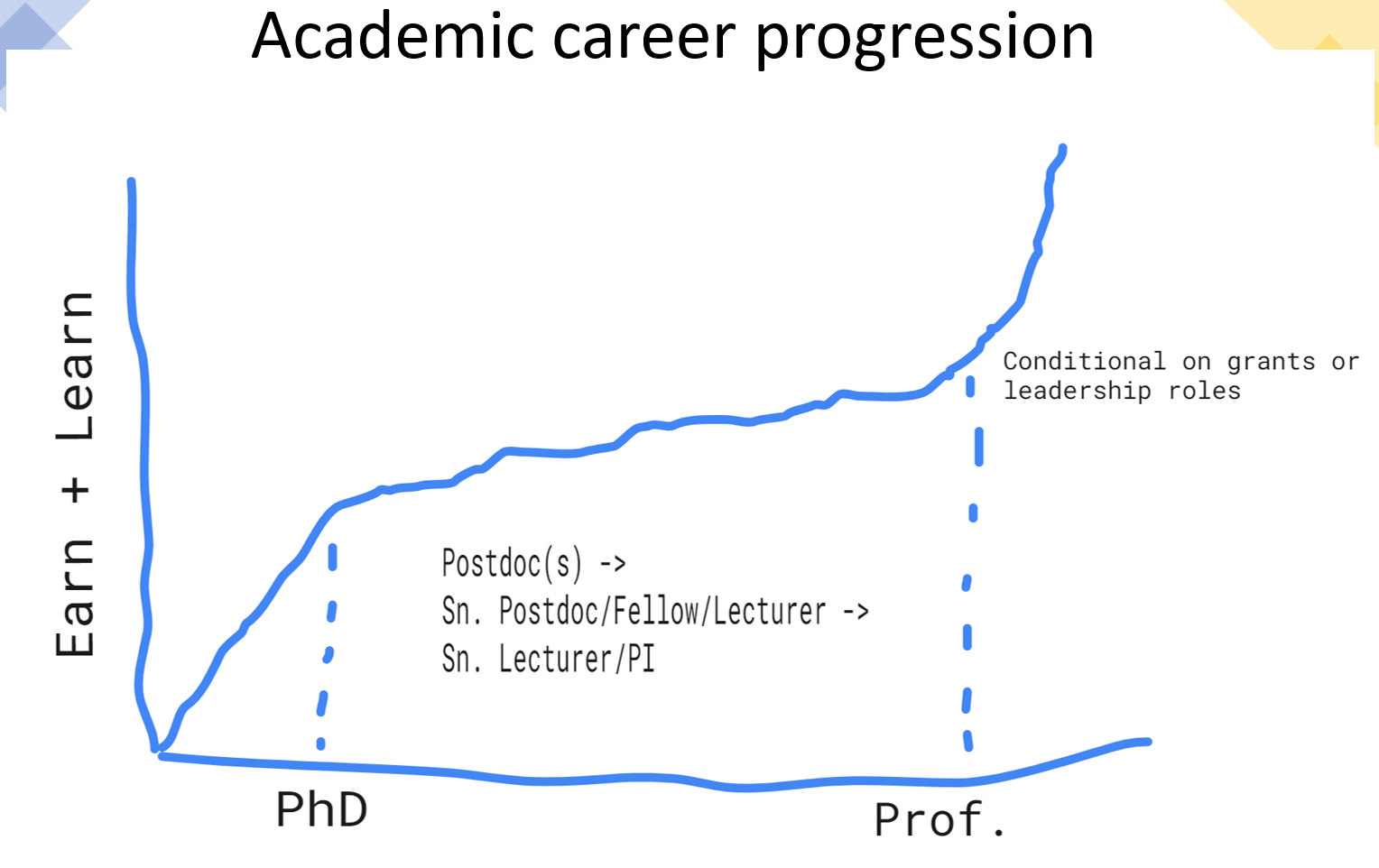
I always judged my ‘value’ at a place by adding how much I was earning and learning there. I was very happy during my PhD and first few years as a postdoc as I was learning a lot (from top scientists, attending conferences, giving talks, being provided the time to explore) and had a good salary/scholarship for a person who is single and <30 years of age. Unfortunately, for me, the increase in this regard was just not steep enough after this period. This feeling didn’t change much even after I secured a Lecturer post at the Univ. of Manchester – I just could not beg funders and apply for grants every year until I die. At BI, in addition to a very good salary, I’m also learning a lot from the different groups we are interacting with (e.g. wet-lab researchers/CRISPR screens, drug target research in different disease areas such as respiratory, immunology, oncology, and cardio-metabolic diseases) whilst also taking part in ‘cutting-edge’ research. There are also internal funds to explore your own ideas and a separate programme called ‘Research Beyond Borders’, which is dedicated to looking into other diseases which do not fit the main programmes.

To finish, I again re-iterate that it would be wise for a talented postdoc with data science and statistical skills to have a look around while they’re still comfortable in their current post (i.e. still have >12 months contract). If you have experience working with clinical and genetic data, then Pharma and Biotech companies would also be very interested in you.

I hope this post is of help, but feel free to contact me if you have specific questions that are not answered here.


Addendum (23/12/23) Reflecting on my first ~2.5 years at BI’s Human Genetics team:

Still happy. Family’s happy here. South Germany is very good for families: Very safe. My son’s kindergarten is great; Biberach and surrounding area is great. So much to see and learn.

Happy with the research I’m doing, things I’ve learned/learning, and my impact in the drug target development process at BI.

Also check out our preprint on structural variants – a valuable resource, openly shared with the research community (Note: I had encouraged Boris Noyvert to join our team and now we’ve published this preprint together):

Noyvert B, Erzurumluoglu AM, Drichel D, Omland S, Andlauer TFM et al. 2023. Imputation of structural variants using a multi-ancestry long-read sequencing panel enables identification of disease associations: https://www.medrxiv.org/content/10.1101/2023.12.20.23300308v1

Tweetorial:

Read Full Post »

copd_smoking_nat_genet_lung_function_gwas_wain

We – as a group – carried out the largest genome-wide association study to identify genetic variants that are associated with decreased lung function and increased risk of chronic obstructive pulmonary disease. We hope that our findings will ultimately lead to the identification of effective drug targets for COPD. Image source: University of Leicester

I remember reading somewhere that ‘if you get asked the same question three times, then write a blog post about it’. That’s what I’ve been doing so far, and the purpose of this blog post is the same: to try and provide an answer to a commonly asked question. (Important note: my answers are in no way authoritative and only meant for interested non-scientists)

As a ‘Genetic Epidemiologist’, I constantly get asked what I do and what my (replace ‘my’ with ‘our’, as I do everything within a team) research can lead to. Please see my previous post ‘Searching for “Breathtaking” genes. Literally!‘ and My Research page for short answers to these questions. In tandem to these, I am constantly asked ‘why we can’t find a ‘cure’ for (noncommunicable) diseases that affect/will affect most of us such as obesity, diabetes, cancer, COPD – although there are many scientific advancements?’. I looked around for a straight forward example, but couldn’t find one (probably didn’t look hard enough!). So I decided to write my own.

I will first try and put the question into context: We do have ‘therapies’ and ‘preventive measures’ for most diseases and sometimes making that distinction from ‘a cure’ answers their question. For example, coronary heart disease (CHD) is a major cause of death both in the UK and worldwide (see NHS page for details) but we know how we can prevent many CHD cases (e.g. lowering cholesterol, stopping smoking, regular exercise) and treat CHD patients (e.g. statins, aspirin, ACE inhibitors). However, there are currently there are no ‘cures’ for CHD. So once a person is diagnosed with CHD, it is currently impossible to cure them from it, but doctors can offer quite a few options to make their life better.

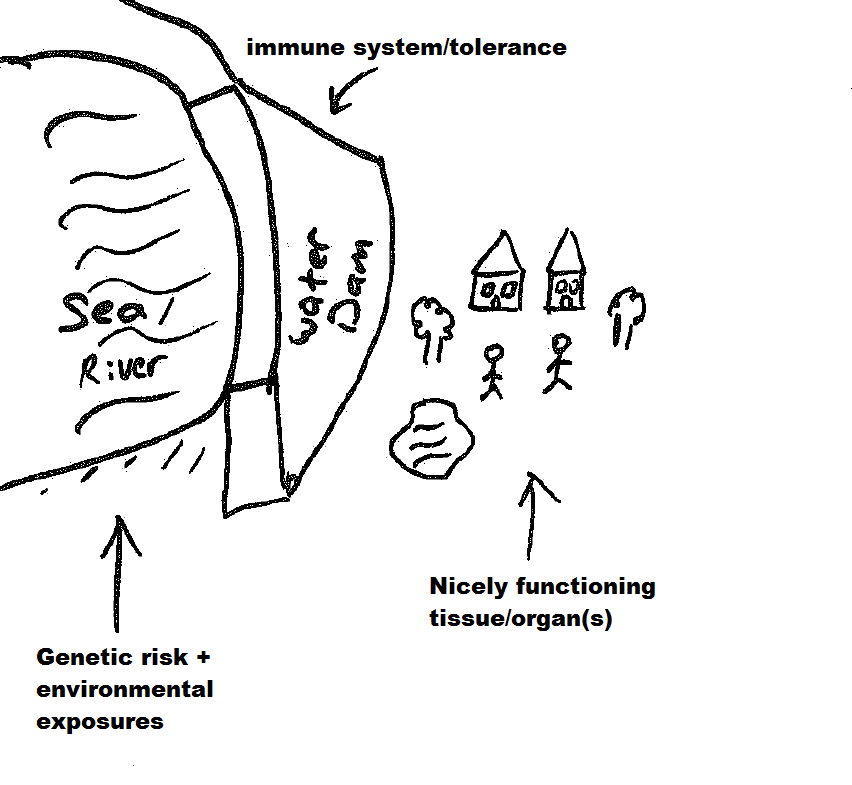
I then gave it some thought about why finding a ‘cure’ was so hard for most diseases, and came up with the below analogy of a river/sea, water dam, and a nicely functioning village/city (excuse my awful drawing!).

The first figure below sets the scene: there’s a water dam that’s keeping the river from flooding and damaging the nice village/city next to it. Now please read the caption of the below figure to make sense of how they’re related to a disease.

Prevention

The river/sea is the combination of your genetic risk (e.g. you could have inherited genetic variants from your parents that increased your chances of type-2 diabetes) and environmental exposures (e.g. for type-2 diabetes, that would be being obese, eating high sugar content diet, smoking). The water dam is your immune system and/or mechanisms in your body which tame the sea of risk factors to ensure that everything in your body work fine (e.g. pancreatic islet cells have beta cells which produce insulin to lower your glucose levels back to normal levels – which would be damaging to the body’s organs if it stayed high).

So to ‘prevent’ a disease (well, flooding in this case), we could (i) make the water dam taller, (ii) make the dam stronger, and (iii) do regular checks to patch any damage done to the dam. To provide an example, for type-2 diabetes, point (i) could correspond to being ‘fit’ (or playing with your genes, which currently isn’t possible), point (ii) could correspond to staying ‘fit’, and point (iii) could correspond to having regular check-ups to see whether any preventive measures are necessary. Hope that made sense. If not, please stop reading immediately and look for other blog posts on the subject matter 🙂

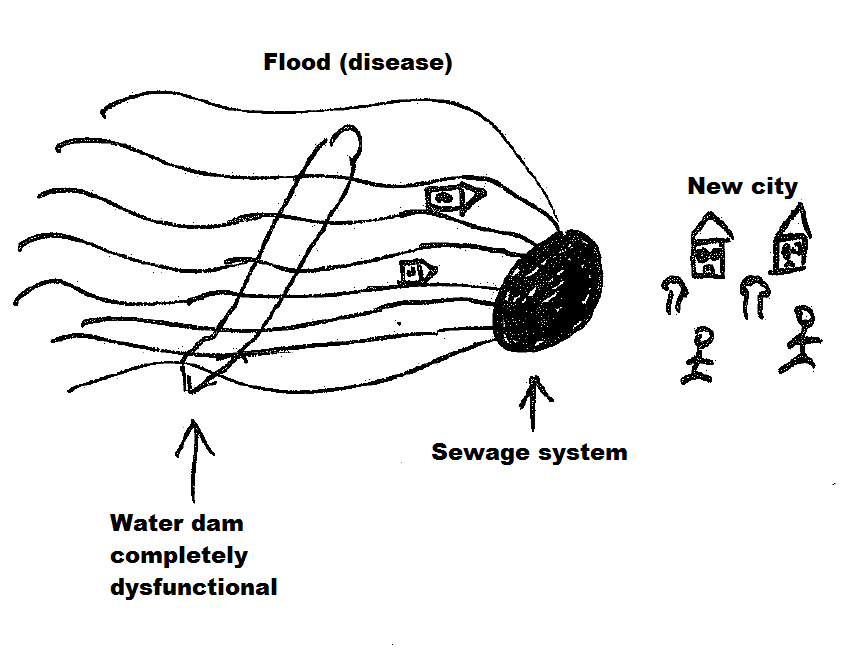
Using the figure below, I wanted to then move to ‘therapy’. So as you can see, the river has flooded i.e. this individual has the disease (e.g. type-2 diabetes as above). The water dam is now not doing a good job of stopping the river and the city is in danger of being destroyed. But we have treatments: (i) The (badly drawn) water pumping trucks suck up excess water, and (ii) we have now built a second (smaller) dam to protect the houses and/or slow the flow of the water. Again, to provide an example using type-2 diabetes, water pumping trucks could be analogous to insulin or metformin injections, and the smaller dams could be changing current diet to a ‘low sugar’ version. This way we can alleviate the effects of the current and future ‘floods’.

Therapy

Analogy for therapy/treatment – after being diagnosed with the disease

Finally, we move on to our main question: ‘the cure’. Using the same analogy as above, as the water dam is now dysfunctional, the only way to stop future ‘floods’ would be to design a sewage system that can mop up all water that could come towards the city. Of course the water dam and ‘old city’ was destroyed/damaged due to past floods, so we’d need to build a new functioning city to take over the job of the old one. A related real example (off the top of my head) could be to remove the damaged tissues and replace them with new ones. Genetic engineering (using CRISPR/Cas9) and/or stem cell techniques are likely to offer useful options in the future.

Cure

Analogy for cure – after being diagnosed with the disease

Hopefully it is now clear that the measures taken to prevent or treat the disease, cannot be used to cure the disease. E.g. you can build another dam in place of the old one, but the city is already destroyed so that’s not going to be of any use in curing the disease.

So to sum up, diseases like obesity, cancer, COPD are very complex diseases – in fact they’re called ‘complex diseases’ in the literature – and understanding their underlying biology is very hard (e.g. hundreds of genes and environmental exposures could combine to cause them). We’re currently identifying many causal variants but turning these findings into ‘cures’ is a challenge that we have not been able to crack yet. However, it is clear that the methods that we currently use to identify preventive measures and therapies cannot be used to identify cures.

I hope that was helpful. I’d be very happy to read your comments/suggestions and share credit with contributing scientists. Thanks for reading!

Read Full Post »

evolution_of_intellectual_freedom_cham_phdcomics

Source URL: PhD Comics

Figuratively speaking, what is the ‘worth’ of a certain academic? Between two academics, which one has had more positive academic impact than the other? How do you rank academics? And award grants, promotion, tenure etc. to the best* ones?

I’m not going to answer these questions but would like to chip in with some food for thought and suggestions.

Well; one may say: “It’s easy! Just compare their h-index and total no of citations!

This may be an effective way to go about answering the question. Surely someone with an h-index of 30 has had more positive academic impact than someone with let’s say an h-index of 15 – and is the better candidate?

Maybe – that is if all things are equal regarding the way citations and the h-index works i.e. if both academics:

  • are in similar fields – as papers in certain fields receive more citations overall than papers in other fields,
  • are in similar stages in their careers – as comparing an early-career postdoc with an established “Prof.” wouldn’t be fair,
  • have similar numbers of first/equal-first or last author papers – as an academic with many middle-authorships can have excessively inflated h-indexes,
  • have similar number of co-authors – as it may be easier to be listed as a co-author in some fields than others and/or mean that more people will be presenting and citing the paper as their own, and
  • have a similar distribution of citations across the papers – as the h-index ignores highly influential papers and the total citations can be highly influenced by even just one of these (see figure below).

I may have missed other factors, but I think these are the main ones (please add a comment below).

mesut_erzurumluoglu_h-index_academic_2018

Calculating my h-index: Although problematic (discussed here), the h-index has become the standard metric when measuring the academic output of an academic. It is calculated by sorting the publications of an academic from most to least cited, then checking whether he/she has h papers with h citations e.g. if an academic has 10 papers with ≥10 citations but not 11 papers with ≥11 citations then their h-index will be 10. It was proposed as a way to summarise the number of publications that an academic has and their academic impact (via citations) with a single number. The above citation counts were obtained from my Google Scholar page

As of 31st July 2018, I have 14 published papers – including 5 as first/equal-first author – under my belt. I have a total citation count of 316 and an h-index of 6 (225 and 5 respectively, when excluding publications marked with an asterisk in the above figure). It is fair to say that these numbers are above average for a 29-year-old postdoc. But even I’m not content with my h-index – and many established academics are definitely right not to be. I’ll try and explain why: the figure above shows the citation distribution of my 14 publications sorted by the ‘number of times cited’ from the left (highest) to right (lowest). One can easily see that the h-index (red box) captures only a small portion of the general picture (effectively, 6 x 6 i.e. 36 citations) and ignores the peak (>6 on the y-axis) and tail (>6 on the x-axis) of the publication-citation distribution. I have also included the publication year of each paper and added an asterisk (*) against the publications where I haven’t provided much input e.g. I have done almost nothing for the Warren et al (2017) paper but it constitutes almost a third of my total citations (90/316)**. The ‘ignored peak’ contains three highly cited papers to which I have made significant contributions to and the ‘ignored tail’ contains research papers that (i) I am very proud of (e.g. Erzurumluoglu et al, 2015) or (ii) are just published – thus didn’t have the time to accumulate citations. What is entirely missing from this figure are my (i) non-peer-reviewed publications (e.g. reports, articles in general science magazines), (ii) correspondence/letters to editor (e.g. my reply to a Nature News article), (iii) blog posts where I review papers or explain concepts (e.g. journal clubs), (iv) shared code/analysis pipelines, (v) my PhD thesis with potentially important unpublished results, (vi) other things in my CV (e.g. peer-review reports, some blog posts) – which are all academia-related things I am very proud of. I have seen other people’s contributions in relation to these (e.g. Prof. Graham Coop’s blog) and thought that they were more useful than even some published papers in my field. These contributions should be incorporated into ‘academic output’ measures somehow.

It is also clear that “just compare their h-index and total no of citations!” isn’t going to be fair on academics that (i) do a lot of high-quality supervision at different levels (PhD, postdoc, masters, undergrad project – which all require different skill sets and arrangements), (ii) spend extra time to make their lectures inspiring and as educative as possible to undergrad and Masters students, (iii) present at a lot of conferences, (iv) do ‘admin work’ which benefits early-career researchers (e.g. workshops, discussion sessions), (v) do a lot of blogging to explain concepts, review papers, and offer personal views on field generally, (vi) have a lot of social media presence (e.g. to give examples from my field i.e. Genetic Epidemiology, academics such as Eric Topol, Daniel MacArthur, Sek Kathiresan take time out from their busy schedules to discuss, present and debate latest papers in their fields – which I find intellectually stimulating), (vii) give a lot of interviews (TV, online media, print media) to correct misconceptions, (viii) take part in public engagement events (incl. public talks), (ix) organise (inter-disciplinary) workshops, (x) inspire youngsters to become academics working for the benefit of humankind, (xi) publish reliable reports for the public and/or corporations to use, (x) provide pro bono consultation, (xi) take part in expert panels and try very hard to make the right decisions, (xii) engage in pro bono work, (xiii) do their best to change bad habits in the academic circles (e.g. by sharing code, advocating open access publications, standing up to unfair/bad decisions whether it affects them or not), (xiv) extensively peer-review papers, (xv) help everyone who asks for help and/or reply to emails… The list could go on but I think I’ll stop there…

I acknowledge that some of the above may indirectly help increase the h-index and total citations of an individual but I don’t think any of the above are valued as much as they should be per se by universities – and something needs to change. Academics should not be treated like ‘paper machines’ until the REF*** submission period, and then ‘cash cows’ that continually bring grant money until the next REF submission cycle starts. As a result, many academics have made ‘getting their names into as many papers as possible’ their main aim – it is especially easier for senior academics, many with a tonne of middle-authorships for which they have done virtually nothing****. This is not how science and scientists should work and universities are ultimately disrespecting the tax payers’ and donors’ money. Some of the above-mentioned factors are easier to quantify than others but thought should go into acknowledging work other than (i) published papers, (ii) grant money brought in, and maybe (iii) appearing on national TV channels.

Unless an academic publishes a ‘hot paper’ as first or corresponding author – which very few have the chance and/or luck to do – and he/she becomes very famous in their field, their rank is usually dictated by the h-index and/or total citations. In fact, many scientists who have very high h-indexes (e.g. because of many middle-author papers) put this figure at the top of their publication list to prove that they’re top scientists – and unfortunately, they contribute to the problem.

People have proposed that contributions of each author are explicitly stated on each paper but this is going to present a lot of work when analysing the academic output of tens of applicants – especially when the number of publications an individual has increases. Additionally, in papers with tens or even hundreds of authors, general statements such as “this author contributed to data analysis” are going to be assigned to many authors without explicitly stating what they did to be included as a co-author – thus the utility of this proposition could also be less than expected in reality.

It’s not going to solve all the problems, but I humbly propose that a figure such as the one above be provided by Google Scholar and/or similar bibliometric databases (e.g. SCOPUS, CrossRef, Microsoft Academic, Loop) for all academics, where the papers for which the respective academic is not the first author are marked with an asterisk. The asterisks could then be manually removed by the respective academic on publications where he/she has made significant contributions (i.e. equal-first, corresponding author, equal-last author or other prominent role) but wasn’t the first author. Metrics such as the h-index and total citations could then become better measures by giving funders/decision makers the chance to filter accordingly.

Thanks for reading. Please leave your comments below if you do not agree with anything or would like to make a suggestion.

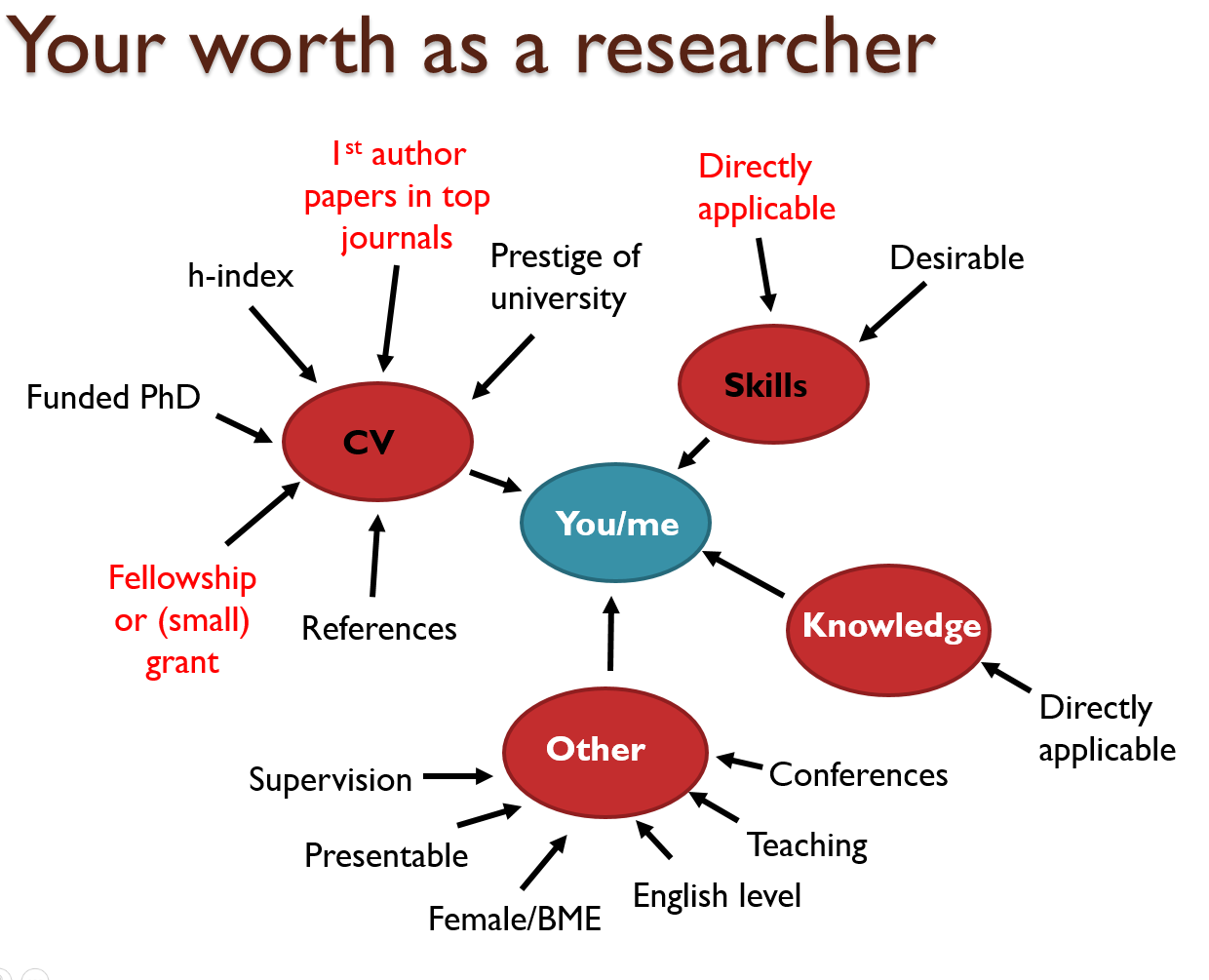
academic_worth_researcher_university_mesut_erzurumluoglu

The heuristic that I think people use when calculating the worth of an early career researcher (but generally applies to all levels): ‘CV’ and ‘Skills’ are the two main contributors, with the factors highlighted in red carrying enormous weight in determining whether someone should get the job/fellowship or not. Virtually no one cares about anything that is outside what is written here – as mentioned in the post. Directly applicable: Some technical skill that the funder/Professor thinks is essential for the job; Prestige of university: where you did your PhD and/or undergrad; Funded PhD: whether your PhD was fully funded or not; Female/BME: being female and/or of BME background – this can be an advantage or a disadvantage depending on the regulations/characteristics of the university/panel, as underrepresented groups can be subjected to both positive and negative discrimination. NB: this is a simplified version and there are many factors that affect outcomes such as “who you know” and “being at the right place at the right time“.


Added on 30/10/18: I just came across ‘No, it’s not The Incentives—it’s you‘ by Tal Yarkoni about the common malpractices in academic circles, and I think it’s well worth a read.


*Making sure there’s a gender balance and that academics from BME backgrounds are not excluded from the process – as they’ve usually had to overcome more obstacles to reach the same heights.

**I have been honest about this in my applications and put this publication under “Other Publications” in my CV.

***REF stands for the ‘Research Excellence Framework’, and is the UK’s system for assessing the quality of research in higher education institutions. The last REF cycle finished in 2014 and the next one will finish in 2021 (every 7 years). Universities start planning for this 3-4 years before the submission dates and the ones ranked high in the list will receive tens of millions of pounds from the government. For example, University of Oxford (1st) received ~£150m and University of Bristol (8th) received ~£80m.

****Sometimes it’s not their fault; people add senior authors on their papers to increase their chances of getting them accepted. It’s then human nature that they’re not going to decline authorship. It sounds nice when one’s introduced in a conference etc. as having “published >100 papers with >10,000 citations” – when in reality they’ve not made significant (if any!) contributions to most of them.


PS: I also propose that acknowledgements at the bottom of papers and PhD theses be screened in some way. I’ve had colleagues who’ve helped me out a lot when learning some concepts who then moved on and did not have the chance to be a co-author on my papers. I have acknowledged them in my PhD thesis and would love to see my comments be helpful to these colleagues in some way when they apply for postdoc jobs or fellowships. Some of them did not publish many papers and acknowledgements like these could show that they not only have the ability to be of help (e.g. statistical, computational expertise), but are also easy to work with and want to help their peers.

Read Full Post »

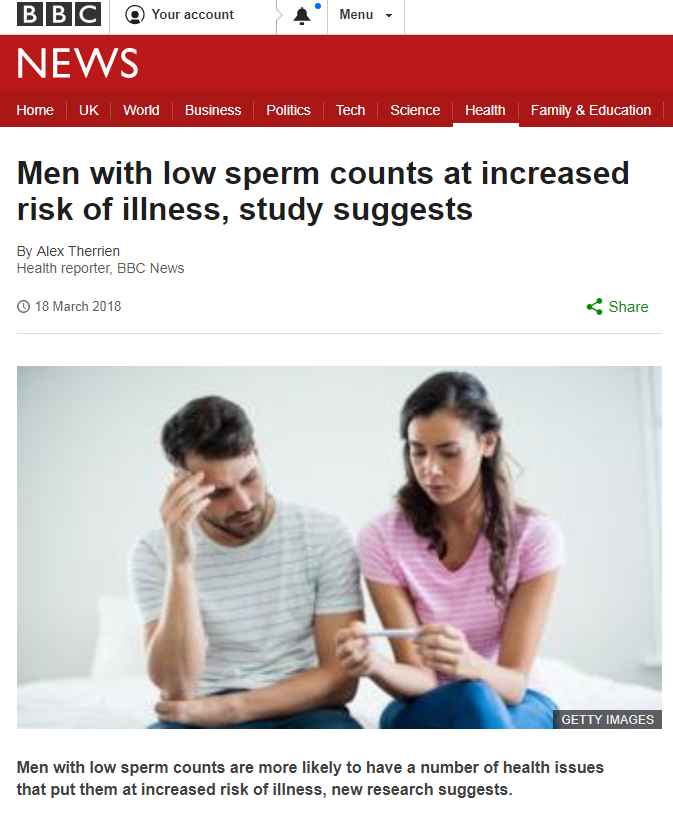
BBC_news_sperm_count

BBC news article published on the 18th March 2018. According to the article, men with low sperm counts are at a higher risk of disease/health problems. However, this is unlikely to be a causal relationship and more likely to be a spurious correlation. May even turn out to be the other way round due to “reverse causality”, a bias we encounter a lot in epidemiological studies. The following sounds more plausible (to me at least!): “Men with disease/health problems are likely to have low sperm counts” (likely cause: men with health problems tended to smoke more in general and this caused low sperm counts in those individuals).

As an enthusiastic genetic epidemiologist (keyword here: epidemiologist), I try to keep in touch with the latest developments in medicine and epidemiology. However, it is impossible to read all articles that come out as there is a lot of epidemiology and/or medicine papers published daily (in fact, too much!). For this reason, instead of reading the original academic papers (excluding papers in my specific field), I try to skim read from reputable news outlets such as the BBC, The Guardian and Medscape (mostly via Twitter). However, health news even in these respectable media outlets are full of wrong and/or oversensationalised titles: they either oversensationalise what the scientist has said or take the word of the scientist they contact – who are not infallible and can sometimes believe in their own hypotheses too much.

It wouldn’t harm us too much if the message of an astrophysics related publication is misinterpreted but we couldn’t say the same with health related news. Many people take these news articles as gospel truth and make lifestyle changes accordingly. Probably the best example for this is the Andrew Wakefield scandal in 1998 – where he claimed that the MMR vaccine caused autism and gastro-intestinal disease but later investigations showed that he had undeclared conflicts of interest and had faked most of the results (click here for a detailed article in the scandal). Many “anti-vaccination” (aka anti-vax) groups used his paper to strengthen their arguments and – although now retracted – the paper’s influence can still be felt today as many people, including my friends, do not allow their children to be vaccinated as they falsely think they might succumb to diseases like autism because of it.

The first thing we’re taught in our epidemiology course is “correlation does not mean causation.” However, a great deal of epidemiology papers published today report correlations (aka associations) without bringing in other lines of evidence to provide evidence for a causal relationship. Some of the “interesting ones” amongst these findings are then picked up by the media and we see a great deal of news articles with titles such as “coffee causes cancer” or “chocolate eaters are more successful in life”. There have been instances when I read the opposite in the same paper a couple of months later (example: wine drinking is protective/harmful for pregnant women). The problem isn’t caused only due to a lack of scientific method training on the media side, but also due to health scientists who are eager to make a name for themselves in the lay media without making sure that they have done everything they could to ensure that the message they’re giving is correct (e.g. triangulating using different methods). As a scientist who analyses a lot of genetic and phenotypic data, it is relatively easier for me to observe that the size of the data that we’re analysing has grown massively in the last 5-10 years. However, in general, we scientists haven’t been able to receive the computational and statistical training required to handle these ‘big data’. Today’s datasets are so massive that if we take the approach of “let’s analyse everything we got!”, we will find a tonne of correlations in our data whether they make sense or not.

To provide a simple example for illustrative purposes: let’s say that amongst the data we have in our hands, we also have each person’s coffee consumption and lung cancer diagnosis data. If we were to do a simple linear regression analysis between the two, we’d most probably find a positive correlation (i.e. increased coffee consumption means increased risk of lung cancer). 10 more scientists will identify the same correlation if they also get their hands on the same dataset; 3 of them will believe that the correlation is worthy of publication and submit a manuscript to a scientific journal; and one (other two are rejected) will make it past the “peer review” stage of the journal – and this will probably be picked up by a newspaper. Result: “coffee drinking causes lung cancer!”

However, there’s no causal relationship between coffee consumption and lung cancer (not that I know of anyway :D). The reason we find a positive correlation is because there is a third (confounding) factor that is associated with both of them: smoking. Since coffee drinkers smoke more in general and smoking causes lung cancer, if we do not control for smoking in our statistical model, we will find a correlation between coffee drinking and lung cancer. Unfortunately, it is not very easy to eliminate such spurious correlations, therefore health scientists must make sure they use several different methods to support their claims – and not try to publish everything they find (see “publish or perish” for an unfortunate pressure to publish more in scientific circles).

cikolata_ve_nobel_odulu

A figure showing the incredible correlation between countries’ annual per capita chocolate consumption and the number of Nobel laureates per 10 million population. Should we then give out chocolate in schools to ensure that the UK wins more Nobel prizes? However, this is likely not a causal relationship as it makes more sense that there is a (confounding) factor that is related to both of them: (most likely) GDP per capita at purchasing power parity. To view even quirkier correlations, I’d recommend this website (by Tyler Vigen). Image source: http://www.nejm.org/doi/full/10.1056/NEJMon1211064.

As a general rule, I keep repeating to friends: the more ‘interesting’ a ‘discovery’ sounds, the more likely it is to be false.

Hard to explain why I think like this but I’ll try: for a result to sound ‘interesting’ to me, it should be an unexpected finding as a result of a radical idea. There are just so many brilliant scientists today that finding unexpected things is becoming less and less likely – as almost every conceivable idea arises and is being tested in several groups around the world, especially in well researched areas such as cancer research. For this reason, the idea of a ‘discovery’ has changed from the days of Newtons and Einsteins. Today, ‘big discoveries’ (e.g. Mendel’s pea experimets, Einstein’s general relativity, Newton’s law of motion) have given way to incremental discoveries, which can be as valuable. So with each (well-designed) study, we’re getting closer and closer to cures/therapies or to a full understanding of underlying biology of diseases. There are still big discoveries made (e.g. CRISPR-Cas9 gene editing technique), but if they weren’t discovered by that respective group, they probably would have been discovered within a short space of time by another group as the discoverers built their research on a lot of other previously published papers. Before, elite scientists such as Newton and Einstein were generations ahead of their time and did most things on their own, but today, even the top scientists are probably not too ahead of a good postdoc as most science literature is out there for all to read in a timely manner (and more democratic compared to the not-so-distant past) and is advancing so fast that everyone is left behind – and we’re all dependent on each other to make discoveries. The days of lone wolves is virtually over as they will get left behind those who work in groups.

To conclude, without carefully reading the scientific paper that the newspaper article is referring to – hopefully they’ve included a link/citation at the bottom of the page! – or seeking what an impartial epidemiologist is saying about it, it’d be wise to take any health-related finding we read in newspapers with a pinch of salt as there are many things that can go wrong when looking for causal relationships – even scientists struggle to make the distinction between correlations and causal relationships.

power_posing

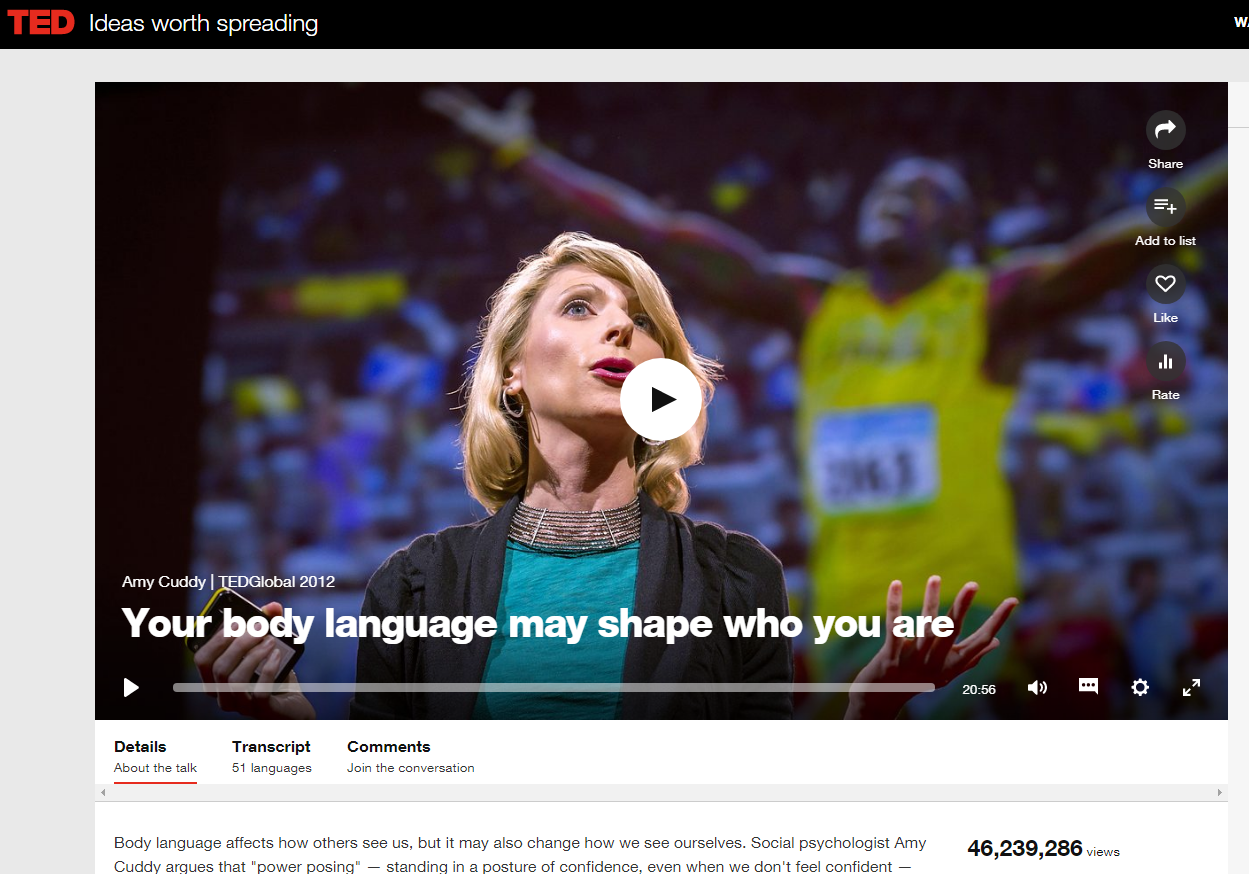
Amy Cuddy’s very famous ‘Power posing’ talk, which was the most watched video on the TED website for some time. In short, she states that if you give powerful/dominant looking poses, this will induce hormonal changes which will make you confident and relieve stress. However, subsequent studies showed that her ‘finding’ could not be replicated and she that did not analyse her data in the manner expected of a scientist. If a respectable scientist had found such a result, they would have tried to replicate their results; at least would have followed it up with studies which bring other lines of concrete evidence. What does she do? Write a book about it by bringing in anecdotal evidence at best and give a TED talk as if it’s all proven – as becoming famous (by any means necessary) is the ultimate aim for many people; and many academics are no different. Details can be found here. TED talk URL: https://www.ted.com/talks/amy_cuddy_your_body_language_shapes_who_you_are

PS: For readers interested in reading a bit more, I’d like to add a few more sentences. We should apply the below four criteria – as much as we can – to any health news that we read:

(i) Is it evidence based? (e.g. supported by a clinical trial, different experiments) – homeopathy is a bad example in this regard as they’re not supported by clinical trials, hence the name “alternative medicine” (not saying they’re all ineffective and further research is always required but most are very likely to be);

(ii) Does it make sense epidemiologically? (e.g. the example mentioned above i.e. the correlation observed between coffee consumption and lung cancer due to smoking);

(iii) Does it make sense biologically? (e.g. if gene “X” causes eye cancer but the gene is only expressed in the pancreatic cells, then we’ve most probably found the wrong gene)

(iv) Does it make sense statistically? (e.g. was the correct data quality control protocol and statistical method used? See figure below for a data quality problem and how it can cause a spurious correlation in a simple linear regression analysis)

graph-3

Wrong use of a statistical (linear regression) model. If we were to ignore the outlier data point at the top right of the plot, it becomes easy to see that there is no correlation between the two variables on the X and Y axes. However, since this outlier data point has been left in and a linear regression model has been used, the model identifies a positive correlation between the two variables – we would not have seen that this was a spurious correlation had we not visualised the data.

PPS: I’d recommend reading “Bad Science” by Ben Goldacre and/or “How to Read a Paper – The basics of evidence based medicine” by Trisha Greenhalgh – or if you’d like to read a much better article on this subject with a bit more technical jargon, have a look this highly influential paper by Prof. John Ioannidis: Why Most Published Research Findings Are False.

References:

Wakefield et al, 1998. Ileal-lymphoid-nodular hyperplasia, non-specific colitis, and pervasive developmental disorder in children. The Lancet. URL: http://www.thelancet.com/journals/lancet/article/PIIS0140-6736%2897%2911096-0/abstract

Editorial, 2011. Wakefield’s article linking MMR vaccine and autism was fraudulent. BMJ. URL: http://www.bmj.com/content/342/bmj.c7452

Read Full Post »

FfA_freedom_for_academia_report_2017_figure_1
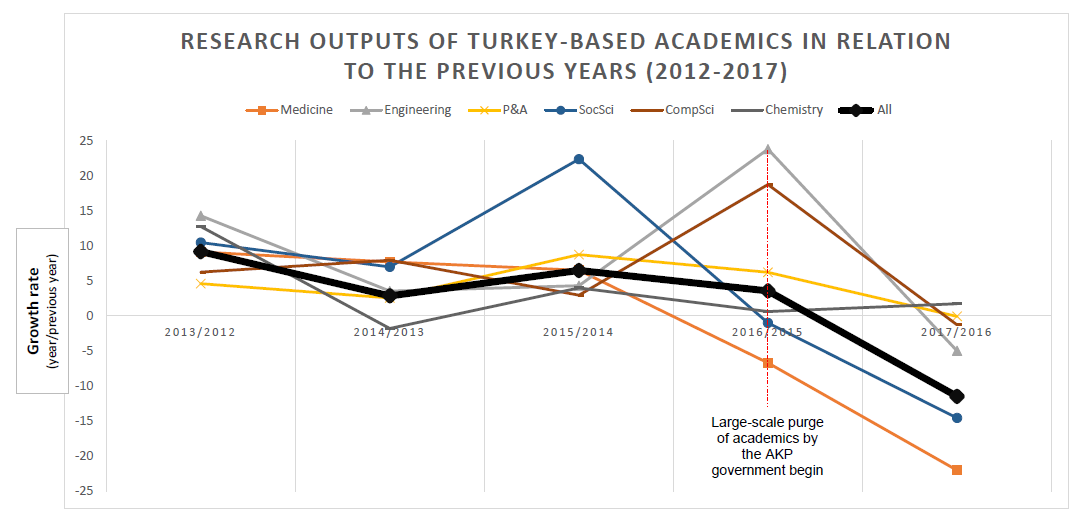
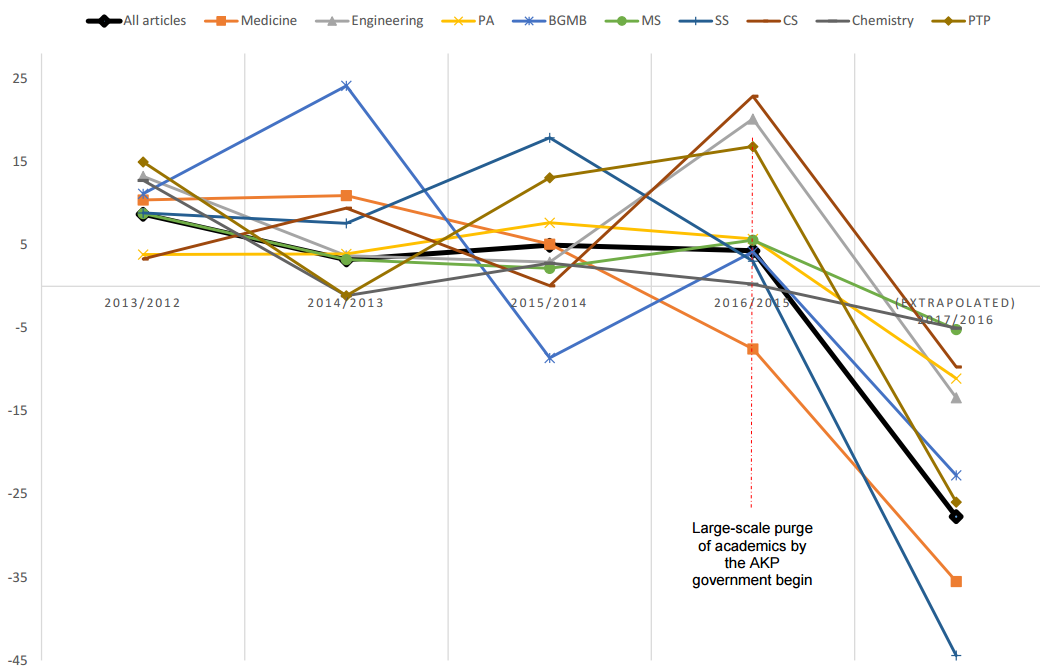
Research outputs of Turkey-based academics in relation to the previous year. This Freedom for Academia (FfA) study identified a significant reduction (11.5% on average) in the research output of Turkey-based academics in 2017 compared to 2016. When the average increase of 6.7% per year observed in the research output of Turkey-based academics between 2008 and 2015 is taken into account, this translates to a decrease of over 7,000 papers than the expected figure in 2017 in journals indexed by SCOPUS – a bibliographic database of peer-reviewed literature. Image Source: freedomforacademia.org

Freedom for Academia (website), a group consisting of (incl. myself) “British and Turkish academics/researchers who are willing to lend a helping hand to our colleagues and bring the struggles that they face to the attention of the public and academic circles”, has just published an ‘Annual report 2017’ on the effects of the AKP government’s large-scale purges on the research output of Turkey-based academics, titled:

7,000 papers gone missing: the short-term effects of the large-scale purges carried out by the AKP government on the research output of Turkey-based academics

(click here to access full article with photos, or ‘print friendly’ version from here)

I gave an interview to Santiago Moreno of Chemistry World regarding this report (Source: Turkish crackdown takes toll on academic output. Aug 2017. Chemistry World)

Firstly, as a Turkish citizen living in the UK – who loves his country of origin (also a proud British citizen), I am heartbroken, disappointed and terrified, all at the same time, with what has been going on in Turkey for some time now. Within the last 18 months or so, thousands of academics – as well as tens of thousands of other civil servants – have lost their jobs due to decrees issued by the Turkish government. None of them have been told how they are linked to the “15th July 2016 coup attempt” and what their crime (by international standards) was.

FfA_freedom_for_academia_report_2017_figure_2
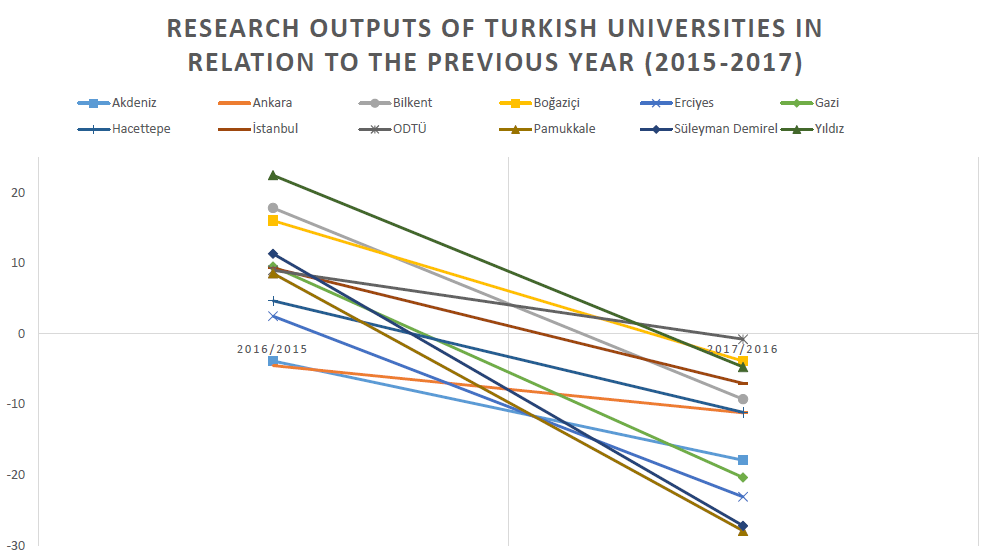
The percentage change in research outputs of 12 Turkish universities in relation to the previous year

These large-scale sackings have undoubtedly had an impact on the state of Turkey-based research and academia. The report tries to quantify the relative decreases in the research output of Turkey-based academics in different academic fields, and speculates on the causal factors. They find, on average, a ~12% decrease in the research output of Turkey-based academics in 2017. They also identified substantial decreases in the research outputs of some of Turkey’s top universities such as Bilkent (-9%), Hacettepe (-11%) and Gazi (-20%) in 2017 compared to 2016. Both Süleyman Demirel University and Pamukkale University, which lost nearly 200 academics each to governmental decrees issued by the AKP government, showed nearly a 30% decrease in 2017 compared to 2016.

I believe, a decrease in the number of publications is just one of the ways academia in Turkey has been affected overall. Turkey/Turkish academia wasn’t a place/group necessarily known for its work/scientific ethic and any ethics that was present before these large-scale dismissals has now definitely disappeared as the posts left by the dismissed academics is being filled by cronies (as I had stated in my Chemistry World interview in August 2017). These cronies are then going to hire individuals who are not necessarily good scientists but good bootlickers like themselves, and even if everything became relatively ‘normal’ (e.g. state of emergency lifted, academics in prison are acquitted) today, it would still take tens of years to change the academic circles that have been poisoned because of nepotism/cronyism, governmental suppression and political factionalism. In fact, academics in Turkey are so divided that not many cared when over eight thousand of their colleagues were dismissed as “members of a terrorist organisation”, as they did not belong to their ‘creed’ (e.g. to their ‘Kemalist’ or ‘Nationalist’ or ‘Islamist’ or ‘Pro-Kurdish’ groups). I try and follow many Turkey-based academics, and unfortunately, I barely see them talk about anything other than political issues – not on scientific and/or social advancements as academics/intellectuals should be doing. I tried to make my point in a short letter I wrote to Nature and in a (longer) blog post: Blame anyone but the government (Mar 2017).

Finally, I agree with the conclusions of the report that the sharp decrease of ~18%* in the research outputs of Turkey-based academics in relation to the expected 2017 figures is likely to be due to a combination of factors, especially psychological stresses endured by academics; and not just due to the absolute number of the purged academics (~6% of total), as outlined in the discussion section of the report.

*6.5% average increase every year between 2012 and 2016 + 11.5% decrease in 2017 figures compared to 2016 figures

References

1- FfA contributors. FfA Annual Report 2017. URL: http://www.freedomforacademia.org/ffa-annual-report-2017/. DOI: 10.13140/RG.2.2.16386.02244. Date accessed: 01/03/2018

2- Moreno, SS. Turkish crackdown takes toll on academic output. Chemistry World. 4 Aug 2017. URL: https://www.chemistryworld.com/news/turkish-crackdown-takes-toll-on-academic-output/3007804.article. Date accessed: 01/03/2018

3- Erzurumluoglu, A. Listen to accused Turkish scientists. Nature 543, 491 (2017). https://doi.org/10.1038/543491c

PS: To view a collection of my previous comments about the subject matter, please see my June 2017 post: Effects of the AKP government’s purges on the research output of Turkey-based academics (Jun 2017)

Read Full Post »

AKP_KHK_academic_ffa_report_1_june_2017
Research outputs of Turkey-based academics in relation to the previous year. Image from Freedom for Academia website

Freedom for Academia, a group consisting of “British and Turkish academics/researchers who are willing to lend a helping hand to our colleagues and bring these injustices to the attention of the public and academic circles”, has just published a report on the effects of the AKP government’s purges on the research output of Turkey-based academics, titled: The short-term effects of the large-scale purges carried out by the AKP government on the research output of Turkey-based academics  (click to see full article on a new page).

Firstly, as a Turkish citizen living in the UK (also a proud British citizen), I am heartbroken, disappointed and terrified, all at the same time, with what is going on in Turkey at the moment. Within the last 10 months or so, thousands of academics – as well as tens of thousands of other civil servants – have lost their jobs due to decrees issued by the Turkish government. None of them have been told how they are linked to the “15th July 2016 coup attempt” and what their crime (by international standards) was.

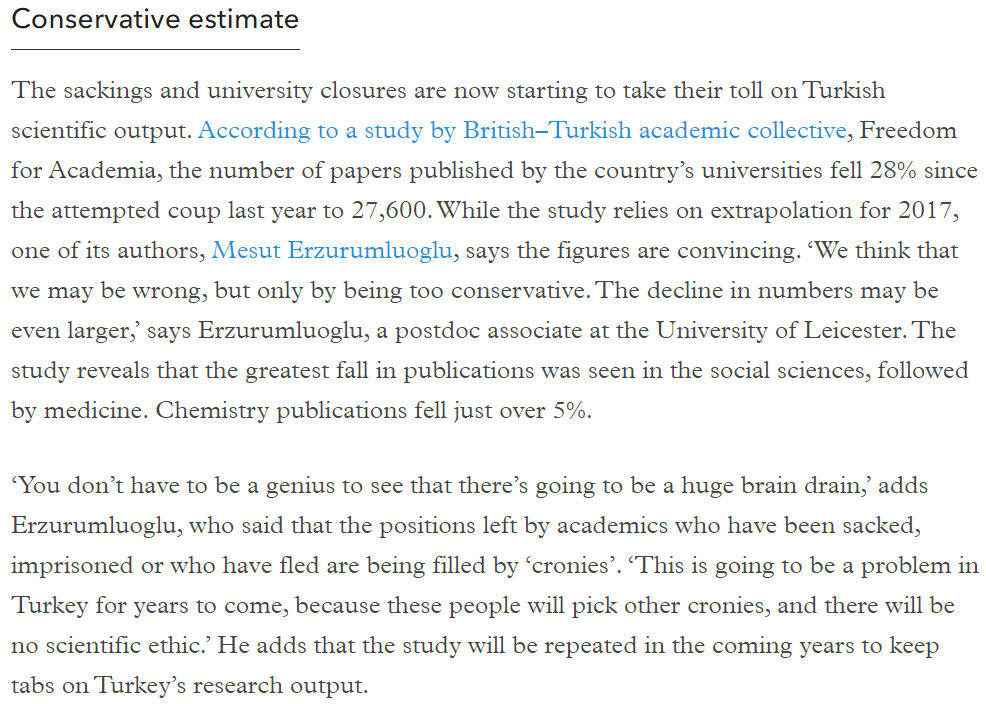
These large-scale sackings have undoubtedly had an impact on the state of Turkey-based research and academia. The report tries to quantify the relative decreases in the research output of Turkey-based academics in different academic fields, and speculates on the causal factors. They find, on average, a ~30% decrease in the research output of Turkey-based academics in 2017 – likely to be an underestimate because of the extrapolation method used (i.e. if there is a downward trajectory in the research outputs of Turkey-based academics – which there clearly is – then multiplying the cumulative figure on the 31st May 2017 by two is going to overestimate the 2017 figures).

Finally, I agree with the conclusions that the sharp decrease in the research outputs of Turkey-based academics in relation to the 2016 figures is likely to be due to a combination of factors, especially psychological stresses endured by academics; and not just due to the absolute number of the purged academics, as outlined in the discussion section of the report.

Addition to post (04/08/17): I gave an interview to Santiago Saez of Chemistry World and shared my views on the struggles academics in Turkey face: Turkish crackdown takes toll on academic output. You can also read my views on the mass-scale purges in my Blame anyone but the government post.

PS: Myself and Dr Firat Batmaz from Loughborough University were invited by Dr. Ismail Sezgin to give two interviews (one in English and one in Turkish) on this report and share our thoughts on the state of Turkey-based academia. You can view these below:

I gave an interview to Santiago Moreno of Chemistry World regarding this report (Source: Turkish crackdown takes toll on academic output. Aug 2017. Chemistry World)

Addition to blog (08/08/2019) – a crude analysis for 2018:

Read Full Post »

logical-fallacies

Millet olarak tartışırken çok sık işledigimiz mantık hataları (logical fallacies). Benim de başımdan sık geçen üç-beş tanesini bu yazımda kaleme alacağım

Asıl olaya geçmeden, kısa bir giriş yapalım: İngiltere’de büyüdüm ve buralarda her türden, her milletten insanla tanıştım. Nispeten, buradaki akademik camiada da kendime bir yer edindim ve birçok yabancı akademisyen/araştırmacı arkadaş edindim. Burada yaşadığım süreç içerisindeki gözlemlerimle de şunu çok rahatlıkla söyleyebilirim: bizim insanımız kadar ‘bir tartışma nasıl yapılmalı?’ hiç bilmeyen ve karşısındaki insanı aşağı çekme/itibarsızlaştırma konusunda maharetli ikinci bir millet bulmak zor – sadece, bize çok benzeyen diğer Orta Doğulularla yarışıyoruz bu konuda. Normal halkı geçtim; “mürekkep yalamış” insanımız da aynı problemden muzdarip.

Bu konuda birçok trajikomik anekdot paylaşabilecek akademisyen arkadaşım var. Benim de başıma çok sık gelen bir-iki örneği burada paylaşmak istiyorum: İngiliz eğitim sisteminde (nispeten, yaşıma göre) başarılı olmuş, 28 yaşında bir akademisyenim. Genç olmamın, benden daha başarılı, tecrübeli ve makamı yüksek olan Ingiliz meslektaşlarım ve/ya da hocalarım arasında hiç bir önemi yok. Söylediklerim/sorularım mantıklıysa (mantıksız konuşmamaya calışıyorum), benim fikrimi/sorumu bir Profesörün fikrinden/sorusundan ayrı tutmuyorlar. Lakin, Türkiye’de yetişip, buralara gelmiş meslektaşlarımın çoğu için aynısını söyleyemeyeceğim (istisnalar da yok degil Allah’tan. Onları tenzih ediyorum buradaki söylemlerimden). Maalesef çoğu kendilerini hala Türkiye’de sanıyorlar ve oralarda yaptıkları yanlışları ve kurdukları hiyerarşik yapıları buralarda da devam ettirmek istiyorlar – karşısındakini hiç bir şekilde ikna etme ihtiyacı duymadan.

Örneğin:

1- Bir konu üzerine tartışma oluyor ve konuyla ilgili bir-iki hatalarını ve/ya da Ingiltere de bu işlerin böyle olmadığını söylüyorsun:

Biz de biliyoruz bu işleri”, “ben 3 yıldır İngiltere’de yaşıyorum”, “Master/doktoramı Avrupa/Amerika’da yaptım”, “şurada konferansa gittim” gibi sözler sarfedip geçiştiriyorlar. Çünkü kendileri (her) konuyla ilgili herşeyi biliyorlar ve senin gibi “ukala gençler”den öğrenecekleri çok birşey yok.

2- Ortadaki bir sorunu (İngiltere’deki) konjönktüre en uygun ve etkin şekilde çözelim diye fikir beyan ediyoruz:

Her kafadan ses geliyor. Bize bu dönemde sorgulamadan iş yapacak adamlar lazım”ı tekrar tekrar duymaktan insana gına geliyor. Istiyorlarki karşılarındaki “yetenekli ama daha yolun başındaki” gençler “hadlerini bilsin” ve her dediklerini yapsın; hiçbir şekilde “şunu neden böyle yapıyoruz?” diye sorgulamasın.

3- Konuyla ilgili gördüğün bariz hataları, baktın sakince anlatınca anlamıyor/dinlemiyorlar, biraz sert bir dille söylüyorsun:

Samimiyetsiz bir şekilde “Tabi arkadaş genç; onu da anlamak/dinlemek lazım” deyip, kendi aralarında sana “meczup/kanser hücresi” muamelesi yapıyorlar. Daha anlayışsız, cahil ve/ya da görgüsüz olanları ise, söylediklerini kişiselleştirip, direk kişiliginize saldırıyorlar.

4- Önemli bir detaya parmak basıyorsun:

Detaylara takılmamak lazım“, “mükemmeliyetçilikten vazgeçmeli; o zaman hiçbir iş yapamayız” gibi cümleleri yağdırıyorlar üzerine.

5- Yapılmak istenen işe atılmadan “bir ön çalışma başlatmalıyız” diyorsun:

Ya Hu biran evvel başlamalıyız. Kervan yolda düzülür” cevabını alıyorsun. Bir-iki ay sonra herkesin hevesi kaçınca (“gaz bitince”), iş ortada kalıyor ve o kadar emek boşa gidiyor. Oysa başta biraz sabır gösterip, hazır bir şekilde yola çıkılsa daha uzun soluklu projelere imza atılabilir. Maalesef, “dostlar alışverişte görsün” mantığı da hakim birçogumuzda.

6- On tane şeyden bahsediyorsun; aralarından birisi bir tanesine takılıp, onun üzerinden senin tüm soylediklerini heba etmeye çalışıyor. Diğerleri de “dur arkadaş; söyledikleri mantıklıydı” demiyor. Çünkü hakikati bulmaktan çok, herkes kendi fikrini kabul ettirme derdinde. (not: Felsefe’deki mantık hataları/logical fallacies kavramlarına her akademisyen/araştırmacı/yazarın bakması lazım bence)


Anlatamıyorsun maalesef. Eğer İngiltere akademik/bilimsel arenada (futbol tabiriyle) ‘Premier League’se, Türkiye maalesef (çok genel olarak konuşursak) ‘3.ncü lig’. Ekstrem bir örnek olsa da, buralarda yetişmiş (son sınıf/ileri seviye) doktora öğrencisi bile bazen alanına Türkiye’deki bir Doçent/Profesör’den daha hakim olabiliyor. İngiltere’de çıkardıkları bir yayının, Türkiye’dekilerin bütün akademik hayatında çıkardığı yayınların toplamından daha fazla impact factor/etki faktörü olabiliyor. Yani bazılarının yaşları (nispeten) genç ve/ya da ünvanları düşük olsa da, Türkiye’den gelen çoğu akademisyenin (akademik çerçevede) onları küçümseyip, “ah bu hayta gençler/delikanlılar yok mu?”, **”kendisi buralarda basit bir Yardımcı Doçent/Assistant Professor” gibi tavırları takınmaları doğru değil. Türkiye’de yetişen gençlerin/insanların aksine kendilerine çok güvenen, araştırdığı konularda kimseye “eyvallah”ı olmayan, belli bir standardın altında (baştan-sağma, amatör) iş yapmaktan kaçınan, aklını duygularının önüne koymayı becermiş kişiliklere sahip oluyorlar.

Yine bizdekinin aksine, İngiltere kültüründe yetişmiş bir akademisyen/araştırmacı bilmediği, araştırmadığı konularda fikir beyan etmez. Bu yüzden bir konu hakkında konuşuyorsa, çoğu kez söylediklerinde bir mantık vardır. Fakat Türkiye’de genel olarak işler liyakatle değil de ünvanlarla ilerlediği için, buralara Türkiye (ya da Orta Dogu)’den gelen akademisyenlerde “ben Doçent/Profesörüm, bu da basit bir araştırma görevlisi” tavrını gözlemlemek çok zor değil. Bundan dolayı kendi fikirleri, eğer kafalarında şekillendirdikleri ‘hiyerarşi’de aşağılardaysan (hele bir de gençsen), senin fikrinden çok daha önemlidir – konunun ne olduğu ya da liyakatinin olup-olmadığı farketmez. Bu (hak edilmemiş*) kibirlerinden (ve bir çoğunun da ekstradan, aşağılık kompleksinden) dolayı ne kadar anlatsan da, bu yazdıklarımı anlamaları zor görünüyor.

Kısaca toparlamak gerekirse: Gençsen, çocuk muamelesi görüyorsun. Kadınsan, “bunun ne işi var bu kadar erkeğin arasında?” bakışları arasında boğuluyorsun. Ünvanın düşükse, adam yerine konmuyorsun (konuyla ilgili bilgi/tecrübenin çok önemi yok). Gurbetçiysen, “tabi kultürümüzden/ülkemizden uzak kalmış” tabirlerine maruz bırakılıyorsun. Bir gruba yeni katılmışsan, “sen giderken biz dönüyorduk oğlum”un muhattabı oluyorsun. Bir sorunun çözümü adına (sakin/aklı selim bir şekilde) fikir beyan ederken ağlayıp-sızlayıp, görmek istedikleri kadar duygusal davranmıyorsan, “sen bu işin ızdırabını çekmiyorsun!”, “sen bilmezsin; biz neler yaşadık!” cevaplarını alıyorsun; sorunu konuşma/çözme yerine, arabesk bir mağduriyet yarışması başlıyor – “’hangimiz daha çok sıkıntı çektik?’ anlatalım da görelim” yarışması… Maalesef, sen de çıldırdığınla kalıyorsun; ve çoğu kez “o kadar işimin arasında bir de sizinle mi ugraşacağım?” deyip aralarından ayrılmak zorunda kalıyorsun.

Artık “akıl yaşta degil, baştadır” gibi atasözlerimiz sadece lafta kalmamalı; her işi ehline bırakmayı (daha doğrusu bırakabilmeyi) öğrenmeliyiz. Ehil olan kim olursa olsun…


*”Hak edilmemiş” tabirini kullandım çünkü alanlarında çok büyük başarılara imza atmış ve/ya da dünyaca ünlü olsalar, yine yakışık almasa da, bir nispet anlayacağım kibirli davranmalarını.

**Bir defasında misafir akademisyen olarak ugradıgım bir Türk üniversitesinde dekan olan bir Hocaya, benim hakkımda telefondan “önemli biri mi?” diye soruldugunda “yok ya; asistan” dedigini duydum. (Soranda da, cevap verende de) Seviye bu işte – ki asistan da degildim. Ayrıca o yaşımda kendisinden daha fazla yayınım ve atfım vardı.


Istişare kuralları

PS: Ingiliz kültürüyle ilgili gözlemlerimi karaladığım Ingiliz kültürüne dair gözlemlerim adlı yazıma da göz atabilirsiniz.

PPS: Bazı şeyleri söylerken, onları iyi/halis bir niyetle, “kendini begenmiş/ukala”ca davranmadan söyledigini ispat etmen çok zor. Karşındakinin ne düşündügünü kontrol edemiyorsun. Ama insan böyle görünme pahasına dahi bilgi ve tecrübesinin hakkını vermeli. Ben de çapım yettigince her girdigim ortamda “kötü olma” pahasına dahi olsa yanlış ya da daha iyi yapılabilecegini düşündügüm konularda fikrimi beyan ediyorum. Fakat en çok kızdıgım/kendimi tutamadıgım zamanlar, ortalıkta liyakatli insanlar varken, “onun gözünün üzerinde kaşı var“, “bizden degil“, “o da kim? daha çömez o“, “biz ne yaptıgımızı biliyoruz, kendisine ihtiyaç yok“, “ama üslubu kötü” gibi sebeplerle işin ehline verilmedigini gördügüm zamanlar (hatta bence insanlara devamlı “üslubun kötü” diyen insanları hayatınızdan çıkartın – hiçbir şey kaybetmezsiniz). Maalesef ne zaman “bu konuda işe başlamadan önce, şurada şoyle bir hocamız/arkadaşımız var; ona da bir fikir danışalım” dedigimde bizim insanımız tarafından çok sallanmadıgımı gördüm. Oysa o insanlar, Ingiltere gibi dünyada en üste oynayan ve inanılmaz bir rekabet ortamı olan bir ülkede bir akademisyen/araştırmacı olarak çok başarılı olmuşlar. Başarılı olmalarını saglayan en önemli faktörler de, tipik Türk insanının aksine, (i) bir işe başlamadan önce ön-çalışma/araştırmaları yapmaları ve gerekli rapor/makaleleri okumaları, (ii) kendilerine en iyi şekilde yardımcı olabilecek insanları tespit etmeleri, ve (iii) kendilerini devamlı geliştirme ve yenileme adına sistematik bir yaklaşım/metot geliştirmeleri. Bu sayede hem başarılı oluyorlar, hem de uzun vadeli projeler üretebiliyorlar. Yani kendilerinden ögrenecegimiz çok şey var.

Ozellikle bizim insanımızın “ben yapayım” hastalıgı, birçok işin yarım-yamalak ve/ya da kısa vadeli bir vizyonla yapılmasına sebep oluyor. Sadece işler sarpa sardıgında çıkıp sana geliyorlar; sen de, içinden kızsan da, yine insaniyet namına kendilerine yardımcı oluyorsun. Aslında onlara da bu sayede kötülük yapıyoruz çünkü sen işi düzeltince, yaptıkları hatalardan ders almıyorlar ve bir süre sonra yine eski hallerine geri dönüyorlar. Yine ne arayan var, ne de bir fikrini soran.

Read Full Post »