Feeds:
Posts
Comments

Posts Tagged ‘scholarship’

evolution_of_intellectual_freedom_cham_phdcomics

Source URL: PhD Comics

Figuratively speaking, what is the ‘worth’ of a certain academic? Between two academics, which one has had more positive academic impact than the other? How do you rank academics? And award grants, promotion, tenure etc. to the best* ones?

I’m not going to answer these questions but would like to chip in with some food for thought and suggestions.

Well; one may say: “It’s easy! Just compare their h-index and total no of citations!

This may be an effective way to go about answering the question. Surely someone with an h-index of 30 has had more positive academic impact than someone with let’s say an h-index of 15 – and is the better candidate?

Maybe – that is if all things are equal regarding the way citations and the h-index works i.e. if both academics:

  • are in similar fields – as papers in certain fields receive more citations overall than papers in other fields,
  • are in similar stages in their careers – as comparing an early-career postdoc with an established “Prof.” wouldn’t be fair,
  • have similar numbers of first/equal-first or last author papers – as an academic with many middle-authorships can have excessively inflated h-indexes,
  • have similar number of co-authors – as it may be easier to be listed as a co-author in some fields than others and/or mean that more people will be presenting and citing the paper as their own, and
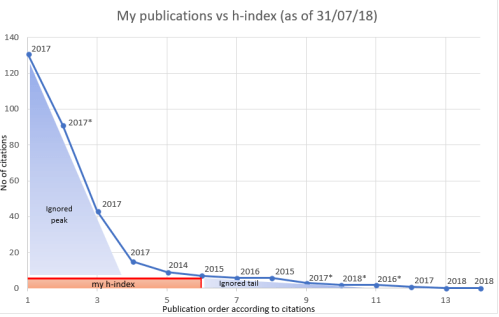
  • have a similar distribution of citations across the papers – as the h-index ignores highly influential papers and the total citations can be highly influenced by even just one of these (see figure below).

I may have missed other factors, but I think these are the main ones (please add a comment below).
mesut_erzurumluoglu_h-index_academic_2018

Calculating my h-index: Although problematic (discussed here), the h-index has become the standard metric when measuring the academic output of an academic. It is calculated by sorting the publications of an academic from most to least cited, then checking whether he/she has h papers with h citations e.g. if an academic has 10 papers with ≥10 citations but not 11 papers with ≥11 citations then their h-index will be 10. It was proposed as a way to summarise the number of publications that an academic has and their academic impact (via citations) with a single number. The above citation counts were obtained from my Google Scholar page

As of 31st July 2018, I have 14 published papers – including 5 as first/equal-first author – under my belt. I have a total citation count of 316 and an h-index of 6 (225 and 5 respectively, when excluding publications marked with an asterisk in the above figure). It is fair to say that these numbers are above average for a 29-year-old postdoc. But even I’m not content with my h-index – and many established academics are definitely right not to be. I’ll try and explain why: the figure above shows the citation distribution of my 14 publications sorted by the ‘number of times cited’ from the left (highest) to right (lowest). One can easily see that the h-index (red box) captures only a small portion of the general picture (effectively, 6 x 6 i.e. 36 citations) and ignores the peak (>6 on the y-axis) and tail (>6 on the x-axis) of the publication-citation distribution. I have also included the publication year of each paper and added an asterisk (*) against the publications where I haven’t provided much input e.g. I have done almost nothing for the Warren et al (2017) paper but it constitutes almost a third of my total citations (90/316)**. The ‘ignored peak’ contains three highly cited papers to which I have made significant contributions to and the ‘ignored tail’ contains research papers that (i) I am very proud of (e.g. Erzurumluoglu et al, 2015) or (ii) are just published – thus didn’t have the time to accumulate citations. What is entirely missing from this figure are my (i) non-peer-reviewed publications (e.g. reports, articles in general science magazines), (ii) correspondence/letters to editor (e.g. my reply to a Nature News article), (iii) blog posts where I review papers or explain concepts (e.g. journal clubs), (iv) shared code/analysis pipelines, (v) my PhD thesis with potentially important unpublished results, (vi) other things in my CV (e.g. peer-review reports, some blog posts) – which are all academia-related things I am very proud of. I have seen other people’s contributions in relation to these (e.g. Prof. Graham Coop’s blog) and thought that they were more useful than even some published papers in my field. These contributions should be incorporated into ‘academic output’ measures somehow.

It is also clear that “just compare their h-index and total no of citations!” isn’t going to be fair on academics that (i) do a lot of high-quality supervision at different levels (PhD, postdoc, masters, undergrad project – which all require different skill sets and arrangements), (ii) spend extra time to make their lectures inspiring and as educative as possible to undergrad and Masters students, (iii) present at a lot of conferences, (iv) do ‘admin work’ which benefits early-career researchers (e.g. workshops, discussion sessions), (v) do a lot of blogging to explain concepts, review papers, and offer personal views on field generally, (vi) have a lot of social media presence (e.g. to give examples from my field i.e. Genetic Epidemiology, academics such as Eric Topol, Daniel MacArthur, Sek Kathiresan take time out from their busy schedules to discuss, present and debate latest papers in their fields – which I find intellectually stimulating), (vii) give a lot of interviews (TV, online media, print media) to correct misconceptions, (viii) take part in public engagement events (incl. public talks), (ix) organise (inter-disciplinary) workshops, (x) inspire youngsters to become academics working for the benefit of humankind, (xi) publish reliable reports for the public and/or corporations to use, (x) provide pro bono consultation, (xi) take part in expert panels and try very hard to make the right decisions, (xii) engage in pro bono work, (xiii) do their best to change bad habits in the academic circles (e.g. by sharing code, advocating open access publications, standing up to unfair/bad decisions whether it affects them or not), (xiv) extensively peer-review papers, (xv) help everyone who asks for help and/or reply to emails… The list could go on but I think I’ll stop there…

I acknowledge that some of the above may indirectly help increase the h-index and total citations of an individual but I don’t think any of the above are valued as much as they should be per se by universities – and something needs to change. Academics should not be treated like ‘paper machines’ until the REF*** submission period, and then ‘cash cows’ that continually bring grant money until the next REF submission cycle starts. As a result, many academics have made ‘getting their names into as many papers as possible’ their main aim – it is especially easier for senior academics, many with a tonne of middle-authorships for which they have done virtually nothing****. This is not how science and scientists should work and universities are ultimately disrespecting the tax payers’ and donors’ money. Some of the above-mentioned factors are easier to quantify than others but thought should go into acknowledging work other than (i) published papers, (ii) grant money brought in, and maybe (iii) appearing on national TV channels.

Unless an academic publishes a ‘hot paper’ as first or corresponding author – which very few have the chance and/or luck to do – and he/she becomes very famous in their field, their rank is usually dictated by the h-index and/or total citations. In fact, many scientists who have very high h-indexes (e.g. because of many middle-author papers) put this figure at the top of their publication list to prove that they’re top scientists – and unfortunately, they contribute to the problem.

People have proposed that contributions of each author are explicitly stated on each paper but this is going to present a lot of work when analysing the academic output of tens of applicants – especially when the number of publications an individual has increases. Additionally, in papers with tens or even hundreds of authors, general statements such as “this author contributed to data analysis” are going to be assigned to many authors without explicitly stating what they did to be included as a co-author – thus the utility of this proposition could also be less than expected in reality.

It’s not going to solve all the problems, but I humbly propose that a figure such as the one above be provided by Google Scholar and/or similar bibliometric databases (e.g. SCOPUS, CrossRef, Microsoft Academic, Loop) for all academics, where the papers for which the respective academic is not the first author are marked with an asterisk. The asterisks could then be manually removed by the respective academic on publications where he/she has made significant contributions (i.e. equal-first, corresponding author, equal-last author or other prominent role) but wasn’t the first author. Metrics such as the h-index and total citations could then become better measures by giving funders/decision makers the chance to filter accordingly.

Thanks for reading. Please leave your comments below if you do not agree with anything or would like to make a suggestion.
academic_worth_researcher_university_mesut_erzurumluoglu

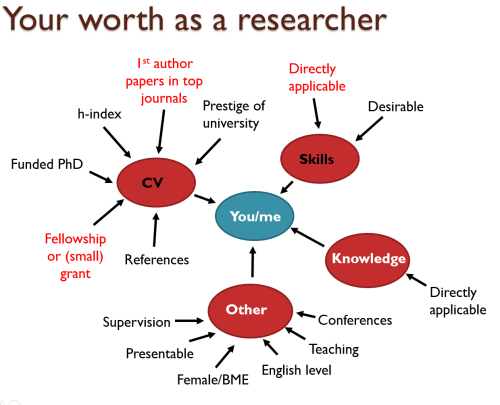
The heuristic that I think people use when calculating the worth of an early career researcher (but generally applies to all levels): ‘CV’ and ‘Skills’ are the two main contributors, with the factors highlighted in red carrying enormous weight in determining whether someone should get the job/fellowship or not. Virtually no one cares about anything that is outside what is written here – as mentioned in the post. Directly applicable: Some technical skill that the funder/Professor thinks is essential for the job; Prestige of university: where you did your PhD and/or undergrad; Funded PhD: whether your PhD was fully funded or not; Female/BME: being female and/or of BME background – this can be an advantage or a disadvantage depending on the regulations/characteristics of the university/panel, as underrepresented groups can be subjected to both positive and negative discrimination. NB: this is a simplified version and there are many factors that affect outcomes such as “who you know” and “being at the right place at the right time“.


Added on 30/10/18: I just came across ‘No, it’s not The Incentives—it’s you‘ by Tal Yarkoni about the common malpractices in academic circles, and I think it’s well worth a read.


*Making sure there’s a gender balance and that academics from BME backgrounds are not excluded from the process – as they’ve usually had to overcome more obstacles to reach the same heights.

**I have been honest about this in my applications and put this publication under “Other Publications” in my CV.

***REF stands for the ‘Research Excellence Framework’, and is the UK’s system for assessing the quality of research in higher education institutions. The last REF cycle finished in 2014 and the next one will finish in 2021 (every 7 years). Universities start planning for this 3-4 years before the submission dates and the ones ranked high in the list will receive tens of millions of pounds from the government. For example, University of Oxford (1st) received ~£150m and University of Bristol (8th) received ~£80m.

****Sometimes it’s not their fault; people add senior authors on their papers to increase their chances of getting them accepted. It’s then human nature that they’re not going to decline authorship. It sounds nice when one’s introduced in a conference etc. as having “published >100 papers with >10,000 citations” – when in reality they’ve not made significant (if any!) contributions to most of them.


PS: I also propose that acknowledgements at the bottom of papers and PhD theses be screened in some way. I’ve had colleagues who’ve helped me out a lot when learning some concepts who then moved on and did not have the chance to be a co-author on my papers. I have acknowledged them in my PhD thesis and would love to see my comments be helpful to these colleagues in some way when they apply for postdoc jobs or fellowships. Some of them did not publish many papers and acknowledgements like these could show that they not only have the ability to be of help (e.g. statistical, computational expertise), but are also easy to work with and want to help their peers.

Read Full Post »

UK-regional-map-562x790
Birleşik Krallık (United Kingdom, UK) Ingiltere (England), Galler (Wales), Iskoçya (Scotland) ve Kuzey Irlanda (Northern Ireland)’dan oluşur. Büyük Britanya (Great Britain) ise Ingiltere, Iskoçya ve Galler’den oluşur. (Not: Spesifik sorusu olanlar bana Twitter ya da emailden ulaşabilirler)

Britanya/Ingiltere’de uzun yıllar yaşamış, bu ülkenin sisteminde yetişmiş ve nispeten başarılı olmuş bir birey olarak bana bu ülkenin egitim sistemi ve yaşam koşullarıyla ilgili çok soru soruluyor. Buralara gelen birçok arkadaşımız da psikolojik ve maddi sorunlarla boguşabiliyor, ya da vize, ingilizce ogrenememe, ingiliz kültürüne alışamama (Ingiliz kültürüne dair gözlemlerim adlı yazıma bakabilirsiniz bu konuda), doktoraları ile ilgili sorunlar yaşayabiliyorlar.

İlginizi çekebilecek bir bilgisel – İngiltere’de “Home fee” okumak için verdiğim mücadeleyle ilgili…

Bir nebze yardımcı olur ümidiyle bana sıkça sorulan soruları burada (oldugu gibi, fazla düzenlemeden) paylaşacagım. Sorunuz burada cevaplanmamışsa, lütfen bana buradan (en altta ‘comment’ atma bolümü var) ya da m.erz@hotmail.com’dan ulaşın; yardımcı olmaya calışayım:

İngiltere’de Doktora/PhD öğrencisiyim. Yakında birinci yıl APG (Advanced Postgraduate Assessment*)’m var. Ne önerirsiniz?

Öncelikle bir Doktora/PhD öğrencisi olduğunuzu unutmayın. PhD, akademik olarak alabileceğiniz en yüksek ünvandır – yani çok önemli bir ünvan. Ingilizler doktorayı bitirdiğinizde, size çalıştığınız spesifik konu/alanda ‘bir uzman’ gözüyle bakacaklar – bu yüzden size şimdiden “uzman olacak potansiyel var mı?” gözüyle bakarlar. Bunun şuurunda olun ve kesinlikle pısırık davranmayın.

APG’ye hazırlanırken (bence) yapmanız gerekenleri kendi tecrübe ve gözlemlerime göre sıralarsam:

1- Herşeyden önce literatüre hakim olun. Spesifik konunuzla ilgili her makale ve kitaptan haberdar olun. “Çok fazla makale var” diyorsanız, spesifik konunuz nedir tam bilmiyorsunuz demektir. (Yıl boyu tembellik yaptıysanız, en son çıkan 1-2 review ya da önemli makaleyi okuyup, tamamen anlamaya çalışın.)

Buna rağmen yine de gözünüzden bir makale kaçmışsa, ve APG’nizde examineriniz “şu makaleden haberin var mı?” diye sorarsa, “yok görmedim” yerine “evet haberim var; print edip masamın üzerine koymuştum. Burdan çıkışta ilk okuyacağım makale olacak” gibi politik cevaplarla geçiştirmeye çalışın.

Bir de examinerlarınızın CV’lerine ya da Google Scholar sayfalarına bakın ki ne gibi makaleler çıkarmışlar haberdar olun.

2- Ingilizlerin çok sevdiğim ve gerçekten de birini ‘judge’ yaparken karakterlerini yansıtan bir deyimi var: “First impression is last impression”  (ilk izlenim, son izlenimdir). Ilk izlenim çok önemli; güler yüzlü olun ve rahat görünmeye çalışın. Heyecanlı olabilirsiniz fakat bunu azaltmanın yolları var. Sunuma başlamadan önce sesinizi odada tanıdık birisiyle konuşarak kalibre edin (hatta bir arkadaşınızdan rica edin, biraz erkenden gelsin sırf bu iş için). O kişiyle konuştukça sesiniz açılacaktır ve nefesinizi daha iyi ayarlamanıza yardımcı olacaktır.

Ayrıca sunumunuza slaytlara değil de, insanların gözünün içine bakarak başlayın. Bu süreci kolaylaştırmak için de aklınızda unutmayacağınız 3-5 basit cümle tutun. Örnek: “Hi everyone. I’m Mesut; and I’m a PhD student working under Prof. Brian studying whether dopamine overexpression causes schizophrenia-like behaviour in mice. In the next 15 minutes or so, I’ll try and present how I’m going to do this. I also have some preliminary results that I’d like to share with you and get your comments on. If at any point you have a question, please do ask“. Sizin rahat (confident) olduğunuzu görünce, examinerlarınız da rahatlayacaktır; ve sonradan ufak-tefek hatalar dahi yapsanız görmezlikten geleceklerdir.

3- Introduction’ı kısa tutun, çünkü examinerlar başkalarının ne yaptığını değil, sizin ne yaptığınızı dinlemek için orada. Fakat alanınıza hakim olduğunuzu göstermeniz önemli (çalıştığınız konu neden önemli? benzer çalışmalar oldu mu? Varsa, senin çalışmanı ayıran nedir?). Güzel bir review/makaleyi örnek alın ve onu 2-3 slaytta anlatın. Sonraki slayt da ise arkadaşlarımızın belki de en az yaptığı şeyi yapın: eski literatürü biraz eleştirin; eksikliklerini, hatalarını bulun ve “ben bu eksiklerden haberdarım” mesajı verin. Bir bilim insanı gibi davranın: eski araştırmalara/buluşlara saygılı ama aynı zamanda eleştirel (critical) yaklaşabilen bir insan gibi…

En başta kendinizi tanıtırken hocanızın da ismini zikrettiniz. Artık bir daha ismini dahi anmayın – ta ki en son slaytınız olan “Acknowledgements” slaytına kadar. Ikide bir hocanızın ismini anmanız ve/ya da teşekkür etmeniz sizi pısırık ve hocasının arkasına saklanan bir öğrenci olarak gösterebilir. Türk mentalitesiyle ikide bir hocanızı övmenizin (“onun sayesinde oldu bunlar“, “hocama çok teşekkür ediyorum“) size hiçbir faydası dokunmayacaktır.

4- Introduction, **Aims & Objectives, Methods, Results ve Discussion slaytlarından sonra birer slaytı da (i) “bu bir senede neler öğrendim?” ve (ii) “bu sene neler yaptım?”a ayırın. Birincisi için, öğrendiginiz “skill”er (programming, wet-lab skills, istatistik vs. gibi), ikincisi icin de (a) bitirdiğiniz kurslar/workshoplar, (b) katıldığınız konferanslar/sunduğunuz posterler, (c) hazırda olan makaleleriniz (submitted/published olmasına gerek yok), (d) katılmayı planladığınız workshop ve conferencelardan bahsedin. Kazandığınız ‘skill’erin doktoranızda size nasıl faydalı olacağından bahsedin.

5- Gelebilecek soruları düşünün. Spesifik soruların dışında çok sık gelen genel sorular: (i) “what do you hope to achieve at the end of your PhD?” – iki cevabınız olsun; biri idealist, diğeri realist; (ii) “how does this help the man on the street?”; (iii) “what are the implications of studying this question?” – mesela önemli bir proteini calışıyorsanız, bunun bir hastalık icin ilaç üretilmesine yol açabileceğini söyleyebilirsiniz.

Çok iyi olan öğrenciler ise gelmesini istedikleri soruları dahi kendileri ayarlayabiliyorlar. Sunumlarında mesela ilgi çekebilecek bir konudan bahsedin ve “isterseniz soru-cevap kısmında daha detaylı anlatabilirim” deyin. Emin olun soracaklardır. Bu sayede sorulacaklardan bir soru azaltmış olursunuz.

Soru-cevap kısmında gerçekten takıldıysanız, “I have no idea” vs. gibi cevaplar vermeyin ya da sessiz-sessiz (kızarıp) durmayın. Gerekirse soruyu onlara geri çevirin: “Of course as a PhD student, I’m still learning; and would value the thoughts of experts like you. You’ve published many papers on schizophrenia before. What do you think?” demeniz daha akıllıca bir opsiyon. Bu da examinerlarınızın CV’lerine önceden bakmış olmanın yararları…

Umarım işinize yarar. Kolaylıklar dilerim.

*First year review ve Probation review olarak da biliniyor.

**’Aim’ ve ‘Objective’ arasındaki farkı ögrenmek/bilmek önemli. Örnegin: Aim “Londra’dan Istanbul’a varmak”sa, “Objective”leriniz (i) Skyscanner.com websitesine girip uygun bir fiyata Londra-Istanbul uçak bileti satın almak, (ii) Evinden Londra’daki havaalanına uygun bir saate otobüs/taksi/tren ayarlamak, (iii) Yola cıkmadan Türk Pasaport’unu yanına almak, (iv) Havaalanına 2 saat erken gelmek ve varınca “check-in” yapmaktır. “Aims and Objectives” slaytı sunumuzun belki de en önemli kısmı.

Yazın İngiltere’de dil okuluna gitmeyi düşünüyorum. Hangi ili seçmemi önerirsiniz? Brighton maddi açıdan uygun gibi duruyor… Ayrıca önerebileceğiniz bir dil okulu var mı? Bir yakınınızın gittiği ve/ya iyi bildiğiniz… Aile yanında kalmak en uygun seçenek gibi duruyor fakat sizin çevrenizde sıkıntı yaşıyanlar oldu mu? Size göre bir insanın aylık yeme-içme masrafı ne kadar olur?

Ben şu anda Leicester’da yaşadıgım icin daha çok bu civardaki dil kurslarından haberdarım. Maddi durumunuzu bilmiyorum ama üniversitelerin ‘intensive’ dil kursları, biraz pahalı olsalar da, çok kaliteli oluyor. Bu intensive kurslar pahalı gelirse, üniversitelerin normal “summer class”ları dahi baska yerlere nazaran daha iyi olabiliyor. Leicester üniversitesinin (konaklama dahil) ‘International Summer School‘ kursuyla kıyaslayıp (fiyat, ders programı vs.), ona göre kararınızı verin bence.

Aile yanında kalacak olmanız ingilizcenizi daha iyi geliştireceksiniz anlamına gelmiyor. Yanında kalacagınız aile işten dolayı yogunsa ve/ya konuşkan olmazsa, yüzlerini dahi göremeyebilirsiniz.

Yemek vs. Orta ve Kuzey Ingiltere’de nispeten ucuz ve zorlarsanız aylık ortalama £150-200’la geçinebilirsiniz. Ama Londra vs. de bunun iki katı rahat gidebilir. Ayrıca belki her gün bir-iki saatiniz metroda/yollarda geçebilir.

Brighton’ı çok bilmiyorum ama turistik bir yer oldugu için yazın konaklama fiyatları tavan yapabilir. Ayrıca Brighton’ın kalitesiz dil kurslarıyla ilgili kötü bir ünü var.

Tabi yazdıklarım çok genel. Aynı şehir içinde dahi fiyatlar ve kalite çok degişebiliyor. Begendiginiz birkaç yere email atıp aklınızda kalan soruları sorabilir, ona göre son kararınızı verebilirsiniz. En geç Nisan/Mayıs’a kadar kursunuzu ayarlamanızda fayda var çünkü yaza dogru hemen hemen her kurs ve aile yanı doluyor. Son dakikaya kalırsa size maddi açıdan çok pahalıya mal olabilir.

Ben İngiltere’de Yüksek Lisans (Master) yapmak istiyorum ama herhangi bir ücret ödemem gerekiyor mu?

Ingiltere’de yüksek lisans/Master’lar ücretli; ve hangi ülkenin vatandaşı oldugunuzun fiyatın belirlenmesinde büyük etkisi var. Avrupa birligi ve Britanya vatandaşlarına daha düşük bir fiyat uygulaması var (yıllık ~£9000 gibi). Yabancılara ise ~£12000 civarında (yıllık). Bu fiyatlar bolümden bolüme ve üniversiteden üniversiteye degişiyor (tıp ve benzeri alanlar çok daha yuksek). Universitenin ‘postgraduate prospectus’larını isteyip bakmak ya da admissions office’e email atıp sormak lazım. QS Top Universities sitesinde bazı genel bilgiler mevcut.

Iyi olan Britanya/ingiltere’de cogu Master programı bir sene (ama iki sene olanlar da var). Findamasters.com ve jobs.ac.uk gibi sitelerde reklamlar oluyor; ama her açılan Master programı da bu sitelerde yayınlanmıyor – bu yuzden direk universitenin sitesine bakmak gerekebilir kendi alanınıza gore.

Ayrıca kira, yemek vs. giderleri yıllık £6-7 bini bulabilir. Londra gibi pahalı şehirleri duşunuyorsanız, bu rakamın üzerine en az bir £3-4 bin daha ekleyin.

Maddi durumunuz yeterliyse, geriye kalan tek sey IELTS skorunuz olacaktır. Cogu üniversite 6-6.5 istiyor.

İngiltere’de üniversite okumak için Türkiye’de uluslararası bakalorya (International Baccalaureate) kapsamında olan bir lisede eğitim görmem zorunlu mu? Yoksa IELTS ve GCE yeterli olacak mıdır? Su an lise öğrencisiyim, İngiltere’de İngiliz Dili ve Edebiyatı bölümünü okumayı planlıyorum. 

Universitelerin en çok ilgilenecekleri kualifikasyonunuz ingilizce yeterliliginiz olacaktır. Normalde IELTS’ten 6 ya da fazlasını alırsanız (ve maddi durumunuz yerindeyse), size çogu bolümün kapısı açılır. Fakat Ingiliz dili ve edebiyatı (ve hukuk) için büyük ihtimal daha yüksek skorlar gerekecektir. Eger IELTS dereceniz nispeten yüksekse (7 gibi), sizi büyük ihtimal direk (lisans) 1’nci sınıfa alırlar. Ama orta seviyeyse (ama yine de en az 6 gerekiyordur ingiliz dili ve edebiyatı icin), o zaman size (bir sene) ‘Foundation’ okumayı şart koşabilirler. Bence başvuruları yapın ve gelecek cevaplara gore pozisyonunuzu belirleyin. Kabul gelirse ne güzel; gelmezse hocalarla emailleşir derdinizi anlatırsınız. Belki bir-iki aylık ‘pre-sessional’ kurstan sonra kabul ederler.

Daha detaylı bilgi isterseniz, üniversitelerin çogunun sitesinde “Turkey” bölümü var (Turkiye’den gelen ögrenciler için). Ornek: Leicester Universitesi le.ac.uk/student-life/international-students/countries-list/europe/turkey ve le.ac.uk/courses/major-in-english-literature-ba

Britanya/Ingiltere’de üniversite okumak ucuz birşey degil. Yabancı ogrenciler (Avrupa birligi dısındakiler) icin fiyatlar senelik £10-15bin arası (tıp ve benzeri alanlar daha da pahalı). Üç yıllık bir kurs için (kira, yemek vs. ile) £60-70binlik masraf demek bu.

Yurtdışına ilk çıkış ve yerleşme bir problem. Biz yaklaşık 10 arkadaş İngiltere’ye gelecegiz. Öncelikli problemimiz ailece yaşayabilecegimiz bir ev bulabilme.

Hoşgeliyorsunuz. Maalesef bir çok arkadaşımız (makul fiyatlarda) kalacak yer bulma sorunu yaşıyor. Biz de bu konuda çok yardımcı olamıyoruz maalesef. Birçok ogrenci grubunun Facebook sayfası var (ornek: University of Leicester Turkish Society), orada duyuru yapabilirsiniz. Bazen buradaki arkadaşlar yazları (ya da kursları bitince) evlerini boşaltıyorlar ve yerlerine kalacak birilerini arıyorlar.

Gruplardan ses çıkmazsa, www.rightmove.co.uk/, www.zoopla.co.uk/ ve www.gumtree.com gibi sitelerden sizlere uygun ‘rent/kira’lık evler aramanız lazım. Bu sitelerdeki evler istediginiz gibi degilse, ajenta/estate agentları da aramanız gerekebilir. Onlara istediginiz tarzdaki evi anlatırsanız (ornek: üniversiteye yakın, 2 odalı, aylık £600), ellerine geçtikçe sizi ararlar (yabancılardan 6 aylık kirayı eve girer girmez isteyebiliyorlar). Acil çözümler için de otel odası tutulabilir, fakat oteller son saniye tutulursa çok pahalı oluyor. Universitelerin de geçici ‘accomodation’ları var fakat onlar da pahalı olabilir. Son çare geçici olarak Booking.com ve Airbnb.com gibi sitelerden ev/otel odası kiralamak.

Bu gibi ülkelerde işin püf noktası her işi çok önceden ayarlamaktır. Lütfen son ana bırakmayın, çünkü ev tutarken kagıt/kürek işleri dahi 1-2 hafta sürebiliyor (bir ay sürenler dahi var). Fazla yardımcı olamadıgım için özür diliyorum.

Anladığım kadarıyla İngiltere’de doktoraya burslu kabul almak biraz zor; eğer vaktiniz varsa, doktora (PhD) başvurum konusunda bana tavsiyede bulunabilir misiniz? Yani “burs alman için şunu yapsan işine yarar“, “dil skorun olmasa da olabiliyor” ya da “deadline’lar genelde şöyle“; “buraları takip etsen çok iyi olur” gibi

Dediğiniz gibi Britanya/İngiltere’de burslu doktora bulmak oldukça zor. Öncelikle ingilizceniniz oldukça iyi bir düzeyde olması lazım (sadece yazım değil, konuşmada da). Bir de açılan pozisyonda/projede ‘background’ınızın iyi olması gerek; sizi rakiplerinizden ayıran özellikleriniz ve somut başarılarınız olmalı.Örneğin kıytırıktan bir makale dahi yazmış olsanız, sizin için büyük avantaj çünkü çogu doktora-öncesi öğrencinin makalesi olmaz.

Şansınızı arttırmak için güzel bir CV ve bir sayfalık ‘Supporting statement’ yazıp, uygun gördügünüz her hocayı ‘spam’leyin (ve kendinizi ‘reject’lere alıştırın) derim. Kısmetin nereden çıkacağı belli olmaz; her yolu denemek lazım. Supporting statement’ta “ben şöyle uçarım; böyle kaçarım“ı yemiyor İngilizler. Bu yüzden somut şeylerle desteklemeniz lazım söylediklerinizi: örnegin “writing skillerim çok iyi” yerine, “şu sayıda makale yazdım” gibi; “şu ‘analysis skilleri’ ögrendim” yerine “şu isimde bir workshop’a katıldım” gibi; “presentation skill’lerim çok iyi” yerine; “şu-şu konferanslarda sunum yaptım” gibi. İngiliz kültürüne dair gözlemlerim adlı yazımın ilgili kısmına bakabilirsiniz bu konuda.

Son olarak, eğer Avrupa Birliği ya da Britanya vatandaşı değilseniz, size verecekleri bursun büyük bir kısmı ‘tuition fee’inize gidecektir (PhD’de ‘Home’ fee: ~£4000; ‘Overseas’ fee: ~£12000). Bunu da düşünmelisiniz.

Doktora burslarını findaphd.com ve jobs.ac.uk gibi sitelerden takip edebilirsiniz. Ben de buralardan bulmuştum doktora bursumu. Ayrıca şu an İngiltere’de bir üniversitede öğrenciyseniz, ‘departmental email’lere de bakmayı ihmal etmeyin. Ben (Leicester Üniversitesi’ndeki) ilk Post-doktoramı, Bristol Üniversitesi’nde doktora yaparken departman-arası gönderilmiş bir emailde gördüm.

Benim (yazıyı yazdığım tarihteki) CV ve Supporting statement örneklerim aşağıda – size uyan kısımlarını uyarlarsınız; benimki bayağı akademik bir versiyon:

mesut_erzurumluoglu_cv_mar_2017

mesut_erzurumluoglu_supporting_statement_postdoc

İngiliz eğitim sisteminden biraz bahsedebilir misiniz?

Ingiliz_egitim_sistemi
En basit şekilde Ingiliz egitim sistemi

Ingiltere’de zorunlu eğitim süresi 11 yıldır (‘Year 11’a kadardır; 15 yaşında mezun olunur). Yukarıdaki tabloyu kısaca özetlersek, ogrenciler 5 yaşındayken okula (1’nci sınıf), 15 yaşında iken GCSE sınavlarına (buna Ingiltere’nin LGS/LYS’si denebilir) başlarlar. GCSE’de aldıkları dersler ve notlara göre ise ‘Sixth form’ college’e girerler (Ingiltere’nin sistemi Türkiye’yle aynı olmasa da, bunlara kabaca ‘lise’ denebilir). GCSE Maths (Matematik), English (Ingilizce) ve Science (Fen) college’lerin en çok önemsedikleri derslerdir. Bu derslerde ‘B’ ve üzeri (en yüksek not ‘A*’, en düşük not ‘G’dir. ‘U’ ise ‘dersten kaldı’ anlamına gelir) alan ögrencilere her bölümün ve kolejin kapısı açılır. College’de ögrenciler çogunlukla 4 ‘A-level’ seçerler; ve yine seçtikleri dersler ve (2 yıl sonunda) bu derslerde aldıkları notlar onlara belli universite ve bölümlerin kapısını açar (örnegin, Cambridge/Oxford’a girmek için başvurdugunuz alanla ilgili olan en az 4 tane A* almak, sonra da bir mülakatdan geçmek gerekiyor. Diger üniversitelerde mülakat yok; sadece notlarına bakıyorlar). Her şey yolunda giderse, bir ögrenci 18 yaşında üniversiteye başlar. Sonrasında yüksek lisans (Master) yapmak isteyenler üniversitede (3 yılın sonunda) en az ‘2.2’, doktora (PhD) yapmak isteyenlerin ise en az ‘2.1’ alması gerekiyor.

Tavsiye edeceğim siteler:

Ucretsiz Ingilizcenizi geliştirmek için: learnenglish.britishcouncil.org

Reel TL/Sterlin kur hesabı için: XE

Burslu ya da ‘self-funded’ PhD/doktora bulmak için: findaphd.com ve jobs.ac.uk/phd

Yüksek lisans/Master kursu bulmak için: findamasters.com ve *jobs.ac.uk

Part-time ya da Full-time iş bulmak için: *jobs.ac.uk, *reed.co.uk, *monster.co.uk ve *indeed.co.uk

Kiralık ev bulmak için: *rightmove.co.uk, *zoopla.co.uk ve *gumtree.com

Kiralık oda/ev bulmak için: *airbnb.com

Otel odası kiralamak için: *booking.com ve *trivago.co.uk

Ucuz uçak biletleri için: *skyscanner.net ve *easyjet.com

Park yeri bulmak için: *justpark.com

Ucuz araba sigortası için: *gocompare.com, *moneysupermarket.com, *comparethemarket.com, *confused.com ve *directline.com

Provisional UK sürücü belgesine başvurmak için: gov.uk/apply-first-provisional-driving-licence

Banka hesabı açmak için gereken belgeler: barclays.co.uk/validid

Ingiltere’de oturum almanın yolları: visabureau.com/uk/indefinite-leave-to-remain.aspx

Ucuz telefon hatları: Lycamobile, Vectone, Lebara ve giffgaff (bir de bu siteye bakın derim: moneysavingexpert.com/phones/cheap-sim-only-contracts)

Dünya üniversite sıralamaları: QS World University Rankings

Okul/kolejlerin performanslarını karşılaştırmak için: Compare School/College Performance

Ingiltere’de gezilecek tarihi yerler için: english-heritage.org.uk

Ucuz otobüs ve tren biletleri için: *uk.megabus.com (otobüs), *crosscountrytrains.co.uk (tren) ve *virgintrains.co.uk (tren) – Eger ögrenci iseniz ve sürekli tren kullanacaksanız, mutlaka 16-25 Railcard‘da da başvurun

Ucuza araba kiralamak için: *Enterprise

Bedava üniversite seviyesinde dersler için: *coursera.org

Etrafınızdaki kazalardan haberdar olmak için: crashmap.co.uk/Search ya da Waze*

*app’ı da var

Ekleme (07/09/2019):

Read Full Post »