Feeds:
Posts
Comments

Posts Tagged ‘university’

A farmer and his son had a beloved stallion who helped the family earn a living. One day, the horse ran away and their neighbours exclaimed, “Your horse ran away, what terrible luck!”

The farmer replied, “Maybe.”

A few days later, the horse returned home, leading a few wild mares back to the farm as well. The neighbours shouted out, “Your horse has returned, and brought several horses home with him. What great luck!”

The farmer replied, “Maybe.”

Later that week, the farmer’s son was trying to break one of the mares and she threw him to the ground, breaking his leg. The villagers cried, “Your son broke his leg, what terrible luck!”

The farmer replied, “Maybe.”

A few weeks later, soldiers from the national army marched through town, recruiting all the able-bodied boys for the army. They did not take the farmer’s son, still recovering from his injury. Friends shouted, “Your boy is spared, what tremendous luck!”

To which the farmer replied, “Maybe.”

IMPORTANT NOTE: EVERYTHING I WROTE BELOW ARE MY OPINIONS AND REFLECT MY EXPERIENCE IN ACADEMIA (IN THE UK) – AT THE TIME OF WRITING. THEREFORE, THEY PROBABLY WILL NOT APPLY TO YOU. ALSO, PLEASE READ FROM START TO FINISH (INCL. FOOTNOTES) BEFORE POSTING COMMENTS.

Very soon, I’ll be moving to the ‘Human Genetics’ team of Boehringer Ingelheim Pharma (BI; Biberach R&D Centre in South Germany) as a ‘Senior Scientist’. I therefore wanted to look back at my time in academia and share my suggestion and concerns with other PhD students and early-career researchers (ECRs). Any criticism mentioned here is aimed at UK-based (research-intensive) academic institutions and “the system” – and not at any of my past supervisors/colleagues. The below are also going to be views that I have shared in some of my blog posts (e.g. Calculating the worth of an academic; Guide to an academic career in the UK; Bring back the ‘philosophy’ in ‘Natural philosophy’; What is success? YOU know better!) and with my colleagues throughout the years – and not something that I am just mentioning after securing a dream (will elaborate below on why I called it a ‘dream’) job at BI. (NB: See ‘Addendum (23/12/21)’ section, reflecting on my first 4-5 months at BI’s Human Genetics team)

To do my time in academia justice, I’ll get the good things out of the way first: I’ve been doing research for >10 years in UK-based academic institutions – first as a PhD student (Univ. of Bristol 2012-2015), then as a (Sn.) Postdoctoral Research Associate (2015-19 Univ. of Leicester; 2019-2021 Univ. of Cambridge) – and enjoyed almost every second of my time here. I met many world-class scientists but also great personalities whose memories and the things I learned from them will remain with me for the rest of my life. I was lucky to have had supervisors who also gave me the space and time to develop myself and I’d like to think I took good advantage of this. I also got to (i) publish quite a few papers I will always be proud about and (ii) travel to the US and many countries in Europe thanks to funding provided for academic conferences and, needless to say, none of them would have been possible without (4-year PhD) funding from the Medical Research Council (MRC UK) or support of my PhD/postdoc supervisors and colleagues. My time in the beautiful cities of Leicester (see: Life in Leicester), Bristol, and Cambridge was enjoyable too! I therefore would recommend any prospective scientist/researcher to spend at least some time as a ‘Postdoc’ in a research intensive UK-based university.

On top of all this, if you were to ask me 5 years ago, I would have said “I see myself staying in academia for the rest of my life” as I viewed my job as being paid for doing a ‘hobby’ – which was doing research, constantly learning, and rubbing shoulders with brilliant scientists. However, things started to change when I became a father towards the end of 2018, and I slowly began to have a change of heart about working in academia due to the well-known problems of fixed-term contracts/lack of permanent job opportunities, relatively poor* salaries compared to the private sector, and the many hurdles (incl. high workload) you need to overcome if you want to move a tiny bit up the ladder. The only thing keeping me going was my ideals of producing impactful science, my colleagues, and the possibility of pursuing my own ideas (and having PhD students). No one needs my acknowledgement to learn that there is ‘cutting-edge’ and potentially very impactful science being done at universities but the meaning of ‘impact’ for me changed during the COVID-19 pandemic when I was sat at home working on projects which I felt didn’t have much immediate impact and probably will not have much impact in the future either – and if they did, I probably would not be involved in the process as an ECR. On top of this, many of the (mostly COVID-19, and academia-related) analyses I was sharing on my Twitter page and blog were being read by tens of thousands. I was also heavily involved with the crowdfunding campaign of a one-year-old spinal muscular atrophy (type-1) patient (see tweet and news article). And these were both eye-opening and thought provoking! So the problems that I ignored or brushed under the carpet when I was a single, very early-career researcher were suddenly too big to ignore, and enduring through fixed-term jobs, relatively low pay packages* and a steep hierarchy (i.e. much more ‘status’ oriented than ideal) was just not worth it.
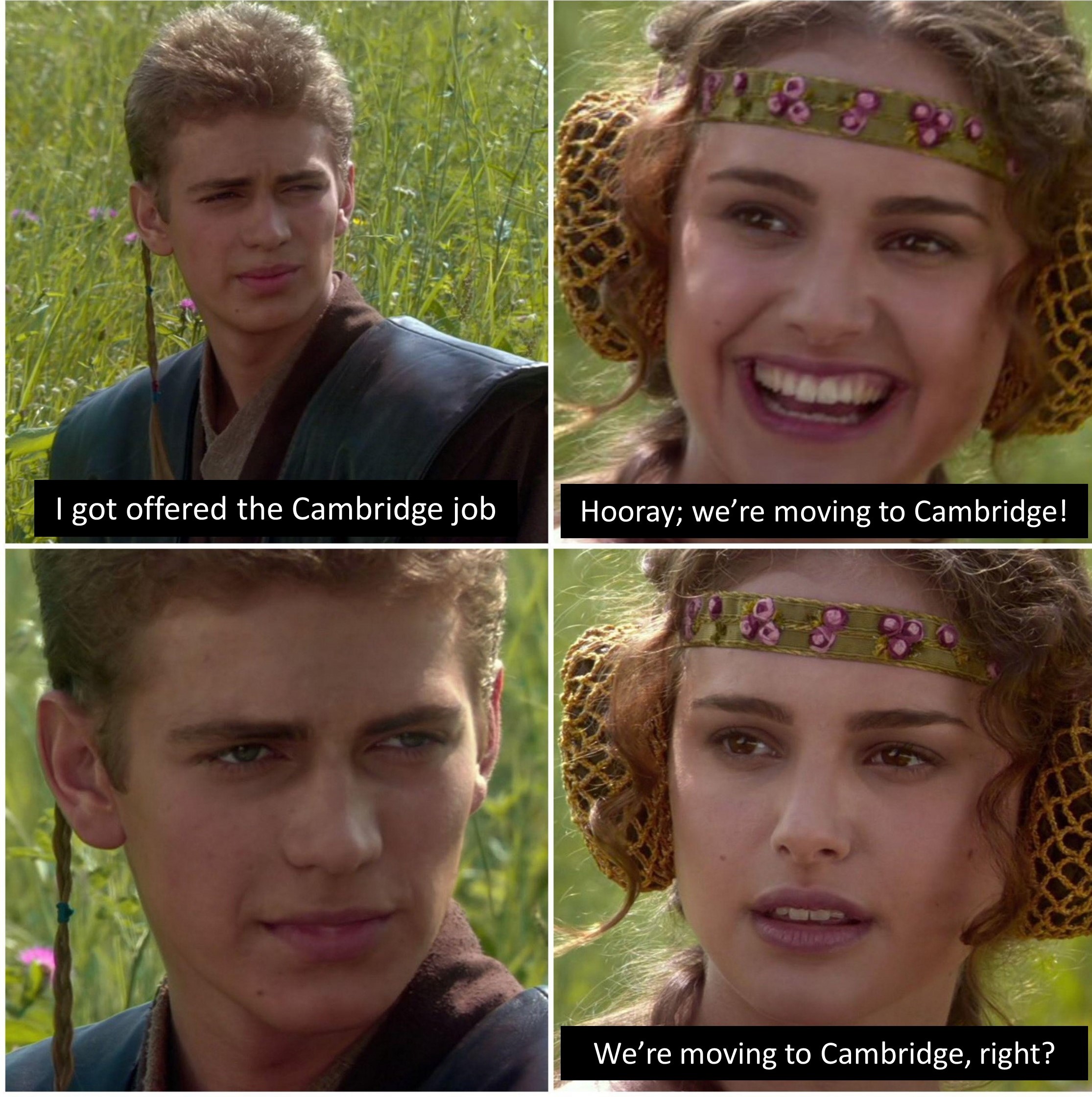
One of my biggest disappointments was not being able to move to Cambridge with my family because (i) Cambridge is very expensive relative to Leicester, and (ii) Univ. of Cambridge doesn’t pay their ECRs accordingly – mind you, I was being paid the equivalent of a (starting) ‘Lecturer’ post at the University’s pay scales (Point 49; see ‘Single Salary Spine’), so many of my colleagues were being paid less than myself.


There was also the issue of not having enough ‘independence’ as an ECR to work on different projects that excited me. As a ‘postdoc’, my priority had to be my supervisor’s projects/ideas. If I wanted to pursue my own projects, I had to bring my own salary via fellowship/grant applications – even those would have to be tailored towards the priorities of the funding bodies. Applying for grants/fellowships is not something I like or I’m trained for but I did try… I submitted three (one grant and two fellowship) applications and made it to the interview/final stage every time, however they were all ultimately rejected mostly because I “was not an expert on that respective disease” or “was too ambitious/couldn’t do all these in 3 (or 5) years”. I guess I also laid all my cards on the table and didn’t hide the fact that I was a proud ‘generalist’** and was never going to be a specialist as I am just too curious (and unwilling) to be working on a single disease or method. In addition to these, I had also co-applied (with a Lecturer colleague in the Arts dept. where we had to submit quite a few documents and a short video) for a very small grant (of ~£6000) to organise a conference to discuss the problems of asylum seekers/refugees in the UK, but it was rejected for strange reasons. I acknowledge that there is an element of luck involved and on another day with another panel, I may have been awarded but these rejections were also eye openers. (NB: I believe the ‘all-or-nothing’ nature of fellowship/grant applications should be revised as a colossal amount of researchers’ time and effort – and therefore taxpayers’ money – is being wasted)

But – in line with the story (of the Chinese farmer) I shared at the start – I am now happy that they didn’t work out as it probably would have meant I stayed in academia for longer (i.e. until the end of my fellowship period). I always took the ‘doing my best and not worrying about the outcome‘ approach and this has proven to be a good strategy for me so far.
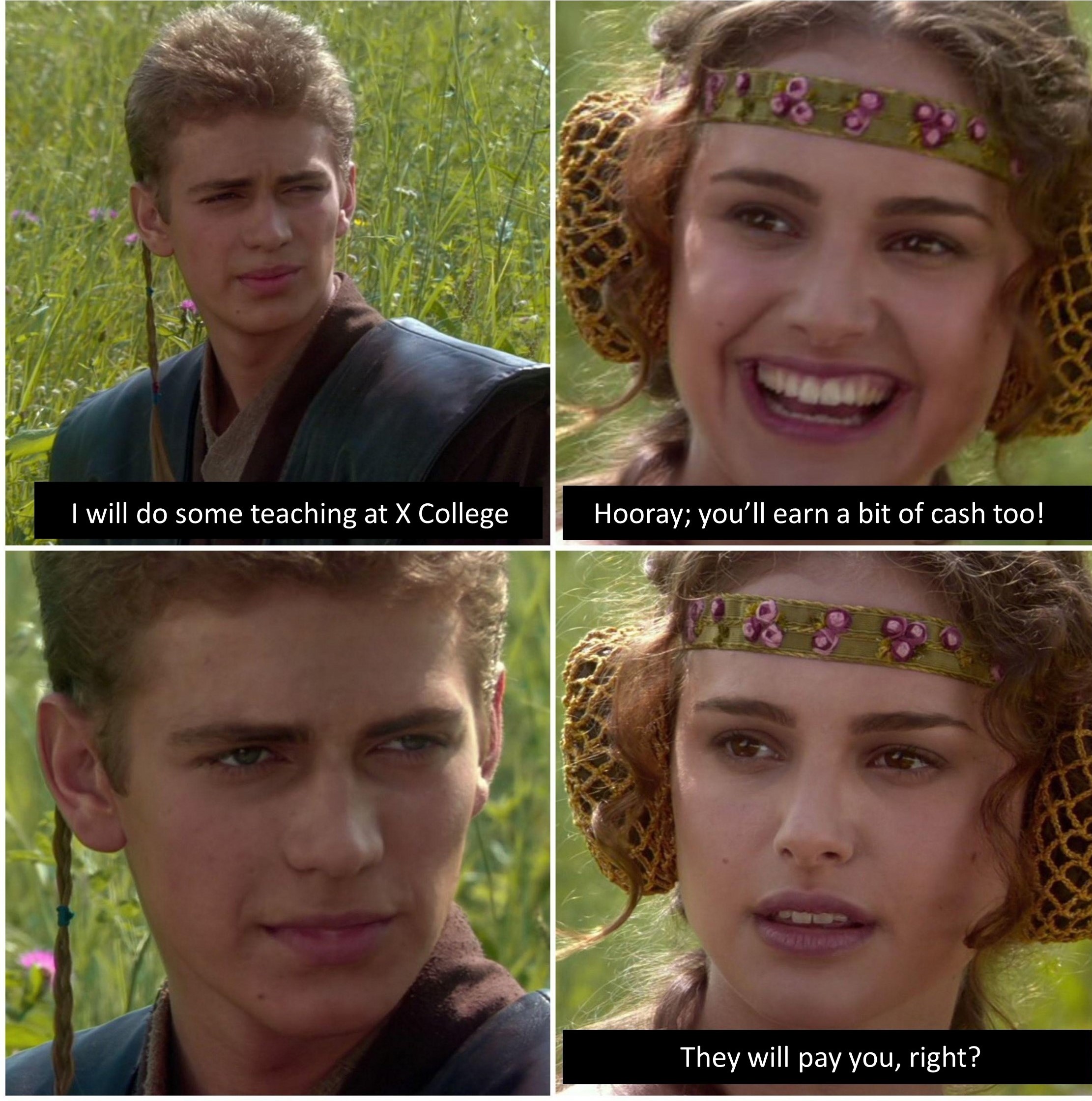
Although unhappy with the way ‘the system’ took advantage of ECRs, I did try and “play by rules” to ramp up my CV and network by applying to become a ‘Non-stipendiary Junior Research Fellow’ at one of the colleges of the Univ. of Cambridge to increase my chances of securing a permanent lecturer post at a high-calibre university. Although I enjoy teaching and think I am good at explaining concepts, the main reason for applying was to add more teaching experience in my CV and secondly, to be more involved with the community of students and ECRs in Cambridge – which I did not have a chance to do much, mostly as I and my wife decided not to move to Cambridge from Leicester for the reasons mentioned above (underneath the first figure). I made a solid application and got to the interview stage. I thought the interview panel would be delighted to see someone like me who has a relatively good academic CV for an ECR (see my CV) but also does sports, has his own podcast, who tried to be active on social media (I had more followers than the college on Twitter – although they’re very active), who writes highly read blogs (some of my blog posts are read and shared by tens of thousands), led many student groups (incl. the President of Turkish Society at the Univ. of Bristol and Leicester) etc. to join their ‘guild’ but I was very surprised to receive a rejection email a couple of weeks later. I was going to work there for free, but it seems like they didn’t value my skills at all and that there were at least 5 other people who they thought were going to contribute to the College’s environment more than me. This was another eye-opener: Academia is full of (highly talented) ECRs who are just happy to do things for free for the sake of adding stuff to their CV and I realised I was about to do the same. I remember thinking “I dodged a bullet there” – I decided it just wasn’t worth fighting/competing over these things. I knew now that I had to explore options outside of academia more assertively as I could see clearer that universities and the senior members who helped build this system were just taking advantage of ECRs’ idealism and ambitions but also desperation. (BTW: I find it astonishing that non-stipendiary fellowships in Cambridge are even a thing. They state that they don’t expect much from their fellows but they clearly do)

I then shared a 1-page CV in certain job recruitment sites to see what was out there for me and I was surprised to see how valuable* some of my transferable skills were to businesses in different sectors. I had many interviews and pre-interview chats with agents and potential employers (incl. Pharma, other private sectors, and public sector) in the last 6 months but only one ticked all the boxes for me: this ‘Senior scientist’ role at the Human Genetics team of BI – who valued my versatility and expertise in various fields***. Thus, I took time out to fully concentrate on the process and prepared well. I had to go through five interview stages, including an hour-long presentation to a group of experts from different fields, before I was offered the post. Throughout the process I also saw that many of my prospective colleagues at BI had seen the abovementioned problems earlier than I did and made the move. They were all very happy, with many working, and hoping to stay, in the company for a long time. I should also mention I had a Lecturer job lined up at the Univ. of Manchester**** too but the opportunity to work for BI’s ‘Human Genetics’ team was too good to refuse.

I didn’t mean this post to be this long so I’ll stop here. To sum up, I am proud of the things I’ve achieved and the friends I’ve made along the way – and if I was to go back, I wouldn’t change anything – but I believe it is the right time for me to leave academia. I think I’ve been a good servant to the groups I worked in and tried to give all I could. Simultaneously, I grew a lot as a scientist but also as a person – and this was almost all down to the environment we were provided at the universities I worked in. But having reached this stage in my life and career, I now think that (UK) universities don’t treat us (i.e. ECRs) in the right way and provide us with the necessary tools or the empathy to take the next step. I don’t see this changing in the near future either because of the fierce job market. Universities are somehow getting away with it – at least for now. This is not to say other sectors are too different in general but I would strongly recommend exploring the job market outside of academia. You may stumble on a recruiter like BI and a post like the one I have been offered, which matches my skill set and ambitions but also pay well so I can live a decent life with my family – without having to live tens of miles away from my office.

Let me re-iterate before I finish: What I wrote above will most probably not apply to you as I (i) am a UK-based academic/researcher, (ii) am an early-career researcher in a field which also has a strong computational/programming and statistics component – so I have a lot of easy-to-sell transferable skills to the Pharma companies/private sector, (iii) am a ‘generalist’** rather than a ‘specialist’ – so I’m a person major funding bodies currently aren’t really too keen on, (iv) don’t have rich parents or much savings, and am married (to a PhD student) and have a son to look after – and thus, salary*****, living in a decent house/neighbourhood and spending time with my family is an important issue, and (v) am an impatient idealist, who wants to see his research have impact – and as soon as possible. I am also in a position that I can make a move to another country with my family.


Footnotes:

*Contractor jobs usually offer much better pay packages than permanent jobs in the ‘data science’ field e.g. as soon I as put my CV on the market as a ‘health data scientist’, I got contacted by a lot of agents who could find me short-term (3-12 months mainly) contracts with very good pay packages. Just to give one example of the salaries offered, there was one agent who in an apologetic tone said: “I know this is not very good for someone like you but we currently offer £400 a day to our contractors but I can push it to £450 for you.”this is ~3x the daily rate of my salary at the Univ. of Cambridge!

**I’ve always been involved in top groups and ‘cutting-edge’ projects so the jump from academia to Pharma in terms of research quality is not going to be too steep but the possibility of being directly involved in the process of a drug target that we identify go through the stages and maybe even become a drug that’s served to patients is not there for a (32 year old) ECR in academia – maybe, when I’m 45-50 years old. I also like the “skin in the game” and “all in the same boat” mentality in many Pharma/BI posts, which I do not see in academia. The current system incentivises people to be very individualistic in academia; and the repetitive and long process of publishing (at least partially) ‘rushed’ papers to lay claim to a potential discovery are things that have always bothered me. I don’t see how I can further improve myself personally and as a scientist as I don’t think my skills were anywhere near fully appreciated there – the system almost solely cares about publishing more and more papers, and bringing in funding. I have many ‘junior’ and ‘senior’ friends/colleagues who have made the transition from academia to Pharma (incl. Roche, NovoNordisk, GSK, AZ, Pfizer) and virtually all of them are happy to have moved on.

***As you can also see from my Google Scholar profile (and CV), I have worked on different diseases/traits and concepts/methods within the fields of medical genetics (e.g. rare diseases such as primary ciliary dyskinesia and Papillon-Lefevre syndrome), genetic epidemiology (e.g. common diseases such as type-2 diabetes and chronic obstructive pulmonary disease, and related traits such as smoking behaviour and blood pressure), (pure) epidemiology (COVID-19 studies), population genetics (Y-DNA & mtDNA haplogroup studies), and statistical genetics (e.g. LD Hub, HAPRAP) – and this is generally not seen as a ‘good sign’ (even when I’ve published papers in some of the most respectable journals in the respective fields as first/equal-first/prominent author) by some ‘senior academics’ (who review your grant/fellowship applications, and papers submitted to respectable journals) as many have spent their entire careers on a single disease, and sometimes on a single/few genes. It doesn’t mean they are right, but they usually make the final decision – and some like to act as gate keepers.

****I applied to the Univ. of Manchester post in case I would not get the BI job but also because it was a nice opportunity to work at a top university/department with high quality students and great scientists. They were also happy to pay me at the higher end of the ‘Lecturer’ salary scale. I believe I would have been a good lecturer and colleague but I just did not see myself in (UK) academia in its current state.

*****Although I – with my wife and son – was living in a nice neighbourhood and house in Leicester (renting of course!), due to my son’s expenses incl. a private nanny for a couple of days a week as my wife was also busy like me (small matter of writing her PhD thesis!), we were basically living paycheck to paycheck – and that was hard. When there were unexpected expenses, we used my wife’s (small amount of) savings, then asked my brother to help out financially – and that was hard too. It was almost impossible to fully concentrate on my research as I was always on the lookout for investment opportunities using the small amount of money I had on the side. At one point, I even contemplated doing casual work to earn a bit of cash on the side. Needless to say, I am very disappointed with the pay packages in academia – at least a stratified approach according to field, (transferable) skillset, and marriage/child status/other circumstances should be considered in my opinion. I also think, universities should at least provide guidance on solid investment (incl. mortgage) opportunities to their ECRs, so they can potentially earn or save a bit more. I can’t say much about my salary but it is a senior and permanent post, and my pay package also includes many of the perks of academia (e.g. >30 days of paid annual leave, flexible working hours, conference/travel allowance).


Couple of tweets – in addition to the blog posts I shared above – where I complain openly about the state of (UK-based) academia:

1- I don’t know how “no/limited feedback” has been normalised in academia:

2- I think science communication is as important as the papers we publish:

3- Publishing papers for the sake of publishing and inflating h-indexes:


Addendum (23/12/21) Reflecting on my first 4 months at BI’s Human Genetics team:

I was going to write a piece later but decided to add to this post now as I have been/am being invited to many ‘academia v industry/pharma‘ workshops/talks and saw that there is a lot of interest in this subject. I cannot properly respond to all emails or accept all invitations, thus would like to direct people here when needed…

A quick summary of what I’m doing: I’m a ‘Senior Scientist’ in the relatively newly established Human Genetics team of BI – and we’re located at the International Research Centre in the beautiful city of Biberach an der Riss in South Germany. As the Human Genetics team, we’re currently building analysis pipelines to make use of the huge amount of human genetics, proteomics and transcriptomics data that’s available to (in)validate the company’s portfolio of drugs (see below video for details).

A short primer on how I spend my days in the Human Genetics team of Boehringer Ingelheim: Leveraging human genetics data to guide drug target validation – Mesut Erzurumluoglu (Respiration/Solunum conference on 31/10/21)

If I say a few words about BI – which I didn’t know before I joined: BI one of the largest family-owned companies in the world with >20 billion euros revenue per year and >50k employees all around the world of which >8k are researchers (largest R&D centre is in Biberach an der Riss, where we’re also located) – so the company and the Boehringer/Von Baumbach family value R&D a lot. Some family members also attend research days organised within the company – which I find very encouraging as an employee but also a scientist at heart!

The other exciting thing for me is that the company’s currently going through a phase of massive expansion in ‘data driven drug target validation’, so the Comp. Bio/Human Genetics department is getting a lot of investment and are going to hire a lot of people in the near future – and I’m very happy to be involved in this process too.

To get back to my views of ‘working for BI v in academia’, I’ve made a summary table below which compares my experience as a Senior Scientist in BI and my time as an ECR/(Sn.) Postdoc/(Prospective) Lecturer in UK academia. I’ve highlighted in bold where I think one side better was than the other for me.

I believe the above rows are self-explanatory except maybe the bottom 4 rows – so I will provide some details here: (i) I feel like we’re ‘all in the same boat’ in my current team as we – as a group – have certain targets that we need to hit, so any success/breakthrough by any of the team members alleviates the pressure on all of us. This is also true of any success within the company. (ii) Re the next point/row, I just want to give one example: I have seen many papers be published in very high-impact journals by ‘top names’, which would not have made it past the ‘top names’ themselves (as reviewers) had the paper been written by some other group. Most of us also don’t have any editor friends who we can write to so that our ‘desk rejection’ at a high-impact journals is reviewed. The struggle for funding is even worse and I think life’s too short to be spending months on a fellowship or grant application, which is usually rejected for non-research related reasons (e.g. competition, timelines, priorities). (iii) We’re not allowed to work on Sundays at BI, and emails sent to others on Saturdays and after work hours is genuinely discouraged. (iv) Last row: We’re encouraged to produce good science and analysis pipelines by the senior management at BI rather than be in competition with colleagues to be the ‘first’ at something. In contrast, many papers in academia will be published in high-impact journals and be cited by others because they were the ‘first’ and not because they did a good job of strengthening their finding(s) via different lines of evidence. They do not lose anything if this ‘new and shiny’ finding turns out to be just a meaningless correlation 5-6 years down the line (i.e. there’s no “skin in the game”; even worse, they will have collected their grants and awards by then).

I also want to mention that career progression in UK academia is too slow for my liking (see below figure). I do not want to be treated as an ECR and living ‘paycheck to paycheck’ until I’m 50 – again, I feel like life is too short for this. This is why I wanted to move to a group where I would be respected more but also earning more – so that I can provide a good life for my family whilst fully concentrating on my/the team’s ‘cutting-edge’ research.
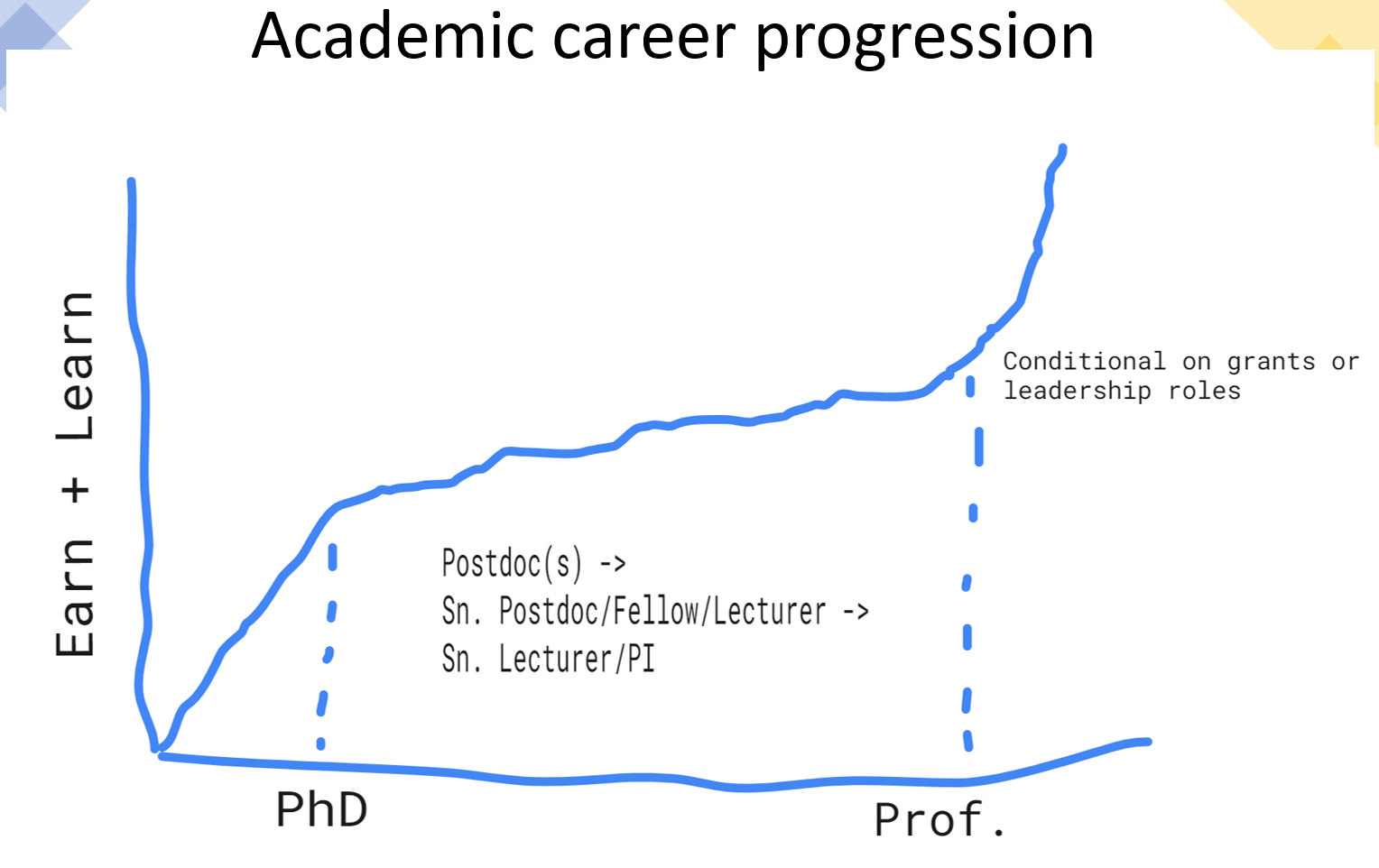
I always judged my ‘value’ at a place by adding how much I was earning and learning there. I was very happy during my PhD and first few years as a postdoc as I was learning a lot (from top scientists, attending conferences, giving talks, being provided the time to explore) and had a good salary/scholarship for a person who is single and <30 years of age. Unfortunately, for me, the increase in this regard was just not steep enough after this period. This feeling didn’t change much even after I secured a Lecturer post at the Univ. of Manchester – I just could not beg funders and apply for grants every year until I die. At BI, in addition to a very good salary, I’m also learning a lot from the different groups we are interacting with (e.g. wet-lab researchers/CRISPR screens, drug target research in different disease areas such as respiratory, immunology, oncology, and cardio-metabolic diseases) whilst also taking part in ‘cutting-edge’ research. There are also internal funds to explore your own ideas and a separate programme called ‘Research Beyond Borders’, which is dedicated to looking into other diseases which do not fit the main programmes.

To finish, I again re-iterate that it would be wise for a talented postdoc with data science and statistical skills to have a look around while they’re still comfortable in their current post (i.e. still have >12 months contract). If you have experience working with clinical and genetic data, then Pharma and Biotech companies would also be very interested in you.

I hope this post is of help, but feel free to contact me if you have specific questions that are not answered here.


Addendum (23/12/23) Reflecting on my first ~2.5 years at BI’s Human Genetics team:

Still happy. Family’s happy here. South Germany is very good for families: Very safe. My son’s kindergarten is great; Biberach and surrounding area is great. So much to see and learn.

Happy with the research I’m doing, things I’ve learned/learning, and my impact in the drug target development process at BI.

Also check out our preprint on structural variants – a valuable resource, openly shared with the research community (Note: I had encouraged Boris Noyvert to join our team and now we’ve published this preprint together):

Noyvert B, Erzurumluoglu AM, Drichel D, Omland S, Andlauer TFM et al. 2023. Imputation of structural variants using a multi-ancestry long-read sequencing panel enables identification of disease associations: https://www.medrxiv.org/content/10.1101/2023.12.20.23300308v1

Tweetorial:
Read Full Post »

smoking_genetics_gwas_mesut_erzurumluoglu
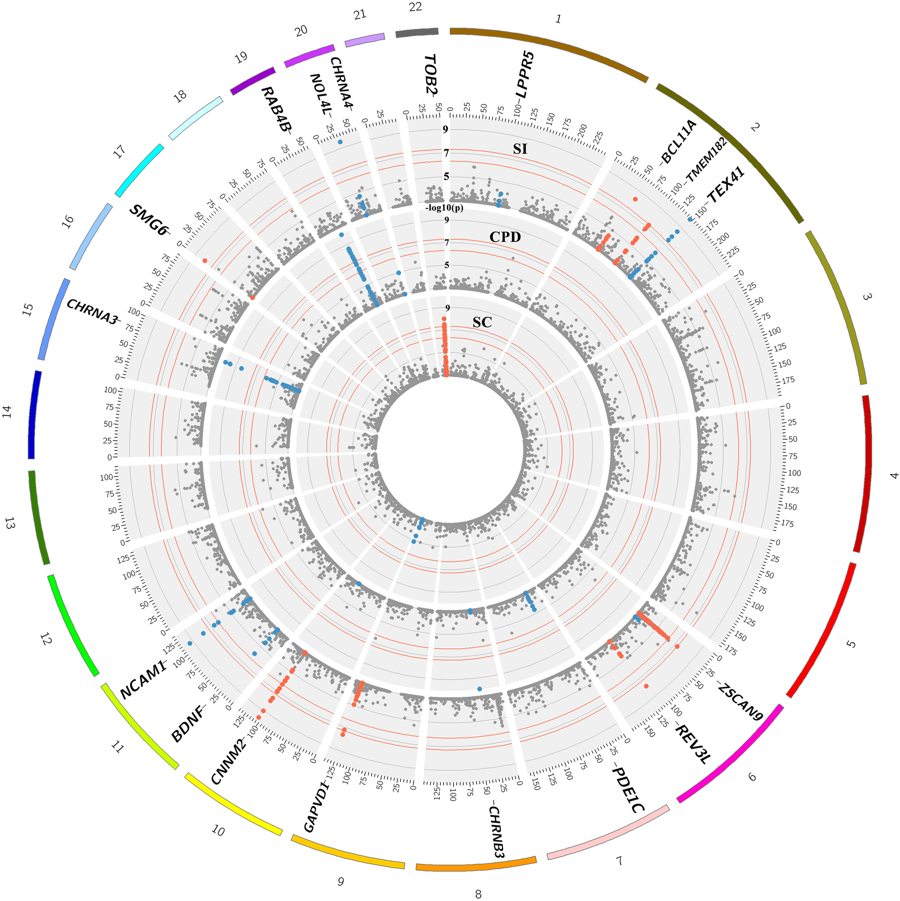
A ‘Circos’ plot (with three concentric circular ‘Manhattan’ plots) presenting results from our latest genetic association study of smoking behaviour – showing some (not all) regions in our genome that are associated with smoking behaviour (Erzurumluoglu, Liu, Jackson et al, 2019). SI: Smoking initiation – whether they smoke or not; CPD: Cigarettes per day – how many cigarettes do they smoke per day; SC: Smoking cessation – whether they’ve stopped smoking after starting. Labels in the outer circle show the name of the nearest gene to the identified variants. X-axis: Genomic positions of the variants in the human genome (chromosome numbers, 1-22, in the outer circle), Y-axis: Statistical significance of the genetic variants in this study – higher the peak, greater the significance. Red peaks are the newly identified regions in the genome, and the blue ones were identified by previous groups. Image source: Molecular Psychiatry

I believe that all scientists should be bloggers and that they should spare some thought and time to explain their research to interested non-scientists without using technical jargon. This is going to be my attempt at one; hopefully it’ll be a nice and short read.

We’ve just published a paper in one of the top molecular psychiatry journals (well, named Molecular Psychiatry 🙂 ) where we tried to identify genetic variants that (directly or indirectly) affect (i) whether a person starts smoking or not, and once initiated, (ii) whether they smoke more. The paper is titled: Meta-analysis of up to 622,409 individuals identifies 40 novel smoking behaviour associated genetic loci. It is ‘open access’ so anyone with access to the internet can read the paper without paying a single penny.

If you can understand the paper, great! If not, I will now try my best to explain some of the key points of the paper:

Why is it important?

Smoking causes all sorts of diseases, including respiratory diseases such as chronic obstructive pulmonary disease (which causes 1 in 20 of all deaths globally; more stats here) and lung cancer – which causes ~1 in 5 of all cancer deaths (more stats here). Therefore understanding what causes individuals to smoke is very important. A deeper understanding can help us develop therapies/interventions that help smokers to stop and have a massive impact on reducing the financial, health and emotional burden of smoking-related diseases.

Genes and Smoking? What!?

There are currently around fifty genetic variants that are identified to be associated with various smoking behaviours and we identified 40 of them in our latest study, including two on the X-chromosome which is potentially very interesting. There are probably hundreds more to be found*. So, it’s hard to comprehend but yes, our genes – given the environment – can affect whether we start smoking or not, and whether we’ll smoke heavier or not. This is not to say our genes determine whether we smoke or not so that we can’t do anything about it.

There are three main take-home messages:

1- I have to start by re-iterating the “given the environment” comment above. If there was no such thing as cigarettes or tobacco in the world, there would be no smoking. If none of our friends or family members smoked, we’re probably not going to smoke no matter what genetic variants we inherit. So the ‘environment’ you’re brought up in is by far the most important reason why you may start smoking.

2- I have to also underline the term “associated“. What we’re identifying are correlations so we don’t know whether these genetic variants are directly or indirectly affecting the smoking behaviour of individuals – bearing in mind that some might be statistical artefacts. Some of the genetic variants are more apparently related to smoking than others though: for example, variants in genes coding for nicotine receptors cause them to function less efficiently so more nicotine is needed to induce ‘that happy feeling‘ that smokers get. Other variants can directly or indirectly affect the educational attainment of an individual, which in turn can affect whether someone smokes or not. I’d highly recommend reading the ‘FAQ’ by the Social Science Genetic Association Consortium (link below) which fantastically explains the caveats that comes with these types of genetic association studies.

3- Last but not least, there are many (I mean many!) non-smokers who have these genetic variants. I haven’t got any data on this but I’m almost 100% sure that all of us have at least one of these variants – but a large majority of people in the world (~80%) don’t smoke.

Closing remarks

To identify these genetic variants, we had to analyse the genetic data of over 620k people. To then identify which genes and biological pathways these variants may be affecting, we queried many genetic, biochemical and protein databases. We’ve been working on this study for over 2 years.

Finally, this study would not be possible (i) without the participants of over 60 studies, especially of UK Biobank – who’ve contributed ~400k of the total 622k, and (ii) without a huge scientific collaboration. The study was led by groups located at the University of Leicester, University of Cambridge, University of Minnesota and Penn State University – with contribution by researchers from >100 different institutions.

It will be interesting to see what, if any, impact these findings will have. We hope that there will be at least one gene within our paper that turns out to be a target for an effective smoking cessation drug.

Further reading

1- FAQs about “Gene discovery and polygenic prediction from a 1.1-million-person GWAS of educational attainment” – a must read in my opinion

2- Smoking ‘is down to your genes’ – a useful commentary on the NHS website on an older study

3- 9 reasons why many people started smoking in the past – a nice read

4- Genetics and Smoking – an academic paper, so quite technical

5- Causal Diagrams: Draw Your Assumptions Before Your Conclusions – a fantastic course on ‘Cause and Effect’ by Prof. Miguel Hernan at Harvard University

6- Searching for “Breathtaking” genes – my earlier blog post on genetic association studies

Data access

The full results can be downloaded from here

*in fact we know that there is another paper in press that has identified a lot more associations than we have

Read Full Post »

evolution_of_intellectual_freedom_cham_phdcomics

Source URL: PhD Comics

Figuratively speaking, what is the ‘worth’ of a certain academic? Between two academics, which one has had more positive academic impact than the other? How do you rank academics? And award grants, promotion, tenure etc. to the best* ones?

I’m not going to answer these questions but would like to chip in with some food for thought and suggestions.

Well; one may say: “It’s easy! Just compare their h-index and total no of citations!

This may be an effective way to go about answering the question. Surely someone with an h-index of 30 has had more positive academic impact than someone with let’s say an h-index of 15 – and is the better candidate?

Maybe – that is if all things are equal regarding the way citations and the h-index works i.e. if both academics:

  • are in similar fields – as papers in certain fields receive more citations overall than papers in other fields,
  • are in similar stages in their careers – as comparing an early-career postdoc with an established “Prof.” wouldn’t be fair,
  • have similar numbers of first/equal-first or last author papers – as an academic with many middle-authorships can have excessively inflated h-indexes,
  • have similar number of co-authors – as it may be easier to be listed as a co-author in some fields than others and/or mean that more people will be presenting and citing the paper as their own, and
  • have a similar distribution of citations across the papers – as the h-index ignores highly influential papers and the total citations can be highly influenced by even just one of these (see figure below).

I may have missed other factors, but I think these are the main ones (please add a comment below).

mesut_erzurumluoglu_h-index_academic_2018

Calculating my h-index: Although problematic (discussed here), the h-index has become the standard metric when measuring the academic output of an academic. It is calculated by sorting the publications of an academic from most to least cited, then checking whether he/she has h papers with h citations e.g. if an academic has 10 papers with ≥10 citations but not 11 papers with ≥11 citations then their h-index will be 10. It was proposed as a way to summarise the number of publications that an academic has and their academic impact (via citations) with a single number. The above citation counts were obtained from my Google Scholar page

As of 31st July 2018, I have 14 published papers – including 5 as first/equal-first author – under my belt. I have a total citation count of 316 and an h-index of 6 (225 and 5 respectively, when excluding publications marked with an asterisk in the above figure). It is fair to say that these numbers are above average for a 29-year-old postdoc. But even I’m not content with my h-index – and many established academics are definitely right not to be. I’ll try and explain why: the figure above shows the citation distribution of my 14 publications sorted by the ‘number of times cited’ from the left (highest) to right (lowest). One can easily see that the h-index (red box) captures only a small portion of the general picture (effectively, 6 x 6 i.e. 36 citations) and ignores the peak (>6 on the y-axis) and tail (>6 on the x-axis) of the publication-citation distribution. I have also included the publication year of each paper and added an asterisk (*) against the publications where I haven’t provided much input e.g. I have done almost nothing for the Warren et al (2017) paper but it constitutes almost a third of my total citations (90/316)**. The ‘ignored peak’ contains three highly cited papers to which I have made significant contributions to and the ‘ignored tail’ contains research papers that (i) I am very proud of (e.g. Erzurumluoglu et al, 2015) or (ii) are just published – thus didn’t have the time to accumulate citations. What is entirely missing from this figure are my (i) non-peer-reviewed publications (e.g. reports, articles in general science magazines), (ii) correspondence/letters to editor (e.g. my reply to a Nature News article), (iii) blog posts where I review papers or explain concepts (e.g. journal clubs), (iv) shared code/analysis pipelines, (v) my PhD thesis with potentially important unpublished results, (vi) other things in my CV (e.g. peer-review reports, some blog posts) – which are all academia-related things I am very proud of. I have seen other people’s contributions in relation to these (e.g. Prof. Graham Coop’s blog) and thought that they were more useful than even some published papers in my field. These contributions should be incorporated into ‘academic output’ measures somehow.

It is also clear that “just compare their h-index and total no of citations!” isn’t going to be fair on academics that (i) do a lot of high-quality supervision at different levels (PhD, postdoc, masters, undergrad project – which all require different skill sets and arrangements), (ii) spend extra time to make their lectures inspiring and as educative as possible to undergrad and Masters students, (iii) present at a lot of conferences, (iv) do ‘admin work’ which benefits early-career researchers (e.g. workshops, discussion sessions), (v) do a lot of blogging to explain concepts, review papers, and offer personal views on field generally, (vi) have a lot of social media presence (e.g. to give examples from my field i.e. Genetic Epidemiology, academics such as Eric Topol, Daniel MacArthur, Sek Kathiresan take time out from their busy schedules to discuss, present and debate latest papers in their fields – which I find intellectually stimulating), (vii) give a lot of interviews (TV, online media, print media) to correct misconceptions, (viii) take part in public engagement events (incl. public talks), (ix) organise (inter-disciplinary) workshops, (x) inspire youngsters to become academics working for the benefit of humankind, (xi) publish reliable reports for the public and/or corporations to use, (x) provide pro bono consultation, (xi) take part in expert panels and try very hard to make the right decisions, (xii) engage in pro bono work, (xiii) do their best to change bad habits in the academic circles (e.g. by sharing code, advocating open access publications, standing up to unfair/bad decisions whether it affects them or not), (xiv) extensively peer-review papers, (xv) help everyone who asks for help and/or reply to emails… The list could go on but I think I’ll stop there…

I acknowledge that some of the above may indirectly help increase the h-index and total citations of an individual but I don’t think any of the above are valued as much as they should be per se by universities – and something needs to change. Academics should not be treated like ‘paper machines’ until the REF*** submission period, and then ‘cash cows’ that continually bring grant money until the next REF submission cycle starts. As a result, many academics have made ‘getting their names into as many papers as possible’ their main aim – it is especially easier for senior academics, many with a tonne of middle-authorships for which they have done virtually nothing****. This is not how science and scientists should work and universities are ultimately disrespecting the tax payers’ and donors’ money. Some of the above-mentioned factors are easier to quantify than others but thought should go into acknowledging work other than (i) published papers, (ii) grant money brought in, and maybe (iii) appearing on national TV channels.

Unless an academic publishes a ‘hot paper’ as first or corresponding author – which very few have the chance and/or luck to do – and he/she becomes very famous in their field, their rank is usually dictated by the h-index and/or total citations. In fact, many scientists who have very high h-indexes (e.g. because of many middle-author papers) put this figure at the top of their publication list to prove that they’re top scientists – and unfortunately, they contribute to the problem.

People have proposed that contributions of each author are explicitly stated on each paper but this is going to present a lot of work when analysing the academic output of tens of applicants – especially when the number of publications an individual has increases. Additionally, in papers with tens or even hundreds of authors, general statements such as “this author contributed to data analysis” are going to be assigned to many authors without explicitly stating what they did to be included as a co-author – thus the utility of this proposition could also be less than expected in reality.

It’s not going to solve all the problems, but I humbly propose that a figure such as the one above be provided by Google Scholar and/or similar bibliometric databases (e.g. SCOPUS, CrossRef, Microsoft Academic, Loop) for all academics, where the papers for which the respective academic is not the first author are marked with an asterisk. The asterisks could then be manually removed by the respective academic on publications where he/she has made significant contributions (i.e. equal-first, corresponding author, equal-last author or other prominent role) but wasn’t the first author. Metrics such as the h-index and total citations could then become better measures by giving funders/decision makers the chance to filter accordingly.

Thanks for reading. Please leave your comments below if you do not agree with anything or would like to make a suggestion.

academic_worth_researcher_university_mesut_erzurumluoglu

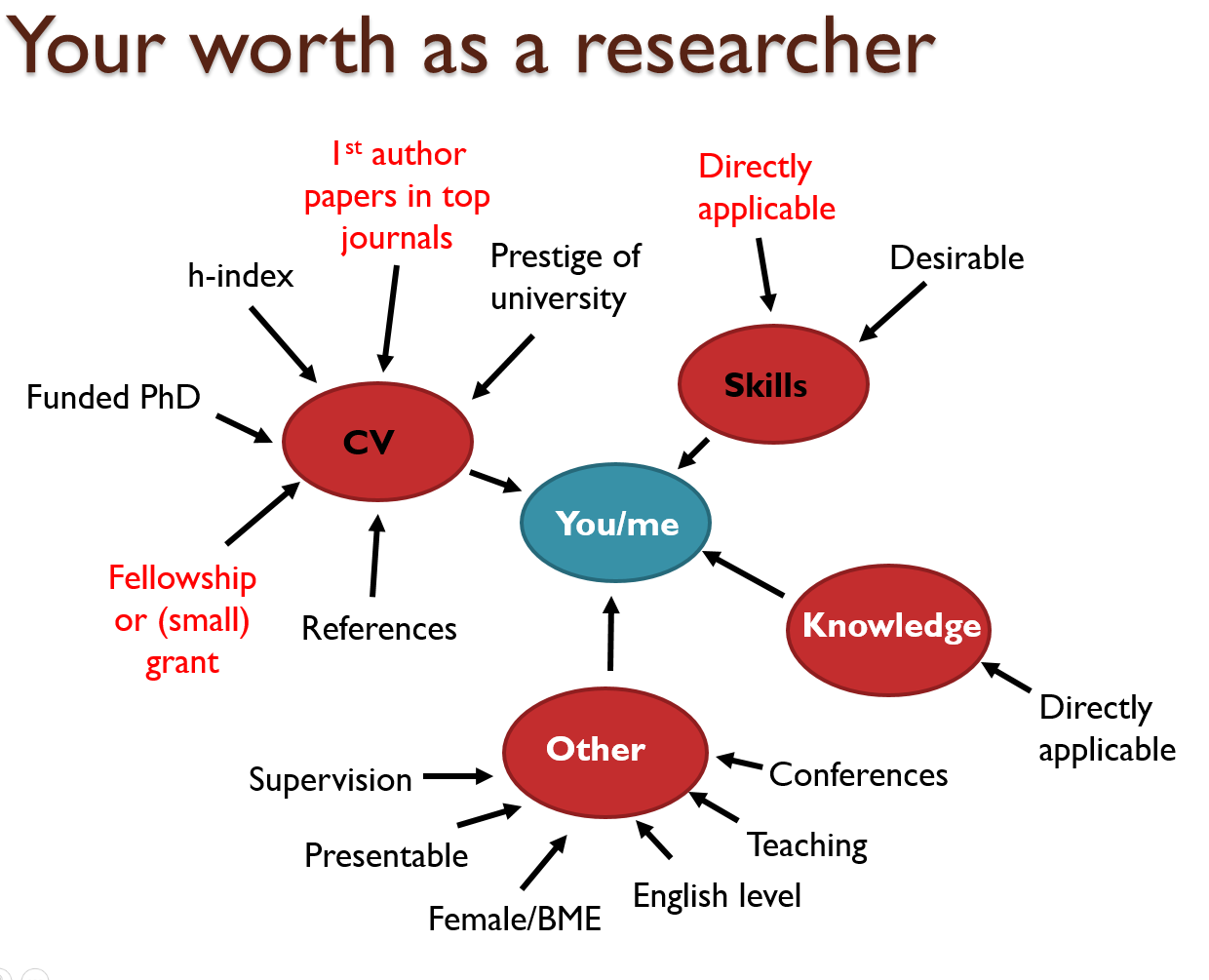
The heuristic that I think people use when calculating the worth of an early career researcher (but generally applies to all levels): ‘CV’ and ‘Skills’ are the two main contributors, with the factors highlighted in red carrying enormous weight in determining whether someone should get the job/fellowship or not. Virtually no one cares about anything that is outside what is written here – as mentioned in the post. Directly applicable: Some technical skill that the funder/Professor thinks is essential for the job; Prestige of university: where you did your PhD and/or undergrad; Funded PhD: whether your PhD was fully funded or not; Female/BME: being female and/or of BME background – this can be an advantage or a disadvantage depending on the regulations/characteristics of the university/panel, as underrepresented groups can be subjected to both positive and negative discrimination. NB: this is a simplified version and there are many factors that affect outcomes such as “who you know” and “being at the right place at the right time“.


Added on 30/10/18: I just came across ‘No, it’s not The Incentives—it’s you‘ by Tal Yarkoni about the common malpractices in academic circles, and I think it’s well worth a read.


*Making sure there’s a gender balance and that academics from BME backgrounds are not excluded from the process – as they’ve usually had to overcome more obstacles to reach the same heights.

**I have been honest about this in my applications and put this publication under “Other Publications” in my CV.

***REF stands for the ‘Research Excellence Framework’, and is the UK’s system for assessing the quality of research in higher education institutions. The last REF cycle finished in 2014 and the next one will finish in 2021 (every 7 years). Universities start planning for this 3-4 years before the submission dates and the ones ranked high in the list will receive tens of millions of pounds from the government. For example, University of Oxford (1st) received ~£150m and University of Bristol (8th) received ~£80m.

****Sometimes it’s not their fault; people add senior authors on their papers to increase their chances of getting them accepted. It’s then human nature that they’re not going to decline authorship. It sounds nice when one’s introduced in a conference etc. as having “published >100 papers with >10,000 citations” – when in reality they’ve not made significant (if any!) contributions to most of them.


PS: I also propose that acknowledgements at the bottom of papers and PhD theses be screened in some way. I’ve had colleagues who’ve helped me out a lot when learning some concepts who then moved on and did not have the chance to be a co-author on my papers. I have acknowledged them in my PhD thesis and would love to see my comments be helpful to these colleagues in some way when they apply for postdoc jobs or fellowships. Some of them did not publish many papers and acknowledgements like these could show that they not only have the ability to be of help (e.g. statistical, computational expertise), but are also easy to work with and want to help their peers.

Read Full Post »

UK-regional-map-562x790
Birleşik Krallık (United Kingdom, UK) Ingiltere (England), Galler (Wales), Iskoçya (Scotland) ve Kuzey Irlanda (Northern Ireland)’dan oluşur. Büyük Britanya (Great Britain) ise Ingiltere, Iskoçya ve Galler’den oluşur. (Not: Spesifik sorusu olanlar bana Twitter ya da emailden ulaşabilirler)

Britanya/Ingiltere’de uzun yıllar yaşamış, bu ülkenin sisteminde yetişmiş ve nispeten başarılı olmuş bir birey olarak bana bu ülkenin egitim sistemi ve yaşam koşullarıyla ilgili çok soru soruluyor. Buralara gelen birçok arkadaşımız da psikolojik ve maddi sorunlarla boguşabiliyor, ya da vize, ingilizce ogrenememe, ingiliz kültürüne alışamama (Ingiliz kültürüne dair gözlemlerim adlı yazıma bakabilirsiniz bu konuda), doktoraları ile ilgili sorunlar yaşayabiliyorlar.

İlginizi çekebilecek bir bilgisel – İngiltere’de “Home fee” okumak için verdiğim mücadeleyle ilgili…

Bir nebze yardımcı olur ümidiyle bana sıkça sorulan soruları burada (oldugu gibi, fazla düzenlemeden) paylaşacagım. Sorunuz burada cevaplanmamışsa, lütfen bana buradan (en altta ‘comment’ atma bolümü var) ya da m.erz@hotmail.com’dan ulaşın; yardımcı olmaya calışayım:

İngiltere’de Doktora/PhD öğrencisiyim. Yakında birinci yıl APG (Advanced Postgraduate Assessment*)’m var. Ne önerirsiniz?

Öncelikle bir Doktora/PhD öğrencisi olduğunuzu unutmayın. PhD, akademik olarak alabileceğiniz en yüksek ünvandır – yani çok önemli bir ünvan. Ingilizler doktorayı bitirdiğinizde, size çalıştığınız spesifik konu/alanda ‘bir uzman’ gözüyle bakacaklar – bu yüzden size şimdiden “uzman olacak potansiyel var mı?” gözüyle bakarlar. Bunun şuurunda olun ve kesinlikle pısırık davranmayın.

APG’ye hazırlanırken (bence) yapmanız gerekenleri kendi tecrübe ve gözlemlerime göre sıralarsam:

1- Herşeyden önce literatüre hakim olun. Spesifik konunuzla ilgili her makale ve kitaptan haberdar olun. “Çok fazla makale var” diyorsanız, spesifik konunuz nedir tam bilmiyorsunuz demektir. (Yıl boyu tembellik yaptıysanız, en son çıkan 1-2 review ya da önemli makaleyi okuyup, tamamen anlamaya çalışın.)

Buna rağmen yine de gözünüzden bir makale kaçmışsa, ve APG’nizde examineriniz “şu makaleden haberin var mı?” diye sorarsa, “yok görmedim” yerine “evet haberim var; print edip masamın üzerine koymuştum. Burdan çıkışta ilk okuyacağım makale olacak” gibi politik cevaplarla geçiştirmeye çalışın.

Bir de examinerlarınızın CV’lerine ya da Google Scholar sayfalarına bakın ki ne gibi makaleler çıkarmışlar haberdar olun.

2- Ingilizlerin çok sevdiğim ve gerçekten de birini ‘judge’ yaparken karakterlerini yansıtan bir deyimi var: “First impression is last impression”  (ilk izlenim, son izlenimdir). Ilk izlenim çok önemli; güler yüzlü olun ve rahat görünmeye çalışın. Heyecanlı olabilirsiniz fakat bunu azaltmanın yolları var. Sunuma başlamadan önce sesinizi odada tanıdık birisiyle konuşarak kalibre edin (hatta bir arkadaşınızdan rica edin, biraz erkenden gelsin sırf bu iş için). O kişiyle konuştukça sesiniz açılacaktır ve nefesinizi daha iyi ayarlamanıza yardımcı olacaktır.

Ayrıca sunumunuza slaytlara değil de, insanların gözünün içine bakarak başlayın. Bu süreci kolaylaştırmak için de aklınızda unutmayacağınız 3-5 basit cümle tutun. Örnek: “Hi everyone. I’m Mesut; and I’m a PhD student working under Prof. Brian studying whether dopamine overexpression causes schizophrenia-like behaviour in mice. In the next 15 minutes or so, I’ll try and present how I’m going to do this. I also have some preliminary results that I’d like to share with you and get your comments on. If at any point you have a question, please do ask“. Sizin rahat (confident) olduğunuzu görünce, examinerlarınız da rahatlayacaktır; ve sonradan ufak-tefek hatalar dahi yapsanız görmezlikten geleceklerdir.

3- Introduction’ı kısa tutun, çünkü examinerlar başkalarının ne yaptığını değil, sizin ne yaptığınızı dinlemek için orada. Fakat alanınıza hakim olduğunuzu göstermeniz önemli (çalıştığınız konu neden önemli? benzer çalışmalar oldu mu? Varsa, senin çalışmanı ayıran nedir?). Güzel bir review/makaleyi örnek alın ve onu 2-3 slaytta anlatın. Sonraki slayt da ise arkadaşlarımızın belki de en az yaptığı şeyi yapın: eski literatürü biraz eleştirin; eksikliklerini, hatalarını bulun ve “ben bu eksiklerden haberdarım” mesajı verin. Bir bilim insanı gibi davranın: eski araştırmalara/buluşlara saygılı ama aynı zamanda eleştirel (critical) yaklaşabilen bir insan gibi…

En başta kendinizi tanıtırken hocanızın da ismini zikrettiniz. Artık bir daha ismini dahi anmayın – ta ki en son slaytınız olan “Acknowledgements” slaytına kadar. Ikide bir hocanızın ismini anmanız ve/ya da teşekkür etmeniz sizi pısırık ve hocasının arkasına saklanan bir öğrenci olarak gösterebilir. Türk mentalitesiyle ikide bir hocanızı övmenizin (“onun sayesinde oldu bunlar“, “hocama çok teşekkür ediyorum“) size hiçbir faydası dokunmayacaktır.

4- Introduction, **Aims & Objectives, Methods, Results ve Discussion slaytlarından sonra birer slaytı da (i) “bu bir senede neler öğrendim?” ve (ii) “bu sene neler yaptım?”a ayırın. Birincisi için, öğrendiginiz “skill”er (programming, wet-lab skills, istatistik vs. gibi), ikincisi icin de (a) bitirdiğiniz kurslar/workshoplar, (b) katıldığınız konferanslar/sunduğunuz posterler, (c) hazırda olan makaleleriniz (submitted/published olmasına gerek yok), (d) katılmayı planladığınız workshop ve conferencelardan bahsedin. Kazandığınız ‘skill’erin doktoranızda size nasıl faydalı olacağından bahsedin.

5- Gelebilecek soruları düşünün. Spesifik soruların dışında çok sık gelen genel sorular: (i) “what do you hope to achieve at the end of your PhD?” – iki cevabınız olsun; biri idealist, diğeri realist; (ii) “how does this help the man on the street?”; (iii) “what are the implications of studying this question?” – mesela önemli bir proteini calışıyorsanız, bunun bir hastalık icin ilaç üretilmesine yol açabileceğini söyleyebilirsiniz.

Çok iyi olan öğrenciler ise gelmesini istedikleri soruları dahi kendileri ayarlayabiliyorlar. Sunumlarında mesela ilgi çekebilecek bir konudan bahsedin ve “isterseniz soru-cevap kısmında daha detaylı anlatabilirim” deyin. Emin olun soracaklardır. Bu sayede sorulacaklardan bir soru azaltmış olursunuz.

Soru-cevap kısmında gerçekten takıldıysanız, “I have no idea” vs. gibi cevaplar vermeyin ya da sessiz-sessiz (kızarıp) durmayın. Gerekirse soruyu onlara geri çevirin: “Of course as a PhD student, I’m still learning; and would value the thoughts of experts like you. You’ve published many papers on schizophrenia before. What do you think?” demeniz daha akıllıca bir opsiyon. Bu da examinerlarınızın CV’lerine önceden bakmış olmanın yararları…

Umarım işinize yarar. Kolaylıklar dilerim.

*First year review ve Probation review olarak da biliniyor.

**’Aim’ ve ‘Objective’ arasındaki farkı ögrenmek/bilmek önemli. Örnegin: Aim “Londra’dan Istanbul’a varmak”sa, “Objective”leriniz (i) Skyscanner.com websitesine girip uygun bir fiyata Londra-Istanbul uçak bileti satın almak, (ii) Evinden Londra’daki havaalanına uygun bir saate otobüs/taksi/tren ayarlamak, (iii) Yola cıkmadan Türk Pasaport’unu yanına almak, (iv) Havaalanına 2 saat erken gelmek ve varınca “check-in” yapmaktır. “Aims and Objectives” slaytı sunumuzun belki de en önemli kısmı.

Yazın İngiltere’de dil okuluna gitmeyi düşünüyorum. Hangi ili seçmemi önerirsiniz? Brighton maddi açıdan uygun gibi duruyor… Ayrıca önerebileceğiniz bir dil okulu var mı? Bir yakınınızın gittiği ve/ya iyi bildiğiniz… Aile yanında kalmak en uygun seçenek gibi duruyor fakat sizin çevrenizde sıkıntı yaşıyanlar oldu mu? Size göre bir insanın aylık yeme-içme masrafı ne kadar olur?

Ben şu anda Leicester’da yaşadıgım icin daha çok bu civardaki dil kurslarından haberdarım. Maddi durumunuzu bilmiyorum ama üniversitelerin ‘intensive’ dil kursları, biraz pahalı olsalar da, çok kaliteli oluyor. Bu intensive kurslar pahalı gelirse, üniversitelerin normal “summer class”ları dahi baska yerlere nazaran daha iyi olabiliyor. Leicester üniversitesinin (konaklama dahil) ‘International Summer School‘ kursuyla kıyaslayıp (fiyat, ders programı vs.), ona göre kararınızı verin bence.

Aile yanında kalacak olmanız ingilizcenizi daha iyi geliştireceksiniz anlamına gelmiyor. Yanında kalacagınız aile işten dolayı yogunsa ve/ya konuşkan olmazsa, yüzlerini dahi göremeyebilirsiniz.

Yemek vs. Orta ve Kuzey Ingiltere’de nispeten ucuz ve zorlarsanız aylık ortalama £150-200’la geçinebilirsiniz. Ama Londra vs. de bunun iki katı rahat gidebilir. Ayrıca belki her gün bir-iki saatiniz metroda/yollarda geçebilir.

Brighton’ı çok bilmiyorum ama turistik bir yer oldugu için yazın konaklama fiyatları tavan yapabilir. Ayrıca Brighton’ın kalitesiz dil kurslarıyla ilgili kötü bir ünü var.

Tabi yazdıklarım çok genel. Aynı şehir içinde dahi fiyatlar ve kalite çok degişebiliyor. Begendiginiz birkaç yere email atıp aklınızda kalan soruları sorabilir, ona göre son kararınızı verebilirsiniz. En geç Nisan/Mayıs’a kadar kursunuzu ayarlamanızda fayda var çünkü yaza dogru hemen hemen her kurs ve aile yanı doluyor. Son dakikaya kalırsa size maddi açıdan çok pahalıya mal olabilir.

Ben İngiltere’de Yüksek Lisans (Master) yapmak istiyorum ama herhangi bir ücret ödemem gerekiyor mu?

Ingiltere’de yüksek lisans/Master’lar ücretli; ve hangi ülkenin vatandaşı oldugunuzun fiyatın belirlenmesinde büyük etkisi var. Avrupa birligi ve Britanya vatandaşlarına daha düşük bir fiyat uygulaması var (yıllık ~£9000 gibi). Yabancılara ise ~£12000 civarında (yıllık). Bu fiyatlar bolümden bolüme ve üniversiteden üniversiteye degişiyor (tıp ve benzeri alanlar çok daha yuksek). Universitenin ‘postgraduate prospectus’larını isteyip bakmak ya da admissions office’e email atıp sormak lazım. QS Top Universities sitesinde bazı genel bilgiler mevcut.

Iyi olan Britanya/ingiltere’de cogu Master programı bir sene (ama iki sene olanlar da var). Findamasters.com ve jobs.ac.uk gibi sitelerde reklamlar oluyor; ama her açılan Master programı da bu sitelerde yayınlanmıyor – bu yuzden direk universitenin sitesine bakmak gerekebilir kendi alanınıza gore.

Ayrıca kira, yemek vs. giderleri yıllık £6-7 bini bulabilir. Londra gibi pahalı şehirleri duşunuyorsanız, bu rakamın üzerine en az bir £3-4 bin daha ekleyin.

Maddi durumunuz yeterliyse, geriye kalan tek sey IELTS skorunuz olacaktır. Cogu üniversite 6-6.5 istiyor.

İngiltere’de üniversite okumak için Türkiye’de uluslararası bakalorya (International Baccalaureate) kapsamında olan bir lisede eğitim görmem zorunlu mu? Yoksa IELTS ve GCE yeterli olacak mıdır? Su an lise öğrencisiyim, İngiltere’de İngiliz Dili ve Edebiyatı bölümünü okumayı planlıyorum. 

Universitelerin en çok ilgilenecekleri kualifikasyonunuz ingilizce yeterliliginiz olacaktır. Normalde IELTS’ten 6 ya da fazlasını alırsanız (ve maddi durumunuz yerindeyse), size çogu bolümün kapısı açılır. Fakat Ingiliz dili ve edebiyatı (ve hukuk) için büyük ihtimal daha yüksek skorlar gerekecektir. Eger IELTS dereceniz nispeten yüksekse (7 gibi), sizi büyük ihtimal direk (lisans) 1’nci sınıfa alırlar. Ama orta seviyeyse (ama yine de en az 6 gerekiyordur ingiliz dili ve edebiyatı icin), o zaman size (bir sene) ‘Foundation’ okumayı şart koşabilirler. Bence başvuruları yapın ve gelecek cevaplara gore pozisyonunuzu belirleyin. Kabul gelirse ne güzel; gelmezse hocalarla emailleşir derdinizi anlatırsınız. Belki bir-iki aylık ‘pre-sessional’ kurstan sonra kabul ederler.

Daha detaylı bilgi isterseniz, üniversitelerin çogunun sitesinde “Turkey” bölümü var (Turkiye’den gelen ögrenciler için). Ornek: Leicester Universitesi le.ac.uk/student-life/international-students/countries-list/europe/turkey ve le.ac.uk/courses/major-in-english-literature-ba

Britanya/Ingiltere’de üniversite okumak ucuz birşey degil. Yabancı ogrenciler (Avrupa birligi dısındakiler) icin fiyatlar senelik £10-15bin arası (tıp ve benzeri alanlar daha da pahalı). Üç yıllık bir kurs için (kira, yemek vs. ile) £60-70binlik masraf demek bu.

Yurtdışına ilk çıkış ve yerleşme bir problem. Biz yaklaşık 10 arkadaş İngiltere’ye gelecegiz. Öncelikli problemimiz ailece yaşayabilecegimiz bir ev bulabilme.

Hoşgeliyorsunuz. Maalesef bir çok arkadaşımız (makul fiyatlarda) kalacak yer bulma sorunu yaşıyor. Biz de bu konuda çok yardımcı olamıyoruz maalesef. Birçok ogrenci grubunun Facebook sayfası var (ornek: University of Leicester Turkish Society), orada duyuru yapabilirsiniz. Bazen buradaki arkadaşlar yazları (ya da kursları bitince) evlerini boşaltıyorlar ve yerlerine kalacak birilerini arıyorlar.

Gruplardan ses çıkmazsa, www.rightmove.co.uk/, www.zoopla.co.uk/ ve www.gumtree.com gibi sitelerden sizlere uygun ‘rent/kira’lık evler aramanız lazım. Bu sitelerdeki evler istediginiz gibi degilse, ajenta/estate agentları da aramanız gerekebilir. Onlara istediginiz tarzdaki evi anlatırsanız (ornek: üniversiteye yakın, 2 odalı, aylık £600), ellerine geçtikçe sizi ararlar (yabancılardan 6 aylık kirayı eve girer girmez isteyebiliyorlar). Acil çözümler için de otel odası tutulabilir, fakat oteller son saniye tutulursa çok pahalı oluyor. Universitelerin de geçici ‘accomodation’ları var fakat onlar da pahalı olabilir. Son çare geçici olarak Booking.com ve Airbnb.com gibi sitelerden ev/otel odası kiralamak.

Bu gibi ülkelerde işin püf noktası her işi çok önceden ayarlamaktır. Lütfen son ana bırakmayın, çünkü ev tutarken kagıt/kürek işleri dahi 1-2 hafta sürebiliyor (bir ay sürenler dahi var). Fazla yardımcı olamadıgım için özür diliyorum.

Anladığım kadarıyla İngiltere’de doktoraya burslu kabul almak biraz zor; eğer vaktiniz varsa, doktora (PhD) başvurum konusunda bana tavsiyede bulunabilir misiniz? Yani “burs alman için şunu yapsan işine yarar“, “dil skorun olmasa da olabiliyor” ya da “deadline’lar genelde şöyle“; “buraları takip etsen çok iyi olur” gibi

Dediğiniz gibi Britanya/İngiltere’de burslu doktora bulmak oldukça zor. Öncelikle ingilizceniniz oldukça iyi bir düzeyde olması lazım (sadece yazım değil, konuşmada da). Bir de açılan pozisyonda/projede ‘background’ınızın iyi olması gerek; sizi rakiplerinizden ayıran özellikleriniz ve somut başarılarınız olmalı.Örneğin kıytırıktan bir makale dahi yazmış olsanız, sizin için büyük avantaj çünkü çogu doktora-öncesi öğrencinin makalesi olmaz.

Şansınızı arttırmak için güzel bir CV ve bir sayfalık ‘Supporting statement’ yazıp, uygun gördügünüz her hocayı ‘spam’leyin (ve kendinizi ‘reject’lere alıştırın) derim. Kısmetin nereden çıkacağı belli olmaz; her yolu denemek lazım. Supporting statement’ta “ben şöyle uçarım; böyle kaçarım“ı yemiyor İngilizler. Bu yüzden somut şeylerle desteklemeniz lazım söylediklerinizi: örnegin “writing skillerim çok iyi” yerine, “şu sayıda makale yazdım” gibi; “şu ‘analysis skilleri’ ögrendim” yerine “şu isimde bir workshop’a katıldım” gibi; “presentation skill’lerim çok iyi” yerine; “şu-şu konferanslarda sunum yaptım” gibi. İngiliz kültürüne dair gözlemlerim adlı yazımın ilgili kısmına bakabilirsiniz bu konuda.

Son olarak, eğer Avrupa Birliği ya da Britanya vatandaşı değilseniz, size verecekleri bursun büyük bir kısmı ‘tuition fee’inize gidecektir (PhD’de ‘Home’ fee: ~£4000; ‘Overseas’ fee: ~£12000). Bunu da düşünmelisiniz.

Doktora burslarını findaphd.com ve jobs.ac.uk gibi sitelerden takip edebilirsiniz. Ben de buralardan bulmuştum doktora bursumu. Ayrıca şu an İngiltere’de bir üniversitede öğrenciyseniz, ‘departmental email’lere de bakmayı ihmal etmeyin. Ben (Leicester Üniversitesi’ndeki) ilk Post-doktoramı, Bristol Üniversitesi’nde doktora yaparken departman-arası gönderilmiş bir emailde gördüm.

Benim (yazıyı yazdığım tarihteki) CV ve Supporting statement örneklerim aşağıda – size uyan kısımlarını uyarlarsınız; benimki bayağı akademik bir versiyon:

mesut_erzurumluoglu_cv_mar_2017

mesut_erzurumluoglu_supporting_statement_postdoc

İngiliz eğitim sisteminden biraz bahsedebilir misiniz?

Ingiliz_egitim_sistemi
En basit şekilde Ingiliz egitim sistemi

Ingiltere’de zorunlu eğitim süresi 11 yıldır (‘Year 11’a kadardır; 15 yaşında mezun olunur). Yukarıdaki tabloyu kısaca özetlersek, ogrenciler 5 yaşındayken okula (1’nci sınıf), 15 yaşında iken GCSE sınavlarına (buna Ingiltere’nin LGS/LYS’si denebilir) başlarlar. GCSE’de aldıkları dersler ve notlara göre ise ‘Sixth form’ college’e girerler (Ingiltere’nin sistemi Türkiye’yle aynı olmasa da, bunlara kabaca ‘lise’ denebilir). GCSE Maths (Matematik), English (Ingilizce) ve Science (Fen) college’lerin en çok önemsedikleri derslerdir. Bu derslerde ‘B’ ve üzeri (en yüksek not ‘A*’, en düşük not ‘G’dir. ‘U’ ise ‘dersten kaldı’ anlamına gelir) alan ögrencilere her bölümün ve kolejin kapısı açılır. College’de ögrenciler çogunlukla 4 ‘A-level’ seçerler; ve yine seçtikleri dersler ve (2 yıl sonunda) bu derslerde aldıkları notlar onlara belli universite ve bölümlerin kapısını açar (örnegin, Cambridge/Oxford’a girmek için başvurdugunuz alanla ilgili olan en az 4 tane A* almak, sonra da bir mülakatdan geçmek gerekiyor. Diger üniversitelerde mülakat yok; sadece notlarına bakıyorlar). Her şey yolunda giderse, bir ögrenci 18 yaşında üniversiteye başlar. Sonrasında yüksek lisans (Master) yapmak isteyenler üniversitede (3 yılın sonunda) en az ‘2.2’, doktora (PhD) yapmak isteyenlerin ise en az ‘2.1’ alması gerekiyor.

Tavsiye edeceğim siteler:

Ucretsiz Ingilizcenizi geliştirmek için: learnenglish.britishcouncil.org

Reel TL/Sterlin kur hesabı için: XE

Burslu ya da ‘self-funded’ PhD/doktora bulmak için: findaphd.com ve jobs.ac.uk/phd

Yüksek lisans/Master kursu bulmak için: findamasters.com ve *jobs.ac.uk

Part-time ya da Full-time iş bulmak için: *jobs.ac.uk, *reed.co.uk, *monster.co.uk ve *indeed.co.uk

Kiralık ev bulmak için: *rightmove.co.uk, *zoopla.co.uk ve *gumtree.com

Kiralık oda/ev bulmak için: *airbnb.com

Otel odası kiralamak için: *booking.com ve *trivago.co.uk

Ucuz uçak biletleri için: *skyscanner.net ve *easyjet.com

Park yeri bulmak için: *justpark.com

Ucuz araba sigortası için: *gocompare.com, *moneysupermarket.com, *comparethemarket.com, *confused.com ve *directline.com

Provisional UK sürücü belgesine başvurmak için: gov.uk/apply-first-provisional-driving-licence

Banka hesabı açmak için gereken belgeler: barclays.co.uk/validid

Ingiltere’de oturum almanın yolları: visabureau.com/uk/indefinite-leave-to-remain.aspx

Ucuz telefon hatları: Lycamobile, Vectone, Lebara ve giffgaff (bir de bu siteye bakın derim: moneysavingexpert.com/phones/cheap-sim-only-contracts)

Dünya üniversite sıralamaları: QS World University Rankings

Okul/kolejlerin performanslarını karşılaştırmak için: Compare School/College Performance

Ingiltere’de gezilecek tarihi yerler için: english-heritage.org.uk

Ucuz otobüs ve tren biletleri için: *uk.megabus.com (otobüs), *crosscountrytrains.co.uk (tren) ve *virgintrains.co.uk (tren) – Eger ögrenci iseniz ve sürekli tren kullanacaksanız, mutlaka 16-25 Railcard‘da da başvurun

Ucuza araba kiralamak için: *Enterprise

Bedava üniversite seviyesinde dersler için: *coursera.org

Etrafınızdaki kazalardan haberdar olmak için: crashmap.co.uk/Search ya da Waze*

*app’ı da var

Ekleme (07/09/2019):

Read Full Post »

bileve_qt_paper_3_lung_function_traits_concentric_circos

Breathtaking genes: A ‘Circos’ plot depicting how chronic obstructive pulmonary disease (COPD) has become a global concern – the 3rd biggest killer, defined by poor lung function. Our work shows that many parts of our DNA play a role in our lung health. Peaks in red are newly discovered regions, and the blue ones were previously identified by other groups. Millions of genetic variants from tens of thousands of individuals were analysed in this study. The identified genes will help us understand why some of us have better lung function, and lead to the identification of drug targets of potential relevance to COPD.

A press release was issued by the University of Leicester Press Office on 6 February 2017 about a study that I was also heavily involved in (please click on links below for details):

Breakthrough advance offers the potential to defuse a ‘ticking timebomb’ for serious lung disease, including for over 1 billion smokers worldwide (source: World lung health study allows scientists to predict your chance of developing deadly disease — University of Leicester)”

COPD_smoking_nat_genet_lung_function_gwas_wain

The study has received a lot of attention from the media, with articles appearing in large media outlets such as BBC News, The Independent and MSN News. If you’re interested in the details, please read the paper published in Nature Genetics.

If interested in reading about the area of Genetic Epidemiology itself, please have a look at my (previously published) blog post about the matter: Searching for “Breath taking” genes. Literally!

Details on Circos plot* (above): FEV1: Forced expiratory lung volume in 1 second; FVC: Forced lung volume capacity; FEV1/FVC: the ratio of the two measurements. Labels in the outer circle show the name of the nearest gene to the newly identified (red) variants. X-axis: Genomic position of variant in genome (chromosome number in the outer circle), Y-axis: Statistical significance of variant in this study (higher the peak the greater the significance).

*The figure is a more artistic version of Figure 1 (Manhattan plot) in the above mentioned academic paper. It did not make it into the final manuscript published in Nature Genetics (6th Feb 2017) as it was found to be “confusing” by one of the reviewers – and the editor agreed. 😦 However, the plot was shortlisted (title: Breathtaking genes) and displayed in the Images of Research exhibition (9th Feb 2017) organised by the University of Leicester. 😉


My role in the Wain et al paper mentioned above: I led the ‘functional follow-up’ of the identified associated variants (e.g. mining eQTL datasets, biological pathway analyses, identify druggable genes, pleiotropy, protein-protein interactions) and appropriately visualise the GWAS results (various Manhattan and Circos plots). I was part of the core bioinformatics team of three in Leicester – alongside Dr. Nick Shrine and Dr. Maria Soler-Artigas.


References:

Wain LV et al., Published online 6th Feb 2017. Genome-wide association analyses for lung function and chronic obstructive pulmonary disease identify new loci and potential druggable targets. Nature Genetics. URL: https://www.nature.com/articles/ng.3787

Read Full Post »

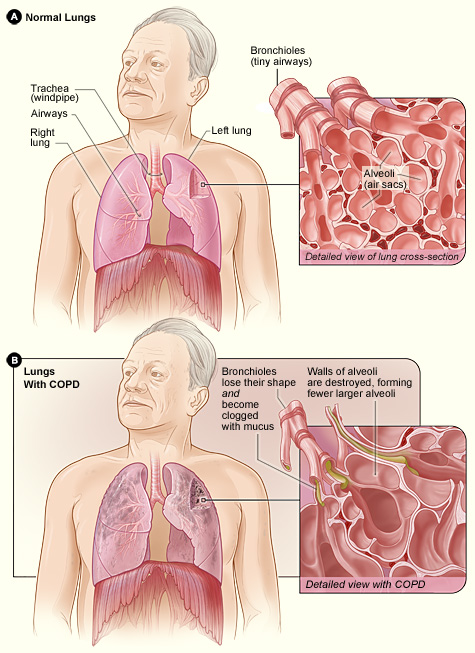
Difference between the lung of a COPD patient and an unaffected one. Image taken from NHLBI website (click on image to access the source)

Difference between the lung of a COPD patient and an unaffected one. Image taken from the NHLBI website (one of the leading institutes in providing information on various diseases; click on image to access the source)

Many of us will either suffer or have a relative/friend who suffers from a disease called Chronic Obstructive Pulmonary Disease (COPD, click on link for details) which is a progressive respiratory disease characterised by decreasing lung function (struggling to inhale/exhale air, irreversible airflow obstruction), very likely accompanied by chronic infections. COPD has a prevalence of over 2% in the UK population (corresponding to approx. 1 million in the UK, probably a lower bound estimate due to many undiagnosed cases; this figure is approx. 16 million in the USA) and is currently the third biggest killer in the world (only behind cancers and heart-related diseases) – costing the lives of millions (in the USA alone, number of deaths attributed to COPD is over 100 thousand); and the health services, billions of pounds.

Contrary to the well-known genetic disorders such as Cystic Fibrosis and Huntington’s disease, which are diseases caused entirely by a person’s genetic makeup and caused by mutations in a single gene, COPD is a (very!) complex disease with many genes and environmental factors (e.g. smoking, pollutants) contributing to the development/progression of the disease. This complexity makes it much harder to dissect the causes and find potential (genetic) targets for cures or therapies. However, we do know that smoking is by far the biggest risk factor with up to 90% of those who go on to develop clinically significant COPD being smokers. But only a minority (<25%) of all smokers develop COPD, indicating the strong role genetics can play in the progression of this disorder. Also not all COPD patients are smokers (up to 25% in some populations), indicating that – at least in some patients – genetics can play a rather determining role. I must stress that all the statistics I provide here can vary considerably from population to population due to different lifestyles and genetic backgrounds.

Genetic_epidemiology_genetics_mesut_erzurumluoglu

I – together with a large group of collaborators – search for genetic predictors of lung function, which helps us to identify which individuals are more likely to develop the disease and potentially understand the underlying biology/pathology of respiratory diseases such as COPD and asthma, and related traits such as smoking behaviour. To do this, we carry out what is called a genome-wide association study (GWAS, click on link for details), where we obtain the genetic data (millions of data points) from tens of thousands of COPD (or asthma) patients and ‘controls’ (people with normal lung function). To ensure that our results are not biased by different ethnicities, life styles and related individuals, we collect all the relevant information about the participants and make sure that we control for them in the statistical models that we use. GWASs have been extremely successful in the identification of successful targets for other diseases and have led to the field of Genetic Epidemiology (GE, click on link for details) to come to the fore of population-based medicine. GE requires extensive understanding of Statistics (needed to make sense of the very large datasets), Bioinformatics (application of computer software to the management of large biological data), Programming (needed to change data formats, manage very large data), Genetics (needed for interpretation of results) and Epidemiology (branch of medicine which deals with how often diseases occur in different groups of people, and why); thus requires inter-disciplinary collaborations.

GWAS results are traditionally presented with a Manhattan plot (due to its resemblance of the city's skyline) where the genetic variants corresponding to the dots above the top grey line (representing P values less than 5e-7 i.e. 0.0000005) are usually followed up with additional studies to validate their plausibility. Image taken from Wikipedia (click on image to access source)

GWAS results are traditionally presented with a Manhattan plot (due to its resemblance of the city’s skyline) where the genetic variants corresponding to the dots above the top grey line (representing P-values less than 5e-8 i.e. 0.00000005) are usually followed up with additional studies to validate their plausibility. Image taken from Wikipedia (click on image to access source)

The inferences we make from these studies can shed light in to which genes and biological pathways play key roles in causing COPD. We then follow up these newly identified genes and pathways to analyse whether there are molecules which could be used to target these and be potential drugs for treating COPD patients. Our results can be of immense help to Pharmaceutical companies (and ultimately to patients), as many clinical trials initiated without genetic line of evidence have failed, costing the public and these companies billions of pounds.

As smoking is the biggest risk factor for respiratory diseases like COPD, I am – also with the contribution of many collaborators – in the process of analysing whether some people are more likely to start smoking, stop after starting, and smoke more than usual when they start smoking. The results can have huge implications as many people struggle to stop smoking, and when they do, research suggests that up to 90% (figure differs between populations) of them start to smoke again within the first year after quitting. Smoking is not only a huge contributor to the risk of developing COPD, but also to lung (biggest killer amongst all cancers), mouth, throat, kidney, liver, pancreas, stomach and colon cancer (not an exhaustive list). In the UK alone, these cancers cause the slow and painful death of tens of thousands, alongside a huge psychological and financial burden on the families and public resources.

The “lung” and the short of it (stealing a phrase thought up by my colleagues at the University of Leicester, click on link to see who they are) is that COPD is a disease that is going to affect many of us, and any useful finding which leads to cures and/or therapies could increase the life years of COPD patients and affect the lives of thousands of people directly, and millions indirectly (e.g. families of COPD sufferers, cost to the NHS). Finding targets to help people stop smoking can potentially have even bigger implications as many continue to smoke, despite huge efforts and funding allocated to smoking prevention and cessation.

A nice TED talk about the world of Data science and Genetic Epidemiology

Addition to post (09/02/17): A Circos plot presenting results from our latest lung function GWAS (Wain et al, 2017; Nature Genetics) was shortlisted (title: Breathtaking genes) and displayed in the Images of Research exhibition (9th Feb 2017) organised by the University of Leicester

Read Full Post »

Birçok kez şuurlu (farkında olarak, özellikle babam), ama çogu kez de farkında olmadan anne-babam bana (ve kardeşlerime) birçok hayat dersi vermeye çalıştılar; ve verdiler/ögrettiler. Istemek/çalışmak ayrı, başarmak apayrı… Bazı anne-babalar çocuklarını küçümseyip “anlamazlar” sanıyorlar, fakat çocuklar her zaman anne-babalarını gözlemlerler; ve çogu kez taklit ederler. Cocukken yaptıklarımız – zorla, sevdirilmeden ve/ya anlatmadan yaptırılmamışsa – sonradan karakterimizi etkiler; ve “kişi 7’sinde neyse, 70’inde de odur” deyimi çogu kez dogru çıkar. Ornegin çocugu döverek/zorla terbiye etmeye kalkarsan, yarın büyüyüp, size ihtiyacı kalmadıgında anne-babanın tüm ögrettiklerini terk edeceklerdir. Hadi o zaman da döv; tabi dövebiliyorsan!

Bu yazıyı sadece kendi gözlemlerimi paylaşmak için yazıyorum (tum önceki yazılarım gibi). Isteyen istedigini alabilir…

Babamla başlayacagım…

1- Ben kendimi bildim bileli kimsenin malında, parasında, makamında gözüm olmadı. Kendi işime-gücüme baktım; başarılı olmak için çabaladım ve Allah bana birçok insana nasip etmedigi başarıları (ve nimetleri) nasip etti. Bugün anlıyorum ki bunun babamın bize helal para yedirmesiyle birebir ilişkisi var. Ama gerçekten (tabiri caizse) kılı kırk yararak yaşadı; ve ‘gerçekten helal’ yedirdi. Yoksa sorsak herkes “çocuklarıma helal lokma yedir(iyorum)dim” der, ama kaç tanesi gerçekten helal yediriyordur, sayıları nispeten çok azdır kanaatimce. Mesela kişi ‘iş-veren’se, kaç tanesi işçisinin hakkını tamamıyla veriyordur. Işçi ise, kaç tanesi işini gerçekten düzgün bir şekilde yapıyordur. Kaç tanesi torpil yapmadan, hak ederek bir yerlere girmiştir (ya da haketmedigi bir iş için birilerini aracı etmiştir)? Konumuz bu olmadıgı için uzerinde fazla durmayacagım. Vicdanında herkes biliyor bu soruların cevabını – en önemlisi de Allah biliyor! Insan helalinden kazanınca, hem dünyevi manada, hemde vicdanen mutlu oluyor. Kanaat etmeyi, işini dürüst yapmayı, kimsenin hakkına girmemeyi, Allah’tan başka kimseye dünya namına veremeyecegin bir hesabının olmaması; bunlar çok önemli şeyler! Hayatdaki en önemli şeyin ‘mutluluk sahibi olmak’ oldugunun, ve bunu da ancak helalinden (dürüst) iş yaparak kazanabileceginin canlı şahidi oluyorsun.

2- Babam bize bunun kadar önemli başka bir şey ögrettiyse, o da sadece çok çalışarak önemli yerlere gelebilecegimizi ögretmesidir. Yurt dışında da yaşasan, fakir de olsan, farklı bir dinden-dilden-görünüşten de olsan, hakeden adamın önünü kimsenin alamayacagını ögretti. “Hakkım yeniyor” diye aglayıp sızlama yerine, gerçekten işe yarar bir adam olursan, kimse senin yerine başka ‘işe yaramaz’ bir adamı tercih etmez. Bir yerde olmazsa, başka yerde mutlaka alırlar. Bundan dolayı çok çalıştım; başkalarından fazla çalıştım; ve Allah’ın da izniyle hep başarılı oldum.

3- Babam ayrıca kimsenin evde sigara içmesine izin vermezdi – yaşlılara ve kendi kardeşlerine bile. (Ben ve hiçbir kardeşim sigara içmez.)

4- Amcalarımın/büyüklerimizin bizimle ilgilenmek ve bizi güldürmek için yaptıkları fakat kandırmalı şakalarına bile ciddi bir şekilde karşı çıkardı. Mesela bir parmagını gösterip “bu hangi sayı?” diye sorarlardı. Tabi “bir” derdik. Sonra iki parmagını birleştirip, “peki, bu hangi sayı?” diye tekrar sorarlardı; biz de “iki” derdik. Fakat amcam “hayır, bu ‘kalın-bir’” derdi. Biz de şaşırırdık. Fakat bunu babam gördügünde onlara dönup “çocukları kandırmayın” der, sonra da bize dönüp “hayır kızım/oglum, siz dogrusunuz; evet bu da ‘bir’” derdi.


Anneme gelecek olursak…

Babam genellikle, çocukluk yıllarımızda bizimle fazla (istedigi/istedigimiz kadar) ilgilenemedi. Cünkü hem çalıştı-para kazandı, hem okudu (doktora yaptı), hem bize baktı; başkalarının işleriyle de (yardım etmek için) çok ugraştı. Cok fedakar bir insandı. Bu yüzden neredeyse hayatının her döneminde çok yogun bir hayat yaşadı.

1- Bundan dolayı bizimle genellikle annem ilgilendi; ve çocukken ne ögrendiysek çogunu annemizden ögrendik. Annemin üniversite diploması yoktu fakat kendisini çok iyi yetiştirmiş bir insandı. Babam fedakarlık ve cefakarlıkta ‘bir’se, annem (nispeten) ‘on’du. Bize okumamızı, kötü alışkanlıklardan uzak durmamız ve vatana-millete-insanlıga faydalı insanlar olmamız gerektigini bıkmadan-usanmadan anlatarak, bizim yaramazlıklarımıza sabrederek, büyük fedakarlıklar yaparak ögretti; ve bu öğretileri içimize adeta işledi. Bizimle çok yakın bir bağ kurdugundan (korktugumuzdan degil) ona karşı saygısızlık yapmaya çocukken bile uzak dururduk. Bu yüzden bize bazen ufak hatalarımızdan dolayı kızdıgında bile karşı çıkmazdık. Mesela üzerimde azıcık sigara kokusu bile olsa çok kötü kızardı. “Yok anne biz degil, arkadaşlar içti” desek te, “o zaman, o arkadaşlarından uzak dur!” derdi. Agzımızdan küfür çıksa ve/yada ‘edep dışı’ sayılacak olayları konuştugumuzu duysa hemen kızardı. Hem de çok! (Ailemizde agzı küfürlü kimse yok)

2- Fakir degildik çok şükür; evde (memur maaşıyla) tek parayı kazananın babaların oldugu her Türk ailesi gibiydi bizim durumumuzda – yani ‘orta hal’ denebilir. Fakat çok kanaatkar bir aileydik. Annem ögretti bunu da bize. Belki farkında dahi olmadan… Bunun ne kadar önemli oldugunu şimdi anlıyorum. Eger zengin/kalbur-üstü bir aileden gelmiyor ama hayatda gerçekten başarılı olmak istiyorsanız, nispeten çok çok daha az *hata yapma şansınız/hakkınız oluyor. Cok şükür bugün (genç ve nispeten başarılı bir akademisyen olarak) dönüp baktıgımda (Allah’a karşı verecek çok hesabım var fakat) dünya namına hesabını veremeyecegim bir suçum, yüz kızartıcı bir halim ya da bilerek hakkına girdigim/yarı yolda bıraktıgım bir insan hatırlamıyorum. Genç yaşıma ragmen kanaatkar olmanın ve (çapım yettigince) haramdan/kul hakkından uzak durmanın başarılarımda ne kadar büyük bir payının oldugunu yeni yeni anlıyorum. Insanlar kısa zamanda ‘köşeyi dönmenin’ peşinde koşarken, ben sabırla okudum, çalıştım, ve bir çogunun (akademik olarak) başaramadıgını başardım…


Ne annem, ne de babam, bizi hiç bir zaman kısıtlamadılar. Dindar olmalarına ragmen, dindar insanların çogu kez başaramadıgı ‘açık görüşlü olmayı’ başardılar; ve bize de tembihlediler. Kesinlikle “şunu-bunu yapma” demediler. “Her işin bir adabı vardır, adabına gore yapın” dediler. Babam bana hep “Mesut bey” diye hitap ederdi. Bir şey sordugumda ya da kendisine muhalefet ettigimde “ya Hu napacan?” ya da “git işine yorgunum şimdi!” demek yerine, bana anlatmaya çalışırdı. Bana hep bilginleri, bilim adamlarını ve alimleri örnek gösterirdi. Kendilerinden birşeyler ögrenebilecegim, kaliteli ve ahlaklı insanlarla tanıştırırdı. Şaka yollu da olsa, sınavlarımızda 95’te alsak, “neden 100 almadın?” diye tembihlerdi… Bu sayede belki de rehavete düşmemizi engellemeye çalışırdı.

Son olarak, annemin de, babamın da agızları hep dualıdır. Duaları sayesinde hep önümün açıldıgını gördüm hayatta. Bunun da onemini yeni yeni anlıyorum; ve herkese tavsiye ediyorum “anne-babanızın duasını alın mutlaka” diye.

Tabi “hatasızdılar” ya da “mükemmeldiler” demiyorum. Onlar da gençti; kimse onlara ‘anne-babalık nasıl yapılır?’ı ögretmedi. Onlerinde öyle çok iyi örnekler de yoktu. Hem babam, hem annem devamlı güçlü olmak zorunda kaldılar. Ne kadar güçlü de olsalar, bazen yorulmuş, bazen ‘tepeleri atmış’, ve (bize ya da birbirlerine) kendi yüksek seviyelerine yakışmayacak bir-iki davranışta bulunmuş olabilirler… Fakat kendilerini hep geliştirdiler; ve zamanla bazı şeyleri daha iyi yapmaya ve bizlere karşı daha sabırlı ve toleranslı davranmayı ögrendiler. Fakat yaptıkları tonlarca iyi iş karşısında, bir-iki ufak hatayı hatırlatmak hakkaniyetli bir davranış olmaz. Ayrıca onları eleştirmek haddime degil.

Allah onları başımızdan eksik etmesin!

*Bu durumda olmanın en büyük handikapı , arkadaşlarının çogu ‘gelecegi parlak olmayan’ tipler oluyor. Suç, kötü alışkanlıklar, cehaletden doğan ahlaksızlıklar vs. diz boyu. Allah korudu bizleri!


PS: Bizim kültürümüzde, genel olarak anne ‘terbiyeci’, baba ise ‘rol model’dir çogu zaman. Insana terbiye sınırlarını, adabı ve kanaati anne öğretir; baba ise çocuklarının onünü açar (ya da kapatır) ve büyük işler başarabileceklerine inandırtır onlara (ya da bu inancı bitirir ve çocuk ‘ezik’ bir tip olur)!

Read Full Post »

UBU Staff League Cup 2015 winners ‘Flying Foxes’ team (Left to Right): Chris Z, Esat E, Mesut E, Guillermo B, Adam T, Askhat T. Tom R was also in the team

UBU Staff League Cup 2015 winners
‘Flying Foxes’ team (Left to Right): Chris Z, Esat E, Mesut E, Guillermo B, Adam T, Askhat T. Tom R was also in the team

‘Flying Foxes’ Team: Mesut Erzurumluoglu (Captain), Esat Erzurumluoglu, Tom G Richardson, Askhat Tleuov, Adam JW Trickey, Jie ‘Chris’ Zheng, Guillermo Fernandez Bunster

See link for full details: Mesut and Co win University of Bristol Staff League Cup 2015

Results

Group Stage:

Flying Foxes 7-1 Mighty Midgets (Mesut 3, Guillermo 2, Adam, Tom)

UoB Staff Team 1-2 Flying Foxes (Adam, Guillermo)

Phys Pharm 2-8 Flying Foxes (Mesut 3, Guillermo 2, Adam 2, Tom)

Eintracht Autopiroozeurs 1-1 Flying Foxes (Adam)

Group Standings (top three)

1st: Flying Foxes (10pts), 2nd: UoB Staff Team (9pts), 3rd: E. Autopiroozeurs (7pts)

Final: Galbani Team 2-4 Flying Foxes (Mesut, Esat, Guillermo 2)

Read Full Post »

Coursera Logo

Coursera Logo

How recent it may seem, when I was a undergrad student (2007-2011) the internet was useless in terms of academic study. Whatever you read from Wikipedia was wrong, all you could do in Youtube was watch some cat videos, and there were no quality resources to access. We had to go to the library to find books (which were mostly outdated) to read out about the subject matter.

Nowadays there are tens of fantastic websites (e.g. Google classes, scientific blogs, past exam papers) and Youtube channels (e.g. Khan Academy, Crash Course) where people have taken the time to organise high-quality courses and/or videos which explain the subject clearly in a relatively short amount of time. Also a lot of the stuff in Wikipedia is top notch nowadays. However what really stands out for me is Coursera. High quality courses for free, tailored to your interest(s) and learning at your own pace; and if you try hard enough you get a certificate (an example below) – which could look good on your CV. I really wish Coursera (and others) was around when I was an undergraduate student.

The point of this post is that youngsters must make the best of the internet nowadays. It has turned into a fantastic resource for learning anything you want! *It just takes a simple Google search most of the time…

*also see my Recommended Websites post for other educative websites

‘Game Theory’ Coursera course certificate

‘Game Theory’ Coursera course certificate

To prove a point, these are the MOOCs I have finished so far (from Feb 2012 to July 2014):

Ones relevant to my research area/interests:

Google’s Python Class by Google Developers

Statistics in Medicine by Stanford University

Computing for Data analysis by John Hopkins University

Epigenetic Control of Gene Expression by University of Melbourne

Computational Molecular Evolution by Technical University of Denmark

Introduction to Systems Biology by Ichan School of Medicine at Mount Sinai

For fun/recreational learning:

Game Theory by Stanford University & University of British Columbia

Introduction to Philosophy by University of Edinburgh

Exploring Quantum Physics by University of Maryland

Archaelogy’s Dirty Little Secrets by Brown University

Think Again: How to Reason and Argue by Duke University

Constitutional Struggles in the Muslim World by University of Copenhagen

Crytography by University of Stanford

Read Full Post »

Department for Education and Skills’ (DfES) report for Children of Ethnic Minority in 2006/07 showed a bleak picture for students of ethnic minorities living in the UK – as they were all performing below the national average. However the picture was even more disturbing for Turks/Kurds because their children were the least performing out of all the groups that had a considerable size in the UK. I am hoping things have gotten better for the Turkish community since then as there have been many steps taken to stop this rot, especially by the Turks themselves. They have opened many supplementary and/or weekend schools all over the UK especially in London and Leicester where there is a considerable amount of Turkish/Kurdish migrants. In one of these weekend schools, called the Horizon supplementary school (located in Leicester), I obtained the Keystage 2 (KS2) and Keystage 3 (KS3) results of nearly 30 students (years 6 to 9) attending their classes and compared them with DfES’s findings. The results were surprising:

ks2 ks3

Overall, the Horizon school’s pupils had achieved higher in all subjects compared to the national average let alone other ethnic minority groups. The difference is greater in Maths and Science.

These results make it clear that given the opportunity, children of Turkish/Kurdish/Turkish-Cypriot background can perform as good as anyone, if not better. Therefore the Turkish/Kurdish community must carry on supporting the existing supplementary schools; and if possible improve on what they’re doing by opening more schools. This is why I’d recommend all ethnic minorities in the UK to follow the Turks’ example and support their children in achieving their academic potential. Educated children would not only be the source of good for the corresponding ethnic minorities, but also the British society as a whole.

Best wishes!


PS: To add to the comments above, the below newspaper article portrays my views in 2006 (when I had just turned 18). I do not agree entirely with it nowadays; would have worded some things differently…  🙂

Me in Leicester Mercury (August 2006)

Me in Leicester Mercury (August 2006)

Read Full Post »

Older Posts »