Feeds:
Posts
Comments

Archive for the ‘English’ Category


This blog post first appeared on the Leicester Connect webpage (a platform for University of Leicester Alumni) on the 20th March 2020


Out of all the inspirational quotes on the internet, an old Sufi saying is the one that touches me the most:

“There are as many paths to God as there are souls on Earth.”

Although it is mostly used in a religious (mostly Islamic) setting, for me it carries truths that tower above this narrow meaning. It especially reminds me that we all start from different steps of the ladder, face different challenges along the way, and ultimately end up where we are because of the way we respond to those challenges, the doors that are open to us and the people we meet along the way – with the latter two we mostly cannot control.

I was kindly asked if I could write a blog post after being awarded the Future Leader Award at the 2020 Alumni Awards. I am grateful and honoured to have received the award but also acknowledge that there were at least two more people (my fellow finalists) who deserved it as much as me – if not more.

I would like to start by saying – from my experience in life and academia – that there are no objective criteria which separates those “who made it” versus those who just fell short. I got to meet plenty of people and interview panels who I felt judged me using very narrow and subjective criteria and ignored every other quality I had. It’s always nice to get the job or funding you applied for, however I never dwelled on the outcome if I did my preparation right. I would strongly recommend this approach.

Free yourself from the need for appreciation

Many academics suffer from a condition called Impostor Syndrome – simply put, doubting one’s own accomplishments and constantly fearing being exposed as a “fraud”. I can’t say I ever had it because I always thought of myself as successful in my own way and never sought confirmation from anyone. Although striving to improve myself all the time, I was happy with “just trying to do the right things” – irrespective of the outcome.

I base this belief on the fact that the people who judge us do not know the full story about us. Maybe if they did, they would look at us differently. For example, someone who is born to a middle-class English family will not be able to judge how much of a success it is for an immigrant to learn advanced-level English from scratch, get citizenship and compete for the same positions. Someone who has not had any serious health issues will not be able to comprehend what success is for a disabled person. How about a person who has managed to stay away from crime in a neighbourhood full of ignorance, hate and violence? None of these are mentioned in a CV and no one finds these people and offers them an MBE… or a job. However, this doesn’t change the fact that these people are inspirational and successful. I can only wish more people would realise this and stop treating subjective decisions about themselves or others as objective truths.

I feel privileged to be living in the UK which is a relatively meritocratic country and has a higher quality of life index compared to most. However, this also means that the competition is fiercer for “top jobs” and can mean those from underprivileged backgrounds are affected severely. One must realise this early on and respond to the challenge. The good news is that there are plenty of people out there who are willing to help and share their knowledge and experience when approached.

Believe in yourself but get help. Make friends!

I had to overcome many financial, emotional and visa issues during my undergraduate years which undoubtedly affected my performance. When I somehow graduated from the University of Leicester with a 2.1 in BSc Genetics in 2011, I did not listen to the people who thought I would not be able to make the cut in academia and started applying for PhDs. Before applying, I read all the blogs and papers that were out there about “selling yourself well” and making your CV stand out. I always did my research before taking an important step. Thankfully, I must have been at the right place at the right time as I was very fortunate to be offered a fully-funded studentship at the University of Bristol – I remember even my interview not going that well. The scholarship freed me from the shackles of financial distress as I was embarking on an academic career.

Again, doing my thorough background reading, I quickly realised that the field of Genetic Epidemiology – the field I now found myself in – required a solid foundation in medical statistics, epidemiology, bioinformatics, and programming as well as human genetics. I realised and accepted my limited expertise in these fields and got to work. I got all the help and knowledge I need from my supervisors, friends, online courses, blogs and research papers. I made sure I spent at least 2-3 hours a day on improving myself on top of working on my specific PhD project. Not keeping to myself, I was also supportive and sincere with my “PhD friends” who were on the same boat as me. I’m still close with many of my supervisors/teachers and friends. I couldn’t have achieved what I’ve achieved without their help.

Ultimate success: happiness and self-respect

In this fast-paced world, especially in academia, we continually forget that family and friends are worth more than any academic success. Although my academic papers are important to me – and I can only hope they’ll be useful to someone, somewhere, somehow – I do not spend much time thinking about my papers or PhD thesis. But I’m always longing to spend more time with my family and friends and the fact that I have them is the success of my life.

I want to finish by saying that I was very fortunate to get to where I am and achieve many milestones in the process, but it could have all turned out very differently, very easily. Yes, I tried to do the right things, but many things were out of my control. But as long as I had my friends and family, I’d like to think I would have been happy wherever I ended up.

I wrote all of these to convince you of one thing: do not let others – even senior people – define what success is for you as they do not know you and how you got to where you are. Just keep doing the rights things and, with the help and support of your loved ones, you’ll eventually get through everything in life.

Feel free to contact me!

I blog – in English and Turkish – about my research and other academia and culture-related things…

E.g. a post that may be of interest: An Academic Career in the UK

Download

If you’d like to download the blog post as it appeared on the Leicester Connect website, click the ‘Download’ button below:
Read Full Post »

This is a post inspired by a question I saw online: Which single public health intervention would be most effective in the UK?

I would like to share my own views on the question although don’t expect anything comprehensive as I don’t have much experience about how an idea can be taken further to impact policy and public health practice.

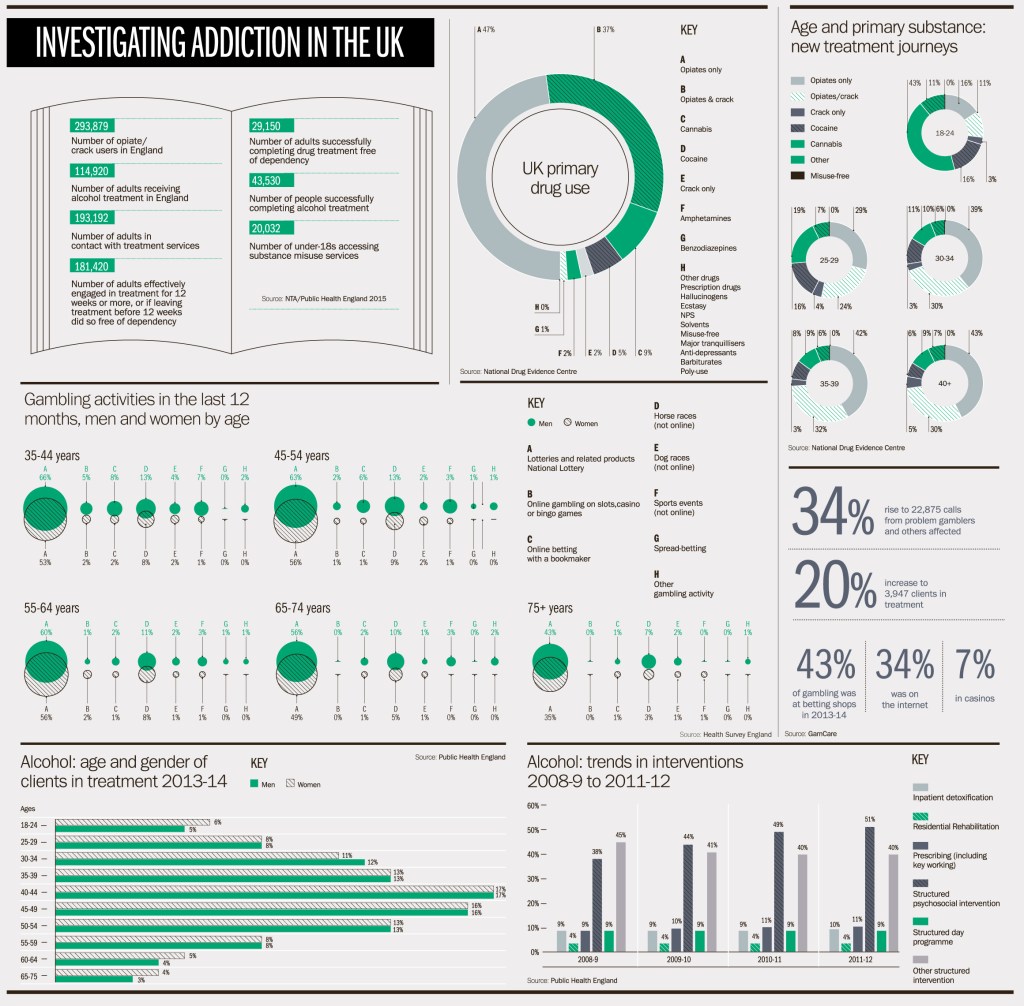
‘Investigating addiction in the UK’ study. Source URL: http://www.raconteur.net

Something must be done – and fast!

Legend has it that a great chess player travelled to Manhattan to take part in a World Chess tournament. Looking around Central Park, he saw that a crowd had gathered around a street chess player who was offering money to those who could beat him. He decided to give it a go – and after a gruelling match, they shaked hands on a draw. This dented his confidence and ultimately caused him to return to his homeland without taking part in the tournament.

Little did he know that the street chess player was a grand master who wanted to pass time before taking part in the same the tournament.

What has this got to do with a public health intervention? I will come back to it…

From my observations over the last 7-8 years as a scientist studying different common diseases such as diabetes – to which £1 of every £10 of the NHS’s budget is spent on, obesity – which is the major risk factor for heart attacks, and chronic obstructive pulmonary disease (COPD) – currently the third leading killer in the world, it is clear that cheap and effective treatments for these diseases are a long way away. This is not to say that there is no progress as there is tremendous research being carried out on (i) understanding the molecular causes of (e.g. genes, proteins that cause) these diseases and (ii) developing new therapies. The continuous economical costs of treating patients with current state-of-the-art therapies is reaching infeasible levels with a significant proportion being wasted on patients who do not adhere to their prescriptions properly1 and ‘top selling’ drugs being so inefficient that up to 25 patients need to be treated in order to prevent one adverse event such as a heart attack2. These diseases drain the NHS’s budget, cost the lives and healthy years of hundreds of thousands of people and causes emotional distress to the patients and their loved ones. If something is not done now – and quick – latter generations may not have an NHS that is ‘free and accessible to all’ to rely on as the system is already showing signs of failure in many parts of the country3,4 – although costing around 1 in 5 of the government’s annual budget.

Parents need help!

What is also striking about these diseases is that up to 9 in 10 cases are thought to be preventable. Thus, concentrating on prevention rather than ‘cure’ makes most sense as the only economically feasible solution lies here. No single public health intervention is going to solve all the problems that the UK health system faces currently but one thing that has always stared me in the face was how clueless and/or irresponsible most parents are, regardless of which socio-economic stratum they belong to – writing this sentence as I read an article on a teenager who died from obesity after his mother continually brought takeaway to his hospital bed5. The consequence is children living through many traumatic experiences, picking up bad habits and developing health problems due to a combination of ignorance, lack of guidance and toxic environments.

A wise man was once asked: “How do we educate our children?” and he is said to have replied “Educate yourself as they will imitate you”. As a new father, I got to observe first-hand that my child is virtually learning everything in life from myself and my wife. Thinking back, my parents never smoked, did not allow any visitors to smoke in the house, and kept me away from friends who smoked. Their actions were the main factor for myself and my three siblings to never start smoking – although there was pressure from my school friends. Research suggests that this is true across the general population, that is, if parents do not smoke, their children are more likely to become adults who will not either6; if parents prepare healthy food, their children will do too; if parents do not drink or drink moderately, the children will do too; if parents are educated, their children will be too7; and the list goes on… As the only economically feasible hope seems to be prevention, there is no better place to start than educating parents.

Since starting as a researcher at my current institute, I have been to a dozen or so ‘induction courses’, taking lessons on a variety of subjects from ‘equality and diversity’ to ‘fire safety’ to ’unconscious biases’. Although most seemed a bit of a time waster at first, after enrolling to them, I soon accepted that these were important as I did not know how crucial they were in certain situations – situations that are more common than one would think. I would not have attended them if they were not mandatory.

However, arguably, none of these skills that I picked up in these induction courses are as important as being a good parent and helping my children achieve their potential physically, intellectually, psychologically, emotionally and socially. I think it is irresponsible that there exists no mandatory training before people become parents. We as parents are expected to be not just people who keep our children alive by providing for them, but we are also expected to be good dieticians, sleep coaches, pedagogues, psychiatrists, life coaches, friends… Unsurprisingly, many parents are failing horribly as we are not equipped with a solid foundation to guide them properly. The result is: one-third of the population is obese, one-fourth drink above advised thresholds, one-fourth of students report to have taken drugs, one-fifth smoke (noting that vaping is not included in this figure), one-fifth show symptoms of anxiety or depression and up to one-tenth may be game addicts.

To help parents in this long and extremely difficult journey of parenthood, I propose mandatory courses tailored for first-time parents – with exemptions & alternatives available. The specific syllabus and the length of the course should be shaped by pedagogy, public health, psychology, sociology, and epidemiology experts but also by the parents themselves.

In this course parents can:

  1. Be persuaded about the importance of such a course – just as I learned that spending time learning about fire safety was not a bad idea
  2. Be provided with links on where to easily find reliable information (e.g. NHS website)
  3. Learn about the mental and physical health aspects of smoking, drinking alcohol, exercising, eating high sugar content food, pollution, watching TV, reading books, cooking healthy food, mould, asthma triggers, excessive use of social media etc.
  4. Feedback any problems they have to a central panel and make suggestions as to how the course could be improved
  5. Hear about local activities (e.g. ‘Stop smoking’ events, English courses, even events such as Yoga classes)
  6. Receive information about who they can contact if they themselves have addiction problems (e.g. smoking, alcohol, drugs, gambling)
  7. Learn about what to look out for in their children (e.g. any obvious signs of physical and mental diseases, bullying)
  8. Be encouraged to support their children achieve their potential – no matter what background they come from
  9. Be encouraged to offer help in local as well as national problems such as the organ donor shortage, climate change (recycling, carbon emissions), air pollution etc.
  10. Be reminded of the responsibility to provide future generations a sustainable world
  11. Be taught about the relevant laws (e.g. child seat, domestic abuse, cannot leave at home on their own).

I believe if the course is designed with the help of experts but also by parents, the course can be engaging and lead to more knowledgeable parents. This is turn will lead to positive changes in behaviour and a significant drop in the incidence of unhealthy diets/lifestyles, (at least heavy) smoking, substance use and binge drinking – major causes of the abovementioned common diseases. I think to ensure that parents engage and take part in the process, an exam should be administered where individuals who fail should re-take the exam. Parents who contribute to the process with feedback and suggestions can be rewarded with minor presents or a simple ‘thank you’ card from the government itself – a gesture that is bound to make parents feel part of a bigger process. Parents who are engaged in this process will also be encouraged to engage with their children’s education and help their teachers when they start going to school. Parental participation in turn, will positively affect academic achievement and the healthy development of children – a phenomenon shown by many studies8,9. Incentives such as additional child tax credit/benefit and/or paid parental leave for both parents should be considered to increase true participation rates.

These courses can then be accompanied by a number of optional courses where NGOs and volunteers from the local community can offer advice on matters such as ‘how to quit smoking?’, ‘how to find jobs?’, online parenting, English language courses (for non-speakers), and engaging children with local sports teams. I would certainly volunteer to give a session on the genetic causes of diabetes and obesity – and I know there are plenty of academics and professionals (e.g. experienced teachers, solicitors) out there whom would happily offer free advice to those who are interested. There are NGOs providing information on almost all diseases and health-related skills (e.g. CPR, first-aid) and this course would offer a more targeted and cost-efficient platform for them to disseminate their brochures and information on their upcoming events.

Many upper-middle to upper class parents regularly attend similar courses and events – and making this available to every parent would represent another way to close ‘the gap’10. Old problems persist but new ones are added on top such as online gaming, e-cigarettes, FOMO and betting addiction – and the courses can evolve with the times. A government which successfully implements such a course can leave a great legacy as social interventions have long lasting impact and even affect other countries.

One could argue that a course like this should be offered to every citizen at few key stages in their lives (e.g. first parenthood, before first child reaches puberty) – and that would be the ultimate aim. But as this option may initially be very costly and hard to organise and focusing on parents ensures that not only the parents are educated but consequently the children are too – making the process more cost efficient. The first courses could be trialled in certain regions of the country before going nation-wide.

We are all in the same boat – whether we realise or not

I would like to diverge a little to mention the potential sociological benefits of the proposed course: Tolstoy, in Anna Karenina wrote “Happy families are all alike; every unhappy family is unhappy in their own way” – also an increasingly used aphorism in public health circles. However, I observe and believe that many of us are unhappy due to similar reasons: we all want to be listened to, understood and feel like we are being cared about. I believe the proposed course accompanied with an honest feedback system would be a great start in getting the ‘neglected masses’ involved in national issues.

I would like to finish by returning to the little story at the start. I believe that many parents, especially those from poorer backgrounds, give up trying for their children early on as they do not think that they or their children can compete against other ‘well-off’ individuals and therefore see no future for themselves. Their children and grandchildren also end up in this vicious cycle. But if they get to see first-hand in the proposed course that we all – rich and poor – start from not too dissimilar levels as parents and have the same anxieties about our children can also motivate us all to push a little bit extra and hopefully close the massive gaps that exist between the different socio-economic strata in the UK11 – and ultimately decrease the prevalence of the diseases that are crippling the NHS.

Further reading

  1. Shork, N. 2015. Personalized medicine: Time for one-person trials. Nature. 520(7549)
  2. Bluett et al., 2015. Impact of inadequate adherence on response to subcutaneously administered anti-tumour necrosis factor drugs: results from the Biologics in Rheumatoid Arthritis Genetics and Genomics Study Syndicate cohort. Rheumatology. 54(3):494-9
  3. NHS failure is inevitable – and it will shock those responsible into action. The Guardian. URL: https://www.theguardian.com/commentisfree/2018/apr/06/nhs-failure-health-service. Accessed on 30th October 2019
  4. The first step towards fixing the UK’s health care system is admitting it’s broken. Quartz. https://qz.com/1201096/by-deifying-the-nhs-the-uk-will-never-fix-its-broken-health-care-system/. Accessed on 30th October 2019
  5. Teenager Dies from Obesity After Mother Brought Takeaways to His Hospital Bed – Extra.ie. URL: https://extra.ie/2019/09/12/news/extraordinary/child-dies-obesity-mum-hospital. Accessed on 27th October 2019
  6. Mike Vuolo and Jeremy Staff. 2013. Parent and Child Cigarette Use: A Longitudinal, Multigenerational Study. Pediatrics. 132(3): 568–577
  7. Sutherland et al. 2008. Like Parent, Like Child. Child Food and Beverage Choices During Role Playing. Arch Pediatr Adolesc Med. 162(11): 1063–1069
  8. Sevcan Hakyemez-Paul, Paivi Pihlaja & Heikki Silvennoinen. 2018. Parental involvement in Finnish day care – what do early childhood educators say? European Early Childhood Education Research Journal, 26:2, 258-273
  9. Jennifer Christofferson & Bradford Strand. 2016. Mandatory Parent Education Programs Can Create Positive Youth Sport Experiences. A Journal for Physical and Sport Educators. 29:6, 8-12
  10. How Obesity Relates to Socioeconomic Status. Population Reference Bureau. URL: https://www.prb.org/obesity-socioeconomic-status/. Accessed: 18/12/19
  11. Nancy E. Adler, Katherine Newman. 2002. Socioeconomic Disparities In Health: Pathways And Policies. Health Affairs. 21:2, 60-76

Read Full Post »

It is not the strongest of the species that survives, nor the most intelligent that survives. It is the one that is most adaptable to change – attributed to Charles Darwin

“How did you get accepted to Cambridge?”

I saw a tweet a while ago which said something along the lines of: “If you’ve been asked the same question three times, you need to write a blog post about it”. I get asked about how I got my current postdoc job at the University of Cambridge all the time. Therefore, I decided to write this document to provide a bit of a backstory as I did many things over the years which – with a bit of luck – contributed to this ‘achievement’.

It is a long document but hopefully it will be worth reading in full for all foreign PhD students, new Postdocs and undergraduates who want an introduction to the world of academia in the UK. I wish I could write it in other languages (for a Turkish version click here) to make it as easy as I can for you, but I strived to use as less jargon as possible. Although there is some UK-specific information in there, the document is mostly filled with general guidance that will be applicable to not just foreign students or those who want to study in the UK, but all PhD students and new Postdocs.

I can only hope that there are no errors and every section is complete and fully understandable but please do contact me for clarifications, suggestions and/or criticism. I thank you in advance!

To make a connection between academia in the UK and the quote attributed to Darwin above, I would say being very clever/intelligent is definitely an advantage in academia but it is not the be-all and end-all. Learning to adapt with the changing landscape (e.g. sought-after skills, priorities of funders and PIs), keeping a good relationship with your colleagues and supervisors, and being able to sell yourself is as, if not more important. Those who pay attention to this side of academia usually make things easier for themselves.

I hope the below document helps you reach the places you want to reach:

Good luck in your career!


I included this tweet here because Ed was one of my lecturers when I was a first year undergraduate student at the University of Leicester (2007)
I was kindly asked to send in a short video for the 2022 Univ. of Leicester Annual Alumni Dinner

Read Full Post »

Many of today’s scientists (incl. myself a lot of the time) have probably lost touch with some of the central tenets of being a scientist – instead titles, number of published papers and grant money brought in becoming more important than the societal impact of their publications and how much they contributed to human knowledge. A shoddy paper published in Nature/Science/Cell (especially if cited/talked about a lot) carries far more weight than a solid paper in a less glamorous journal. An academic who brings in grant money – doesn’t matter if he/she wastes it on shoddy or average research – is far more important (i.e. they will be promoted and bring in further funding easier as they already brought in some before) than one who chooses to concentrate on producing solid research but struggles to bring in money e.g. due to a lack of funding in their specific field or publishing papers in non-glamorous journals due to ‘non-exciting’ results as they didn’t add a spin to their conclusions (click here for other examples). Some of the papers published in prestigious journals in my field would not have been accepted if the senior authors of the same papers were the reviewers – many seem to apply a less stringent criteria to their own papers. The relationship between editors and some senior scientists is also opaque which is ultimately damaging to science. Image source: naturalphilosophy.org

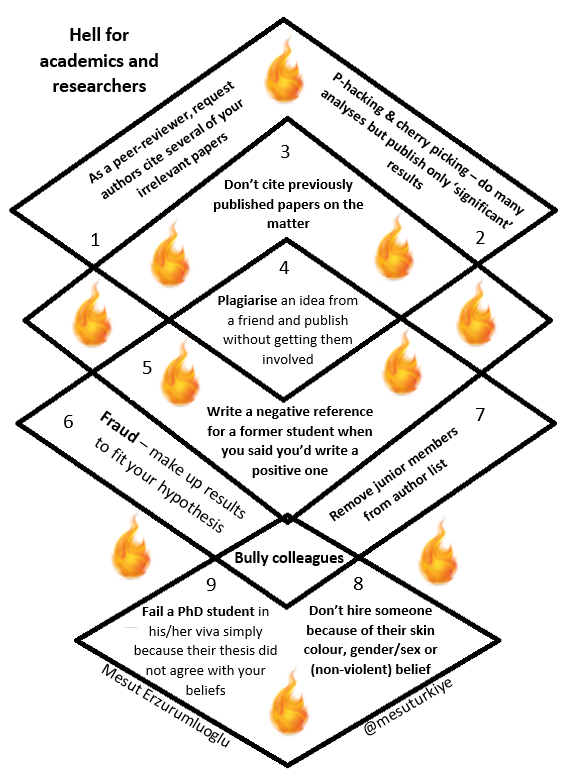
Hell for academics and researchers (NB: The list is loosely ordered and is not an exhaustive one). Of course, inspired by Dante’s Nine levels/layers/circles of Hell

A few months ago, I spent almost a week trying to replicate a published “causal” association which had received >500 citations in the last 5 years. My aim was to provide a better effect estimate and to do this, I used two different datasets, one with similar and another with a larger sample size. However, both of my analyses returned null results (i.e. no effect of exposure on outcome). Positive controls were carried out to make sure the analysis pipeline was working correctly. Ultimately, I moved on to other ‘more interesting’ projects as there was no point spending time writing a paper that was probably going to end up in a ‘not-so-prestigious’ journal and never going to get >500 citations or be weighted heavily when I apply for grants/fellowships.

Consequently, inadvertently I contributed to publication bias on this issue – and no other analyses on the subject matter were published since the original publication, so I am sure others have found similar results and chose not to publish.

State of academia (very generally speaking): Really talented and successful people working like slaves for unimportant academic titles and average salaries. What’s worse is that the job market is so fierce that most are perfectly happy(!) to just get on with their ‘jobs and do what they’ve always been doing (Note: this is my first attempt at drawing using Paint 🙂 )

However, I have changed my mind about publishing null/negative results after encountering Russell, Wittgenstein and others’ long debates on proving ‘negative’ truths/facts (and in a nutshell, how hard it is to prove negatives – which should make it especially important to publish conclusive null findings). These giants of philosophy thought it was an important issue and spent years structuring their ideas but here I am, not seeing my conclusive null results worthy of publication. I (and the others who found similar results) should have at least published a preprint to right a wrong – and this sentiment doesn’t just apply to the scientific literature. I also think academics should spend some time on social media to issue corrections to common misconceptions in the general public.

This also got me thinking about my university education: I was not taught any philosophy other than bioethics during my undergraduate course in biological sciences (specialising in Genetics in the final year). I am now more convinced than ever that ‘relevant’ philosophy (e.g. importance of publishing all results, taking a step back and revisiting what ‘knowledge’ is and how to attain ‘truth’, how to construct an argument1, critical thinking/logical fallacies, what is an academic’s intellectual responsibility?) should be embedded and mandatory in all ‘natural science’ courses. This way, I believe future scientists and journal editors would appreciate the importance of publishing negative/null results more and allow well-done experiments to be published in ‘prestigious’ journals more. This way, hopefully, less published research findings are going to be false2.

References/Further reading:

  1. Think Again I: How to Understand Arguments (Coursera MOOC)
  2. Ioannidis JPA. Why Most Published Research Findings Are False. PLoS Med. 2(8): e124 (2015)
  3. How Life Sciences Actually Work: Findings of a Year-Long Investigation (Blog post)
  4. An interesting Quora discussion: Why do some intelligent people lose all interest in academia?
  5. Calculating the ‘worth’ of an academic (Blog post)
A gross generalisation but unfortunately there is some truth behind this table – and it’s not even a comprehensive list (e.g. gatekeepers, cherry picking of results). Incentives need to change asap – and more idealists are needed in academic circles!

*the title comes from the fact that today’s natural scientists would have been called ‘natural philosophers’ back in the day

Read Full Post »

smoking_genetics_gwas_mesut_erzurumluoglu
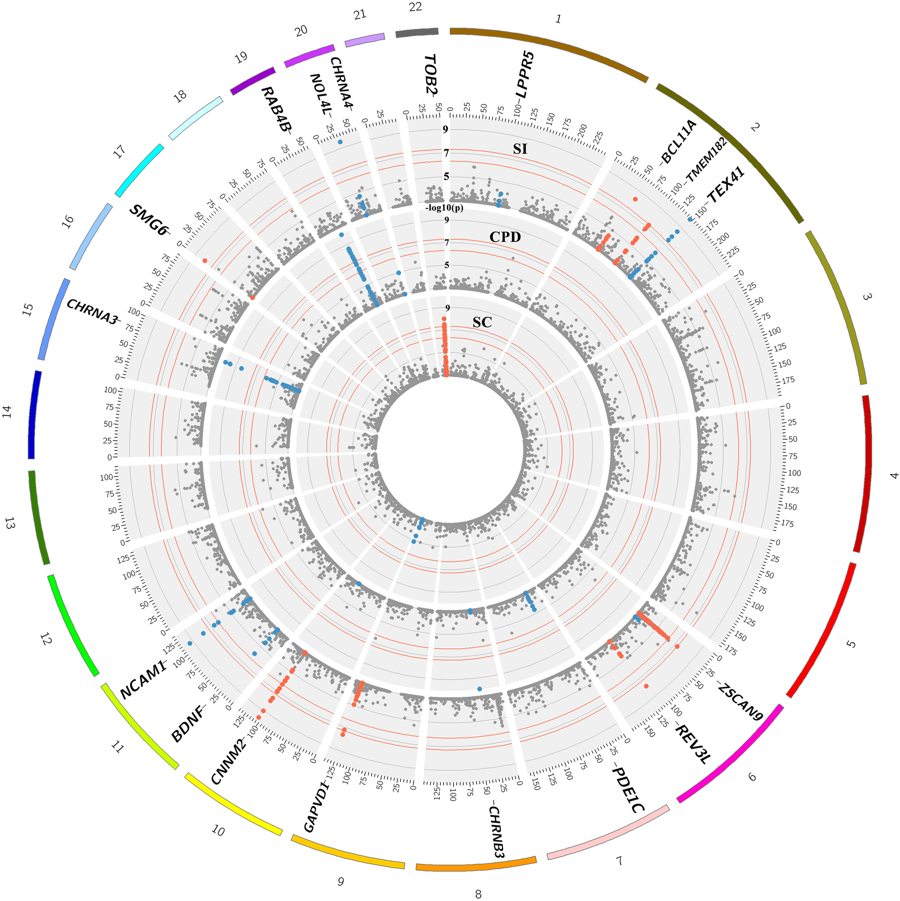
A ‘Circos’ plot (with three concentric circular ‘Manhattan’ plots) presenting results from our latest genetic association study of smoking behaviour – showing some (not all) regions in our genome that are associated with smoking behaviour (Erzurumluoglu, Liu, Jackson et al, 2019). SI: Smoking initiation – whether they smoke or not; CPD: Cigarettes per day – how many cigarettes do they smoke per day; SC: Smoking cessation – whether they’ve stopped smoking after starting. Labels in the outer circle show the name of the nearest gene to the identified variants. X-axis: Genomic positions of the variants in the human genome (chromosome numbers, 1-22, in the outer circle), Y-axis: Statistical significance of the genetic variants in this study – higher the peak, greater the significance. Red peaks are the newly identified regions in the genome, and the blue ones were identified by previous groups. Image source: Molecular Psychiatry

I believe that all scientists should be bloggers and that they should spare some thought and time to explain their research to interested non-scientists without using technical jargon. This is going to be my attempt at one; hopefully it’ll be a nice and short read.

We’ve just published a paper in one of the top molecular psychiatry journals (well, named Molecular Psychiatry 🙂 ) where we tried to identify genetic variants that (directly or indirectly) affect (i) whether a person starts smoking or not, and once initiated, (ii) whether they smoke more. The paper is titled: Meta-analysis of up to 622,409 individuals identifies 40 novel smoking behaviour associated genetic loci. It is ‘open access’ so anyone with access to the internet can read the paper without paying a single penny.

If you can understand the paper, great! If not, I will now try my best to explain some of the key points of the paper:

Why is it important?

Smoking causes all sorts of diseases, including respiratory diseases such as chronic obstructive pulmonary disease (which causes 1 in 20 of all deaths globally; more stats here) and lung cancer – which causes ~1 in 5 of all cancer deaths (more stats here). Therefore understanding what causes individuals to smoke is very important. A deeper understanding can help us develop therapies/interventions that help smokers to stop and have a massive impact on reducing the financial, health and emotional burden of smoking-related diseases.

Genes and Smoking? What!?

There are currently around fifty genetic variants that are identified to be associated with various smoking behaviours and we identified 40 of them in our latest study, including two on the X-chromosome which is potentially very interesting. There are probably hundreds more to be found*. So, it’s hard to comprehend but yes, our genes – given the environment – can affect whether we start smoking or not, and whether we’ll smoke heavier or not. This is not to say our genes determine whether we smoke or not so that we can’t do anything about it.

There are three main take-home messages:

1- I have to start by re-iterating the “given the environment” comment above. If there was no such thing as cigarettes or tobacco in the world, there would be no smoking. If none of our friends or family members smoked, we’re probably not going to smoke no matter what genetic variants we inherit. So the ‘environment’ you’re brought up in is by far the most important reason why you may start smoking.

2- I have to also underline the term “associated“. What we’re identifying are correlations so we don’t know whether these genetic variants are directly or indirectly affecting the smoking behaviour of individuals – bearing in mind that some might be statistical artefacts. Some of the genetic variants are more apparently related to smoking than others though: for example, variants in genes coding for nicotine receptors cause them to function less efficiently so more nicotine is needed to induce ‘that happy feeling‘ that smokers get. Other variants can directly or indirectly affect the educational attainment of an individual, which in turn can affect whether someone smokes or not. I’d highly recommend reading the ‘FAQ’ by the Social Science Genetic Association Consortium (link below) which fantastically explains the caveats that comes with these types of genetic association studies.

3- Last but not least, there are many (I mean many!) non-smokers who have these genetic variants. I haven’t got any data on this but I’m almost 100% sure that all of us have at least one of these variants – but a large majority of people in the world (~80%) don’t smoke.

Closing remarks

To identify these genetic variants, we had to analyse the genetic data of over 620k people. To then identify which genes and biological pathways these variants may be affecting, we queried many genetic, biochemical and protein databases. We’ve been working on this study for over 2 years.

Finally, this study would not be possible (i) without the participants of over 60 studies, especially of UK Biobank – who’ve contributed ~400k of the total 622k, and (ii) without a huge scientific collaboration. The study was led by groups located at the University of Leicester, University of Cambridge, University of Minnesota and Penn State University – with contribution by researchers from >100 different institutions.

It will be interesting to see what, if any, impact these findings will have. We hope that there will be at least one gene within our paper that turns out to be a target for an effective smoking cessation drug.

Further reading

1- FAQs about “Gene discovery and polygenic prediction from a 1.1-million-person GWAS of educational attainment” – a must read in my opinion

2- Smoking ‘is down to your genes’ – a useful commentary on the NHS website on an older study

3- 9 reasons why many people started smoking in the past – a nice read

4- Genetics and Smoking – an academic paper, so quite technical

5- Causal Diagrams: Draw Your Assumptions Before Your Conclusions – a fantastic course on ‘Cause and Effect’ by Prof. Miguel Hernan at Harvard University

6- Searching for “Breathtaking” genes – my earlier blog post on genetic association studies

Data access

The full results can be downloaded from here

*in fact we know that there is another paper in press that has identified a lot more associations than we have

Read Full Post »

Download a PDF version of the blog post from here:


After performing a genome-wide association study (GWAS), we’d then ideally want to link the identified associations/SNPs to (druggable) genes and biological pathways. Unearthing novel biology can inform drug target (in)validation but also lead to higher-impact publications (see ‘selected publications’ below). The latter point is especially important for early-career researchers who will be applying for fellowships and/or lectureships soon 🙂

Happy to help out with any of the below.

A slide from my Journal club on the October 2017 GTEx paper: Identifying the causal variants and genes, and the relevant tissues and pathways is the ultimate aim of GWASs. If the causal gene(s) turns out to be ‘druggable’, it can lead to pharmaceutical companies to develop treatments for the disease of interest. See My Research page to download the full slides.

Methods and Software

The below are some of the Post-GWAS ‘SNP follow-up’ steps/software that I have been taking/using for the last 2-3 years:

1- Finemapping the identified signals:

This step refines each signal to a set of variants that are 99% likely to contain the underlying causal variant – assuming the causal variant has been analysed

• Wakefield method [1] – Output: 99% credible set (Tutorial and R code available here: Wakefield_method_finemapping)

2- Query eQTL databases:

Rather than just assume that the gene nearest to the sentinel SNP is the causal gene, we can bring in other lines of evidence such as eQTL and pQTL analyses to check whether the SNP(s) is associated with the expression of a gene.

• GTEx v7 dataset (n up to 492; RNASeq) [2] – publicly available at [3] (see My Research page to download my Journal club slides on GTEx v6 paper)

• NESDA-NTR Blood eQTL dataset (n=4,896; microarray) [4] – publicly available at [5]

• Lung eQTL dataset (n=1,111; microarray) [6] – need to request lookups from Dr. Ma’en Obeidat

• BIOS (Biobank-Based Integrative Omics Study) Blood eQTL dataset (n=2,116; RNAseq) [7] – publicly available at [8]

• Westra et al Blood eQTL dataset (n=5,311 with replication in 2,775; microarray) [9] – publicly available at [10]

• There are other tissue/organ specific databases such as BRAINEAC (n=134) and Brain xQTL (n=up to 494)

3- eQTL-GWAS signal colocalisation:

• eCAVIAR [11] by Hormozdiari et al, 2016 [12] – Click for Powerpoint presentation (ecaviar_colocalisation_mesut_04_07_18) and methods (ecaviar methods_v3)

• It also helps to plot the Z-scores of the eQTL (separate plots for each gene near the signal) and GWAS SNPs on the same plot – maybe with the SNPs in the 99% credible set mark differently to other SNPs near the sentinel SNP. Of course, choosing the relevant tissue(s) is crucial!

4- Query pQTL databases:

• Sun et al, 2018 dataset [13] – need to request lookups from the authors (maybe Dr. Adam Butterworth)

5- Variant effect prediction:

Checking whether our sentinel SNP is in LD with a coding variant that is predicted to be functional provides another line of evidence for a putatively causal gene.

• DeepSEA – for noncoding SNPs [14] (see My Research page to download my Journal club slides on DeepSEA)

• SIFT, PolyPhen-2, and FATHMM via Ensembl VEP – for coding SNPs [15]

6- Enrichment of associations at DNase hypersensitivity sites:

Using your GWAS results to identify chromatin features relevant to your trait of interest can yield important information on the genetic aetiology of that trait (e.g. DNase hypersensitivity site enrichment in fetal lung would mean that developmental pathways in the lung are playing an important role)

• GARFIELD [16]

• FORGE [17] – very easy to use but superseded by GARFIELD

7- Pathway enrichment analysis:

• ConsensusPathDB [18] – as it queries more biological pathway and gene ontology databases than the alternatives. You can input all the genes that are implicated by eQTL/pQTL databases and variant effect prediction (e.g. genes that harbour a coding variant in the 99% credible set). Good idea to remove genes in the MHC region (e.g. HLA genes) to identify pathways other than the immune system-related ones. Methods can be found here: ConsensusPathDB_methods

• You can also do an additional check to see if the ‘significant’ pathways (e.g. FDR<5%) are mainly due to the implicated genes – as identified by eQTL/pQTL and variant effect prediction (list 1) – or the regions identified by GWAS itself: extract all the genes within 500kb of the sentinel SNPs (list 2) and then make 100 lists (same size as list 1) with genes randomly selected from this set. Then input these to ConsensusPathDB and see how many times the pathways identified by list 1 appears in the output as ‘significant’.

8- LD score regression:

Bivariate LD score regression allows one to identify the genetic correlation between two traits which implies shared biology.

• LD Hub [19] – check the genetic correlation between your trait of interest and up to >600 traits (see My Research page to download my Journal club slides on LD Hub)

• Stratified LD score regression [20] – check if there’s significant enrichment of heritability at variants overlapping histone marks (e.g. H3K4me1, H3K4me3) that are specific to cell lines of interest (e.g. lung-related cell lines for a GWAS of a respiratory disease)

9- Single-variant and genetic risk-score PheWAS (phenome-wide association study):

• GeneAtlas [21] or the UK Biobank Engine [22] for single-variant PheWAS

• PRS Atlas [23] – for polygenic risk score PheWAS (see My Research page to download my Journal club slides on the PRS Atlas)

• Other automated and reliable software include PHESANT

10- Druggability analysis:

Once a list of potentially causal genes is created, one can then query drug/target databases to see whether the respective genes’ products (i.e. protein) are already targeted by certain compounds – or even better, in clinical trials (see ‘Approved Drugs and Clinical Candidates’ section for each protein in ChEMBL – if there is one).

• DGIdb – publicly available at [24]

• ChEMBL – publicly available at [25]

11- Protein-protein interactions:

If several proteins within your gene list are predicted/known to interact, this will provide a separate line of evidence for those genes – that is if they’re implicated by different signals/SNPs.

• STRING [26] – a score of >0.9 implies a ‘high-quality’ prediction

12- Literature review:

• A thorough literature review of the identified genes is always a good way to start a story. Download RefSeq_all_gene_summaries for extracted gene function summaries from RefSeq [27]

13- GWAS catalog lookup:

Checking to see if your associated SNPs are also associated with other traits can be important for (i) shared biology and (ii) specificity – can be important for drug target discovery.

• PhenoScanner [28]

• GWAS catalog – publicly available at [29]

14- Mouse Knockout studies:

• International Mouse Phenotyping Consortium (IMPC) [30] – see (i) if the genes of interest have been knocked out and (ii) what phenotypes were observed in the knockout mice

15- Mendelian randomization analysis:

Although over-hyped in my opinion, when carried out correctly it becomes a very useful tool to assess the causal relationship between an exposure and outcome. You can use your associated SNPs as a proxy for your trait (e.g. LDL cholesterol associated SNPs) and then check to see if your trait causes a disease (e.g. obesity)

• MR-Base [31] – carry out Mendelian randomization studies using your trait of interest as exposure or outcome

Selected Publications:

The methods above were used in the papers below:

1- Shrine, Guyatt, and Erzurumluoglu et al, 2018. New genetic signals for lung function highlight pathways and pleiotropy, and chronic obstructive pulmonary disease associations across multiple ancestries. Nature Genetics [32]

2- Wain et al, 2017. Genome-wide association analyses for lung function and chronic obstructive pulmonary disease identify new loci and potential druggable targets. Nature Genetics [33]

3- Allen et al, 2017. Genetic variants associated with susceptibility to idiopathic pulmonary fibrosis in people of European ancestry: a genome-wide association study. The Lancet Respiratory Medicine [34] – I like Figure 3 in this paper where they align and plot both the Lung eQTL and IPF GWAS results to visualise whether the causal variant in the eQTL study and GWAS are likely to be the same. However, as mentioned above at point 3 (i.e. eQTL-GWAS signal colocalisation), I would suggest using Z-scores rather than P-values to observe the direction of effects

4- Erzurumluoglu, Liu, and Jackson et al, 2018. Meta-analysis of up to 622,409 individuals identifies 40 novel smoking behaviour associated genetic loci. Molecular Psychiatry [35]the Circos plot in this paper is brilliant! No competing interests declared 😉

Further reading

• Visscher et al, 2017. 10 Years of GWAS Discovery: Biology, Function, and Translation. AJHG

• Okada et al, 2014. Genetics of rheumatoid arthritis contributes to biology and drug discovery. Nature – one of those inspirational papers; I really liked Figure 2 the first time I saw it

• Erzurumluoglu et al, 2015. Identifying Highly Penetrant Disease Causal Mutations Using Next Generation Sequencing: Guide to Whole Process. BioMed Research International – I recommend this paper for PhD students who are looking for a comprehensive review comparing the ways Mendelian diseases and complex diseases are analysed. It is a little out of date in terms of the software/databases (e.g. The gnomAD database is not in there) that are in the tables but the main messages hold

Download a PDF version of the blog post from here:


Social Media
There’s a little thread under the below tweet, where Dr. Eric Fauman (Pfizer) states “The gene pointed at by an eQTL is actually less likely to be the causal gene”.

Read Full Post »

copd_smoking_nat_genet_lung_function_gwas_wain

We – as a group – carried out the largest genome-wide association study to identify genetic variants that are associated with decreased lung function and increased risk of chronic obstructive pulmonary disease. We hope that our findings will ultimately lead to the identification of effective drug targets for COPD. Image source: University of Leicester

I remember reading somewhere that ‘if you get asked the same question three times, then write a blog post about it’. That’s what I’ve been doing so far, and the purpose of this blog post is the same: to try and provide an answer to a commonly asked question. (Important note: my answers are in no way authoritative and only meant for interested non-scientists)

As a ‘Genetic Epidemiologist’, I constantly get asked what I do and what my (replace ‘my’ with ‘our’, as I do everything within a team) research can lead to. Please see my previous post ‘Searching for “Breathtaking” genes. Literally!‘ and My Research page for short answers to these questions. In tandem to these, I am constantly asked ‘why we can’t find a ‘cure’ for (noncommunicable) diseases that affect/will affect most of us such as obesity, diabetes, cancer, COPD – although there are many scientific advancements?’. I looked around for a straight forward example, but couldn’t find one (probably didn’t look hard enough!). So I decided to write my own.

I will first try and put the question into context: We do have ‘therapies’ and ‘preventive measures’ for most diseases and sometimes making that distinction from ‘a cure’ answers their question. For example, coronary heart disease (CHD) is a major cause of death both in the UK and worldwide (see NHS page for details) but we know how we can prevent many CHD cases (e.g. lowering cholesterol, stopping smoking, regular exercise) and treat CHD patients (e.g. statins, aspirin, ACE inhibitors). However, there are currently there are no ‘cures’ for CHD. So once a person is diagnosed with CHD, it is currently impossible to cure them from it, but doctors can offer quite a few options to make their life better.

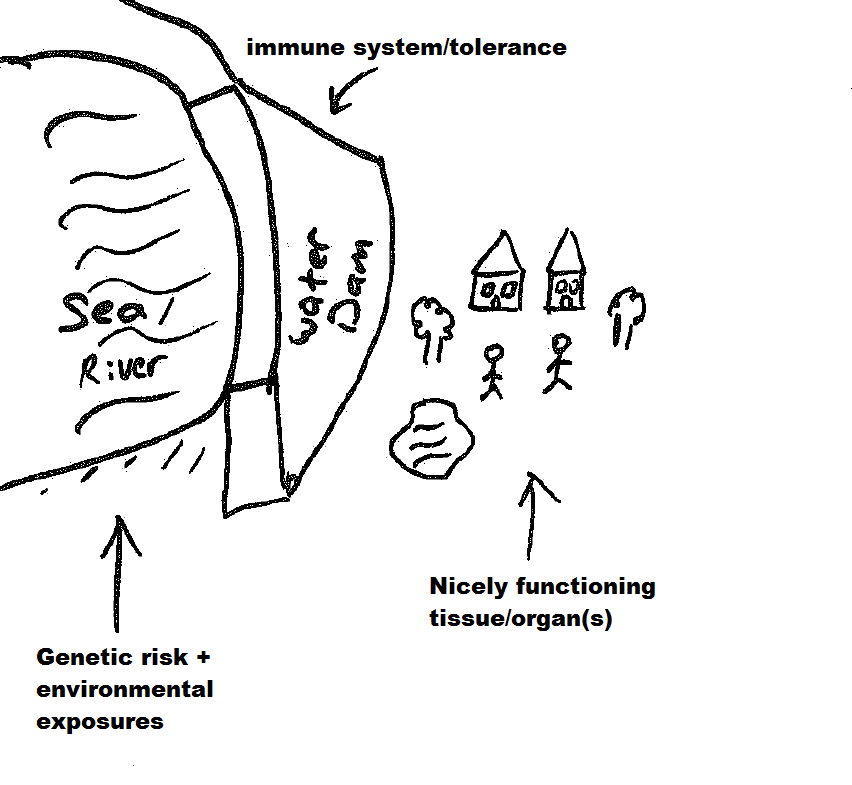
I then gave it some thought about why finding a ‘cure’ was so hard for most diseases, and came up with the below analogy of a river/sea, water dam, and a nicely functioning village/city (excuse my awful drawing!).

The first figure below sets the scene: there’s a water dam that’s keeping the river from flooding and damaging the nice village/city next to it. Now please read the caption of the below figure to make sense of how they’re related to a disease.

Prevention

The river/sea is the combination of your genetic risk (e.g. you could have inherited genetic variants from your parents that increased your chances of type-2 diabetes) and environmental exposures (e.g. for type-2 diabetes, that would be being obese, eating high sugar content diet, smoking). The water dam is your immune system and/or mechanisms in your body which tame the sea of risk factors to ensure that everything in your body work fine (e.g. pancreatic islet cells have beta cells which produce insulin to lower your glucose levels back to normal levels – which would be damaging to the body’s organs if it stayed high).

So to ‘prevent’ a disease (well, flooding in this case), we could (i) make the water dam taller, (ii) make the dam stronger, and (iii) do regular checks to patch any damage done to the dam. To provide an example, for type-2 diabetes, point (i) could correspond to being ‘fit’ (or playing with your genes, which currently isn’t possible), point (ii) could correspond to staying ‘fit’, and point (iii) could correspond to having regular check-ups to see whether any preventive measures are necessary. Hope that made sense. If not, please stop reading immediately and look for other blog posts on the subject matter 🙂

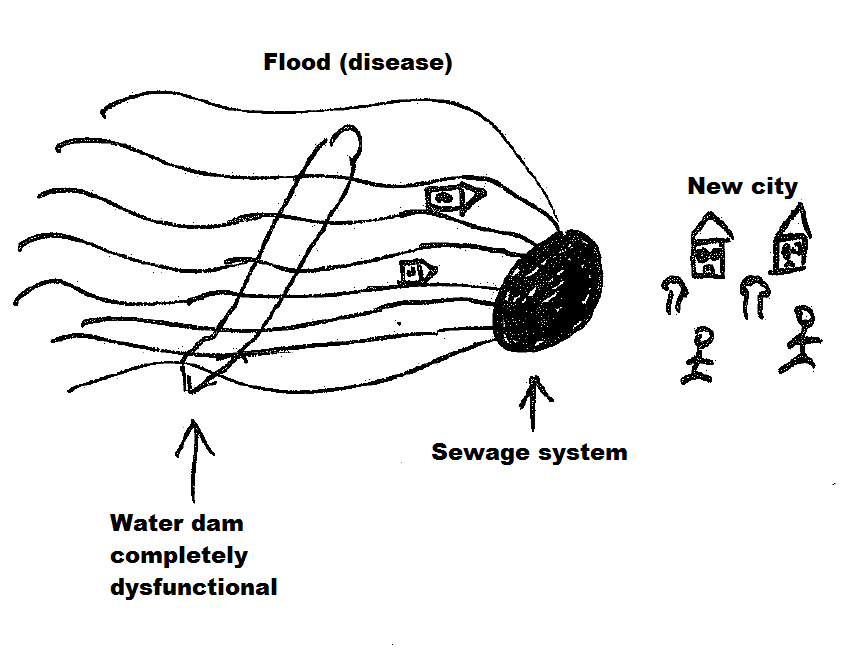
Using the figure below, I wanted to then move to ‘therapy’. So as you can see, the river has flooded i.e. this individual has the disease (e.g. type-2 diabetes as above). The water dam is now not doing a good job of stopping the river and the city is in danger of being destroyed. But we have treatments: (i) The (badly drawn) water pumping trucks suck up excess water, and (ii) we have now built a second (smaller) dam to protect the houses and/or slow the flow of the water. Again, to provide an example using type-2 diabetes, water pumping trucks could be analogous to insulin or metformin injections, and the smaller dams could be changing current diet to a ‘low sugar’ version. This way we can alleviate the effects of the current and future ‘floods’.

Therapy

Analogy for therapy/treatment – after being diagnosed with the disease

Finally, we move on to our main question: ‘the cure’. Using the same analogy as above, as the water dam is now dysfunctional, the only way to stop future ‘floods’ would be to design a sewage system that can mop up all water that could come towards the city. Of course the water dam and ‘old city’ was destroyed/damaged due to past floods, so we’d need to build a new functioning city to take over the job of the old one. A related real example (off the top of my head) could be to remove the damaged tissues and replace them with new ones. Genetic engineering (using CRISPR/Cas9) and/or stem cell techniques are likely to offer useful options in the future.

Cure

Analogy for cure – after being diagnosed with the disease

Hopefully it is now clear that the measures taken to prevent or treat the disease, cannot be used to cure the disease. E.g. you can build another dam in place of the old one, but the city is already destroyed so that’s not going to be of any use in curing the disease.

So to sum up, diseases like obesity, cancer, COPD are very complex diseases – in fact they’re called ‘complex diseases’ in the literature – and understanding their underlying biology is very hard (e.g. hundreds of genes and environmental exposures could combine to cause them). We’re currently identifying many causal variants but turning these findings into ‘cures’ is a challenge that we have not been able to crack yet. However, it is clear that the methods that we currently use to identify preventive measures and therapies cannot be used to identify cures.

I hope that was helpful. I’d be very happy to read your comments/suggestions and share credit with contributing scientists. Thanks for reading!

Read Full Post »

evolution_of_intellectual_freedom_cham_phdcomics

Source URL: PhD Comics

Figuratively speaking, what is the ‘worth’ of a certain academic? Between two academics, which one has had more positive academic impact than the other? How do you rank academics? And award grants, promotion, tenure etc. to the best* ones?

I’m not going to answer these questions but would like to chip in with some food for thought and suggestions.

Well; one may say: “It’s easy! Just compare their h-index and total no of citations!

This may be an effective way to go about answering the question. Surely someone with an h-index of 30 has had more positive academic impact than someone with let’s say an h-index of 15 – and is the better candidate?

Maybe – that is if all things are equal regarding the way citations and the h-index works i.e. if both academics:

  • are in similar fields – as papers in certain fields receive more citations overall than papers in other fields,
  • are in similar stages in their careers – as comparing an early-career postdoc with an established “Prof.” wouldn’t be fair,
  • have similar numbers of first/equal-first or last author papers – as an academic with many middle-authorships can have excessively inflated h-indexes,
  • have similar number of co-authors – as it may be easier to be listed as a co-author in some fields than others and/or mean that more people will be presenting and citing the paper as their own, and
  • have a similar distribution of citations across the papers – as the h-index ignores highly influential papers and the total citations can be highly influenced by even just one of these (see figure below).

I may have missed other factors, but I think these are the main ones (please add a comment below).

mesut_erzurumluoglu_h-index_academic_2018

Calculating my h-index: Although problematic (discussed here), the h-index has become the standard metric when measuring the academic output of an academic. It is calculated by sorting the publications of an academic from most to least cited, then checking whether he/she has h papers with h citations e.g. if an academic has 10 papers with ≥10 citations but not 11 papers with ≥11 citations then their h-index will be 10. It was proposed as a way to summarise the number of publications that an academic has and their academic impact (via citations) with a single number. The above citation counts were obtained from my Google Scholar page

As of 31st July 2018, I have 14 published papers – including 5 as first/equal-first author – under my belt. I have a total citation count of 316 and an h-index of 6 (225 and 5 respectively, when excluding publications marked with an asterisk in the above figure). It is fair to say that these numbers are above average for a 29-year-old postdoc. But even I’m not content with my h-index – and many established academics are definitely right not to be. I’ll try and explain why: the figure above shows the citation distribution of my 14 publications sorted by the ‘number of times cited’ from the left (highest) to right (lowest). One can easily see that the h-index (red box) captures only a small portion of the general picture (effectively, 6 x 6 i.e. 36 citations) and ignores the peak (>6 on the y-axis) and tail (>6 on the x-axis) of the publication-citation distribution. I have also included the publication year of each paper and added an asterisk (*) against the publications where I haven’t provided much input e.g. I have done almost nothing for the Warren et al (2017) paper but it constitutes almost a third of my total citations (90/316)**. The ‘ignored peak’ contains three highly cited papers to which I have made significant contributions to and the ‘ignored tail’ contains research papers that (i) I am very proud of (e.g. Erzurumluoglu et al, 2015) or (ii) are just published – thus didn’t have the time to accumulate citations. What is entirely missing from this figure are my (i) non-peer-reviewed publications (e.g. reports, articles in general science magazines), (ii) correspondence/letters to editor (e.g. my reply to a Nature News article), (iii) blog posts where I review papers or explain concepts (e.g. journal clubs), (iv) shared code/analysis pipelines, (v) my PhD thesis with potentially important unpublished results, (vi) other things in my CV (e.g. peer-review reports, some blog posts) – which are all academia-related things I am very proud of. I have seen other people’s contributions in relation to these (e.g. Prof. Graham Coop’s blog) and thought that they were more useful than even some published papers in my field. These contributions should be incorporated into ‘academic output’ measures somehow.

It is also clear that “just compare their h-index and total no of citations!” isn’t going to be fair on academics that (i) do a lot of high-quality supervision at different levels (PhD, postdoc, masters, undergrad project – which all require different skill sets and arrangements), (ii) spend extra time to make their lectures inspiring and as educative as possible to undergrad and Masters students, (iii) present at a lot of conferences, (iv) do ‘admin work’ which benefits early-career researchers (e.g. workshops, discussion sessions), (v) do a lot of blogging to explain concepts, review papers, and offer personal views on field generally, (vi) have a lot of social media presence (e.g. to give examples from my field i.e. Genetic Epidemiology, academics such as Eric Topol, Daniel MacArthur, Sek Kathiresan take time out from their busy schedules to discuss, present and debate latest papers in their fields – which I find intellectually stimulating), (vii) give a lot of interviews (TV, online media, print media) to correct misconceptions, (viii) take part in public engagement events (incl. public talks), (ix) organise (inter-disciplinary) workshops, (x) inspire youngsters to become academics working for the benefit of humankind, (xi) publish reliable reports for the public and/or corporations to use, (x) provide pro bono consultation, (xi) take part in expert panels and try very hard to make the right decisions, (xii) engage in pro bono work, (xiii) do their best to change bad habits in the academic circles (e.g. by sharing code, advocating open access publications, standing up to unfair/bad decisions whether it affects them or not), (xiv) extensively peer-review papers, (xv) help everyone who asks for help and/or reply to emails… The list could go on but I think I’ll stop there…

I acknowledge that some of the above may indirectly help increase the h-index and total citations of an individual but I don’t think any of the above are valued as much as they should be per se by universities – and something needs to change. Academics should not be treated like ‘paper machines’ until the REF*** submission period, and then ‘cash cows’ that continually bring grant money until the next REF submission cycle starts. As a result, many academics have made ‘getting their names into as many papers as possible’ their main aim – it is especially easier for senior academics, many with a tonne of middle-authorships for which they have done virtually nothing****. This is not how science and scientists should work and universities are ultimately disrespecting the tax payers’ and donors’ money. Some of the above-mentioned factors are easier to quantify than others but thought should go into acknowledging work other than (i) published papers, (ii) grant money brought in, and maybe (iii) appearing on national TV channels.

Unless an academic publishes a ‘hot paper’ as first or corresponding author – which very few have the chance and/or luck to do – and he/she becomes very famous in their field, their rank is usually dictated by the h-index and/or total citations. In fact, many scientists who have very high h-indexes (e.g. because of many middle-author papers) put this figure at the top of their publication list to prove that they’re top scientists – and unfortunately, they contribute to the problem.

People have proposed that contributions of each author are explicitly stated on each paper but this is going to present a lot of work when analysing the academic output of tens of applicants – especially when the number of publications an individual has increases. Additionally, in papers with tens or even hundreds of authors, general statements such as “this author contributed to data analysis” are going to be assigned to many authors without explicitly stating what they did to be included as a co-author – thus the utility of this proposition could also be less than expected in reality.

It’s not going to solve all the problems, but I humbly propose that a figure such as the one above be provided by Google Scholar and/or similar bibliometric databases (e.g. SCOPUS, CrossRef, Microsoft Academic, Loop) for all academics, where the papers for which the respective academic is not the first author are marked with an asterisk. The asterisks could then be manually removed by the respective academic on publications where he/she has made significant contributions (i.e. equal-first, corresponding author, equal-last author or other prominent role) but wasn’t the first author. Metrics such as the h-index and total citations could then become better measures by giving funders/decision makers the chance to filter accordingly.

Thanks for reading. Please leave your comments below if you do not agree with anything or would like to make a suggestion.

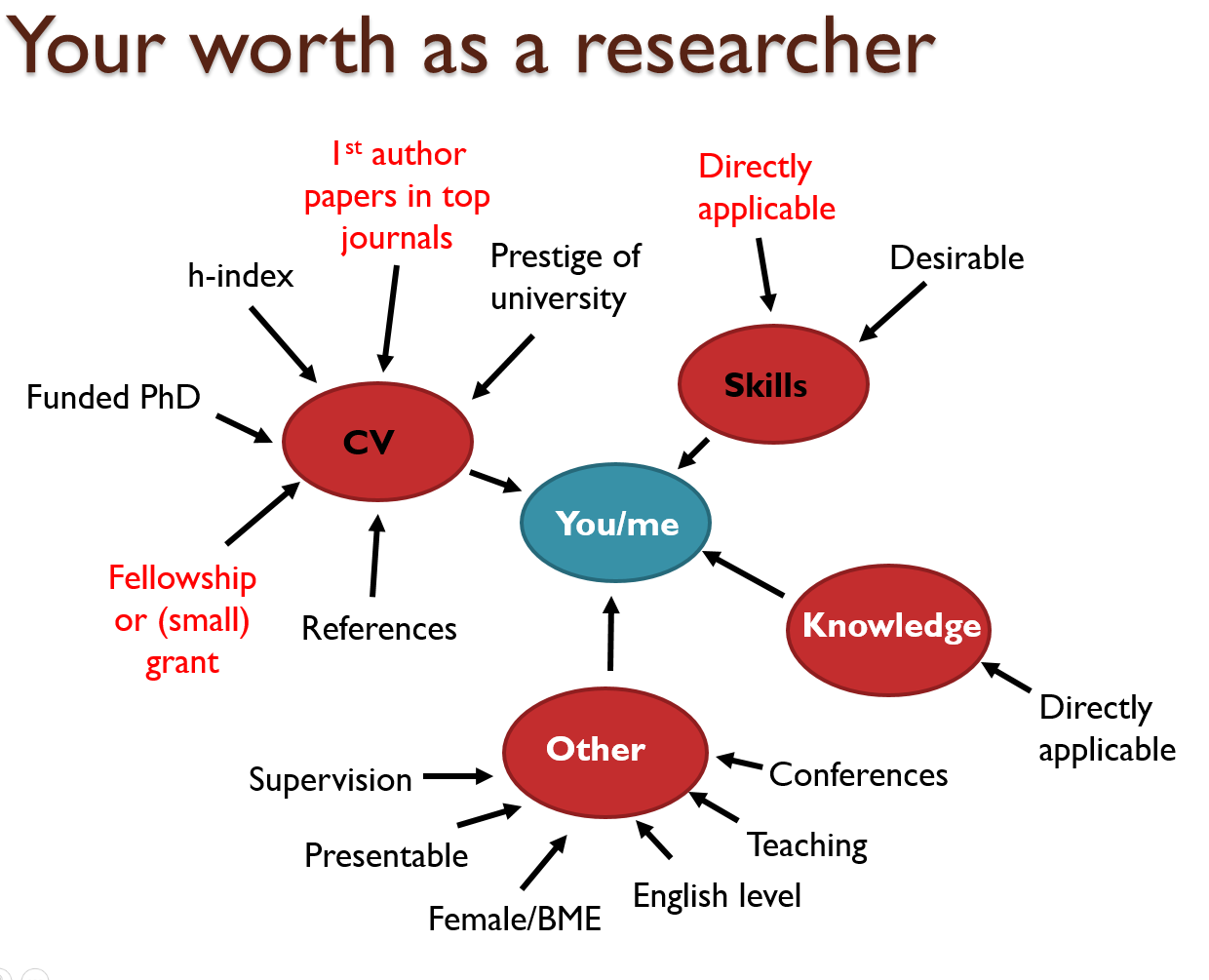
academic_worth_researcher_university_mesut_erzurumluoglu

The heuristic that I think people use when calculating the worth of an early career researcher (but generally applies to all levels): ‘CV’ and ‘Skills’ are the two main contributors, with the factors highlighted in red carrying enormous weight in determining whether someone should get the job/fellowship or not. Virtually no one cares about anything that is outside what is written here – as mentioned in the post. Directly applicable: Some technical skill that the funder/Professor thinks is essential for the job; Prestige of university: where you did your PhD and/or undergrad; Funded PhD: whether your PhD was fully funded or not; Female/BME: being female and/or of BME background – this can be an advantage or a disadvantage depending on the regulations/characteristics of the university/panel, as underrepresented groups can be subjected to both positive and negative discrimination. NB: this is a simplified version and there are many factors that affect outcomes such as “who you know” and “being at the right place at the right time“.


Added on 30/10/18: I just came across ‘No, it’s not The Incentives—it’s you‘ by Tal Yarkoni about the common malpractices in academic circles, and I think it’s well worth a read.


*Making sure there’s a gender balance and that academics from BME backgrounds are not excluded from the process – as they’ve usually had to overcome more obstacles to reach the same heights.

**I have been honest about this in my applications and put this publication under “Other Publications” in my CV.

***REF stands for the ‘Research Excellence Framework’, and is the UK’s system for assessing the quality of research in higher education institutions. The last REF cycle finished in 2014 and the next one will finish in 2021 (every 7 years). Universities start planning for this 3-4 years before the submission dates and the ones ranked high in the list will receive tens of millions of pounds from the government. For example, University of Oxford (1st) received ~£150m and University of Bristol (8th) received ~£80m.

****Sometimes it’s not their fault; people add senior authors on their papers to increase their chances of getting them accepted. It’s then human nature that they’re not going to decline authorship. It sounds nice when one’s introduced in a conference etc. as having “published >100 papers with >10,000 citations” – when in reality they’ve not made significant (if any!) contributions to most of them.


PS: I also propose that acknowledgements at the bottom of papers and PhD theses be screened in some way. I’ve had colleagues who’ve helped me out a lot when learning some concepts who then moved on and did not have the chance to be a co-author on my papers. I have acknowledged them in my PhD thesis and would love to see my comments be helpful to these colleagues in some way when they apply for postdoc jobs or fellowships. Some of them did not publish many papers and acknowledgements like these could show that they not only have the ability to be of help (e.g. statistical, computational expertise), but are also easy to work with and want to help their peers.

Read Full Post »

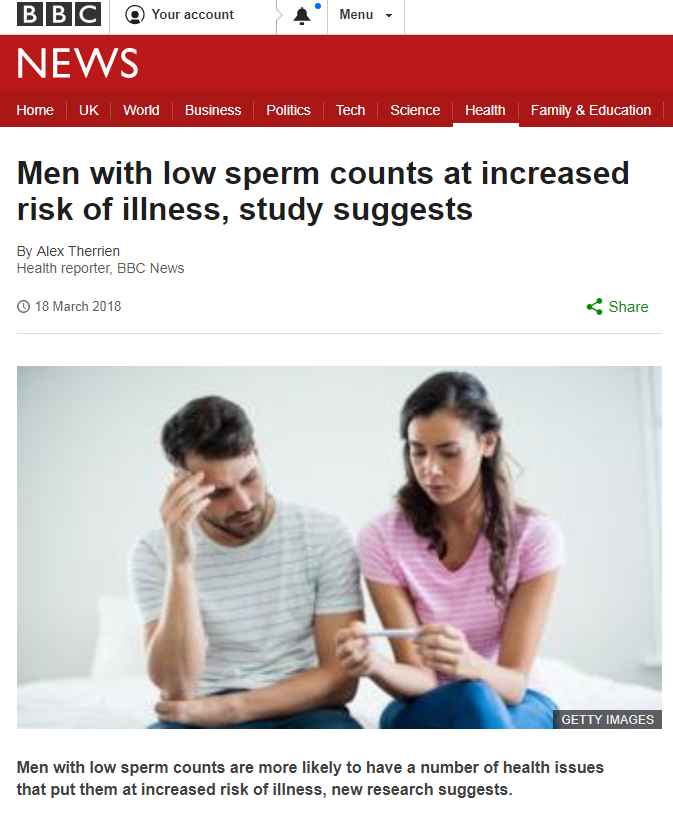
BBC_news_sperm_count

BBC news article published on the 18th March 2018. According to the article, men with low sperm counts are at a higher risk of disease/health problems. However, this is unlikely to be a causal relationship and more likely to be a spurious correlation. May even turn out to be the other way round due to “reverse causality”, a bias we encounter a lot in epidemiological studies. The following sounds more plausible (to me at least!): “Men with disease/health problems are likely to have low sperm counts” (likely cause: men with health problems tended to smoke more in general and this caused low sperm counts in those individuals).

As an enthusiastic genetic epidemiologist (keyword here: epidemiologist), I try to keep in touch with the latest developments in medicine and epidemiology. However, it is impossible to read all articles that come out as there is a lot of epidemiology and/or medicine papers published daily (in fact, too much!). For this reason, instead of reading the original academic papers (excluding papers in my specific field), I try to skim read from reputable news outlets such as the BBC, The Guardian and Medscape (mostly via Twitter). However, health news even in these respectable media outlets are full of wrong and/or oversensationalised titles: they either oversensationalise what the scientist has said or take the word of the scientist they contact – who are not infallible and can sometimes believe in their own hypotheses too much.

It wouldn’t harm us too much if the message of an astrophysics related publication is misinterpreted but we couldn’t say the same with health related news. Many people take these news articles as gospel truth and make lifestyle changes accordingly. Probably the best example for this is the Andrew Wakefield scandal in 1998 – where he claimed that the MMR vaccine caused autism and gastro-intestinal disease but later investigations showed that he had undeclared conflicts of interest and had faked most of the results (click here for a detailed article in the scandal). Many “anti-vaccination” (aka anti-vax) groups used his paper to strengthen their arguments and – although now retracted – the paper’s influence can still be felt today as many people, including my friends, do not allow their children to be vaccinated as they falsely think they might succumb to diseases like autism because of it.

The first thing we’re taught in our epidemiology course is “correlation does not mean causation.” However, a great deal of epidemiology papers published today report correlations (aka associations) without bringing in other lines of evidence to provide evidence for a causal relationship. Some of the “interesting ones” amongst these findings are then picked up by the media and we see a great deal of news articles with titles such as “coffee causes cancer” or “chocolate eaters are more successful in life”. There have been instances when I read the opposite in the same paper a couple of months later (example: wine drinking is protective/harmful for pregnant women). The problem isn’t caused only due to a lack of scientific method training on the media side, but also due to health scientists who are eager to make a name for themselves in the lay media without making sure that they have done everything they could to ensure that the message they’re giving is correct (e.g. triangulating using different methods). As a scientist who analyses a lot of genetic and phenotypic data, it is relatively easier for me to observe that the size of the data that we’re analysing has grown massively in the last 5-10 years. However, in general, we scientists haven’t been able to receive the computational and statistical training required to handle these ‘big data’. Today’s datasets are so massive that if we take the approach of “let’s analyse everything we got!”, we will find a tonne of correlations in our data whether they make sense or not.

To provide a simple example for illustrative purposes: let’s say that amongst the data we have in our hands, we also have each person’s coffee consumption and lung cancer diagnosis data. If we were to do a simple linear regression analysis between the two, we’d most probably find a positive correlation (i.e. increased coffee consumption means increased risk of lung cancer). 10 more scientists will identify the same correlation if they also get their hands on the same dataset; 3 of them will believe that the correlation is worthy of publication and submit a manuscript to a scientific journal; and one (other two are rejected) will make it past the “peer review” stage of the journal – and this will probably be picked up by a newspaper. Result: “coffee drinking causes lung cancer!”

However, there’s no causal relationship between coffee consumption and lung cancer (not that I know of anyway :D). The reason we find a positive correlation is because there is a third (confounding) factor that is associated with both of them: smoking. Since coffee drinkers smoke more in general and smoking causes lung cancer, if we do not control for smoking in our statistical model, we will find a correlation between coffee drinking and lung cancer. Unfortunately, it is not very easy to eliminate such spurious correlations, therefore health scientists must make sure they use several different methods to support their claims – and not try to publish everything they find (see “publish or perish” for an unfortunate pressure to publish more in scientific circles).

cikolata_ve_nobel_odulu

A figure showing the incredible correlation between countries’ annual per capita chocolate consumption and the number of Nobel laureates per 10 million population. Should we then give out chocolate in schools to ensure that the UK wins more Nobel prizes? However, this is likely not a causal relationship as it makes more sense that there is a (confounding) factor that is related to both of them: (most likely) GDP per capita at purchasing power parity. To view even quirkier correlations, I’d recommend this website (by Tyler Vigen). Image source: http://www.nejm.org/doi/full/10.1056/NEJMon1211064.

As a general rule, I keep repeating to friends: the more ‘interesting’ a ‘discovery’ sounds, the more likely it is to be false.

Hard to explain why I think like this but I’ll try: for a result to sound ‘interesting’ to me, it should be an unexpected finding as a result of a radical idea. There are just so many brilliant scientists today that finding unexpected things is becoming less and less likely – as almost every conceivable idea arises and is being tested in several groups around the world, especially in well researched areas such as cancer research. For this reason, the idea of a ‘discovery’ has changed from the days of Newtons and Einsteins. Today, ‘big discoveries’ (e.g. Mendel’s pea experimets, Einstein’s general relativity, Newton’s law of motion) have given way to incremental discoveries, which can be as valuable. So with each (well-designed) study, we’re getting closer and closer to cures/therapies or to a full understanding of underlying biology of diseases. There are still big discoveries made (e.g. CRISPR-Cas9 gene editing technique), but if they weren’t discovered by that respective group, they probably would have been discovered within a short space of time by another group as the discoverers built their research on a lot of other previously published papers. Before, elite scientists such as Newton and Einstein were generations ahead of their time and did most things on their own, but today, even the top scientists are probably not too ahead of a good postdoc as most science literature is out there for all to read in a timely manner (and more democratic compared to the not-so-distant past) and is advancing so fast that everyone is left behind – and we’re all dependent on each other to make discoveries. The days of lone wolves is virtually over as they will get left behind those who work in groups.

To conclude, without carefully reading the scientific paper that the newspaper article is referring to – hopefully they’ve included a link/citation at the bottom of the page! – or seeking what an impartial epidemiologist is saying about it, it’d be wise to take any health-related finding we read in newspapers with a pinch of salt as there are many things that can go wrong when looking for causal relationships – even scientists struggle to make the distinction between correlations and causal relationships.

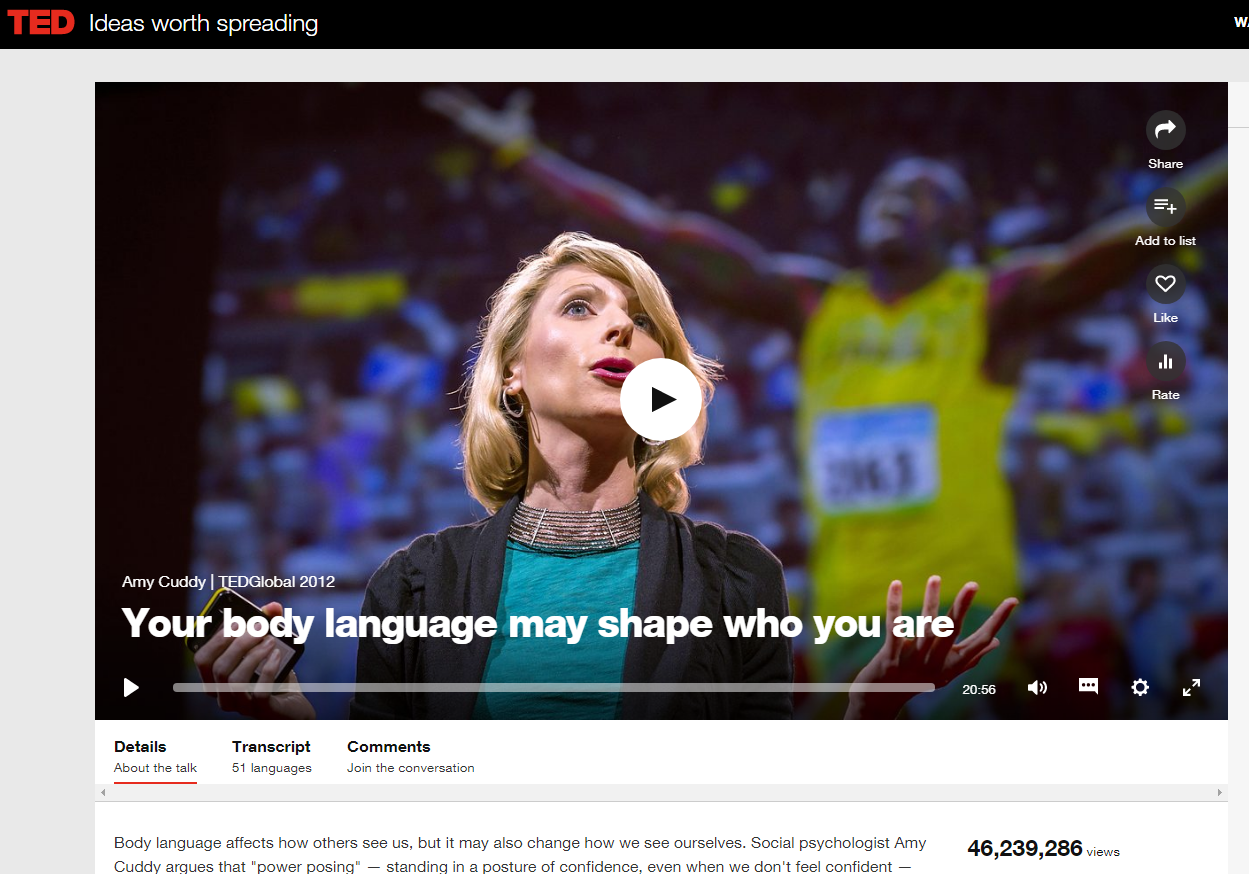
power_posing

Amy Cuddy’s very famous ‘Power posing’ talk, which was the most watched video on the TED website for some time. In short, she states that if you give powerful/dominant looking poses, this will induce hormonal changes which will make you confident and relieve stress. However, subsequent studies showed that her ‘finding’ could not be replicated and she that did not analyse her data in the manner expected of a scientist. If a respectable scientist had found such a result, they would have tried to replicate their results; at least would have followed it up with studies which bring other lines of concrete evidence. What does she do? Write a book about it by bringing in anecdotal evidence at best and give a TED talk as if it’s all proven – as becoming famous (by any means necessary) is the ultimate aim for many people; and many academics are no different. Details can be found here. TED talk URL: https://www.ted.com/talks/amy_cuddy_your_body_language_shapes_who_you_are

PS: For readers interested in reading a bit more, I’d like to add a few more sentences. We should apply the below four criteria – as much as we can – to any health news that we read:

(i) Is it evidence based? (e.g. supported by a clinical trial, different experiments) – homeopathy is a bad example in this regard as they’re not supported by clinical trials, hence the name “alternative medicine” (not saying they’re all ineffective and further research is always required but most are very likely to be);

(ii) Does it make sense epidemiologically? (e.g. the example mentioned above i.e. the correlation observed between coffee consumption and lung cancer due to smoking);

(iii) Does it make sense biologically? (e.g. if gene “X” causes eye cancer but the gene is only expressed in the pancreatic cells, then we’ve most probably found the wrong gene)

(iv) Does it make sense statistically? (e.g. was the correct data quality control protocol and statistical method used? See figure below for a data quality problem and how it can cause a spurious correlation in a simple linear regression analysis)

graph-3

Wrong use of a statistical (linear regression) model. If we were to ignore the outlier data point at the top right of the plot, it becomes easy to see that there is no correlation between the two variables on the X and Y axes. However, since this outlier data point has been left in and a linear regression model has been used, the model identifies a positive correlation between the two variables – we would not have seen that this was a spurious correlation had we not visualised the data.

PPS: I’d recommend reading “Bad Science” by Ben Goldacre and/or “How to Read a Paper – The basics of evidence based medicine” by Trisha Greenhalgh – or if you’d like to read a much better article on this subject with a bit more technical jargon, have a look this highly influential paper by Prof. John Ioannidis: Why Most Published Research Findings Are False.

References:

Wakefield et al, 1998. Ileal-lymphoid-nodular hyperplasia, non-specific colitis, and pervasive developmental disorder in children. The Lancet. URL: http://www.thelancet.com/journals/lancet/article/PIIS0140-6736%2897%2911096-0/abstract

Editorial, 2011. Wakefield’s article linking MMR vaccine and autism was fraudulent. BMJ. URL: http://www.bmj.com/content/342/bmj.c7452

Read Full Post »

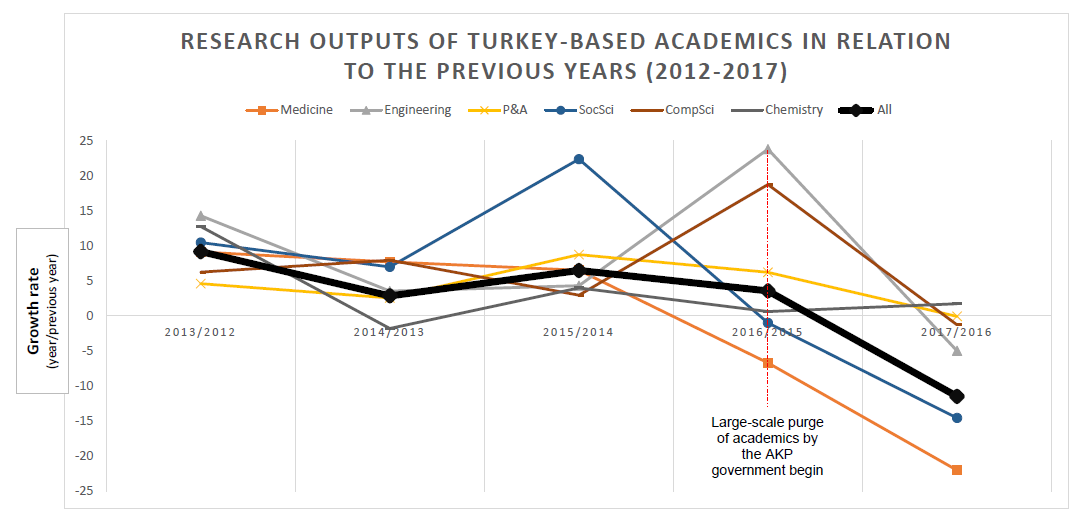
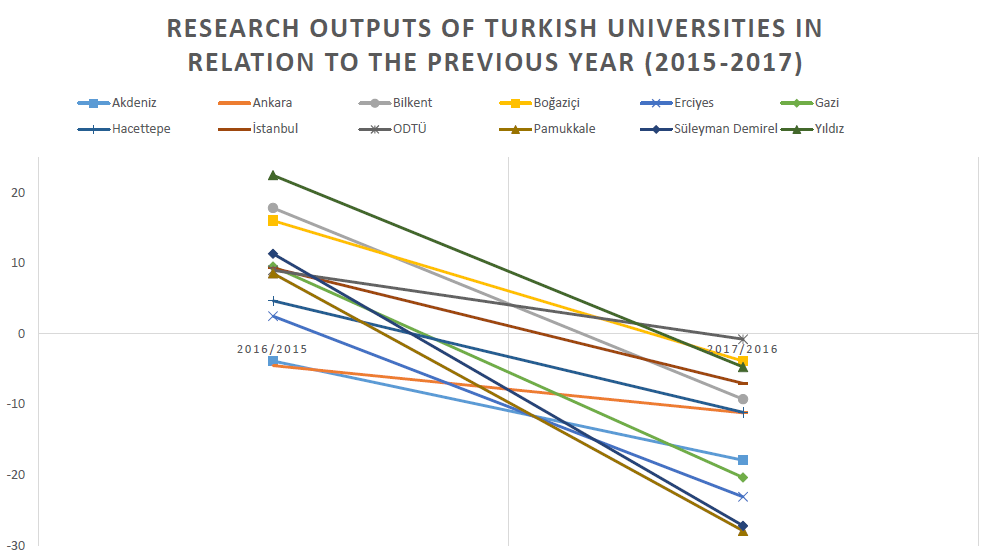
FfA_freedom_for_academia_report_2017_figure_1
Research outputs of Turkey-based academics in relation to the previous year. This Freedom for Academia (FfA) study identified a significant reduction (11.5% on average) in the research output of Turkey-based academics in 2017 compared to 2016. When the average increase of 6.7% per year observed in the research output of Turkey-based academics between 2008 and 2015 is taken into account, this translates to a decrease of over 7,000 papers than the expected figure in 2017 in journals indexed by SCOPUS – a bibliographic database of peer-reviewed literature. Image Source: freedomforacademia.org

Freedom for Academia (website), a group consisting of (incl. myself) “British and Turkish academics/researchers who are willing to lend a helping hand to our colleagues and bring the struggles that they face to the attention of the public and academic circles”, has just published an ‘Annual report 2017’ on the effects of the AKP government’s large-scale purges on the research output of Turkey-based academics, titled:

7,000 papers gone missing: the short-term effects of the large-scale purges carried out by the AKP government on the research output of Turkey-based academics

(click here to access full article with photos, or ‘print friendly’ version from here)

I gave an interview to Santiago Moreno of Chemistry World regarding this report (Source: Turkish crackdown takes toll on academic output. Aug 2017. Chemistry World)

Firstly, as a Turkish citizen living in the UK – who loves his country of origin (also a proud British citizen), I am heartbroken, disappointed and terrified, all at the same time, with what has been going on in Turkey for some time now. Within the last 18 months or so, thousands of academics – as well as tens of thousands of other civil servants – have lost their jobs due to decrees issued by the Turkish government. None of them have been told how they are linked to the “15th July 2016 coup attempt” and what their crime (by international standards) was.

FfA_freedom_for_academia_report_2017_figure_2
The percentage change in research outputs of 12 Turkish universities in relation to the previous year

These large-scale sackings have undoubtedly had an impact on the state of Turkey-based research and academia. The report tries to quantify the relative decreases in the research output of Turkey-based academics in different academic fields, and speculates on the causal factors. They find, on average, a ~12% decrease in the research output of Turkey-based academics in 2017. They also identified substantial decreases in the research outputs of some of Turkey’s top universities such as Bilkent (-9%), Hacettepe (-11%) and Gazi (-20%) in 2017 compared to 2016. Both Süleyman Demirel University and Pamukkale University, which lost nearly 200 academics each to governmental decrees issued by the AKP government, showed nearly a 30% decrease in 2017 compared to 2016.

I believe, a decrease in the number of publications is just one of the ways academia in Turkey has been affected overall. Turkey/Turkish academia wasn’t a place/group necessarily known for its work/scientific ethic and any ethics that was present before these large-scale dismissals has now definitely disappeared as the posts left by the dismissed academics is being filled by cronies (as I had stated in my Chemistry World interview in August 2017). These cronies are then going to hire individuals who are not necessarily good scientists but good bootlickers like themselves, and even if everything became relatively ‘normal’ (e.g. state of emergency lifted, academics in prison are acquitted) today, it would still take tens of years to change the academic circles that have been poisoned because of nepotism/cronyism, governmental suppression and political factionalism. In fact, academics in Turkey are so divided that not many cared when over eight thousand of their colleagues were dismissed as “members of a terrorist organisation”, as they did not belong to their ‘creed’ (e.g. to their ‘Kemalist’ or ‘Nationalist’ or ‘Islamist’ or ‘Pro-Kurdish’ groups). I try and follow many Turkey-based academics, and unfortunately, I barely see them talk about anything other than political issues – not on scientific and/or social advancements as academics/intellectuals should be doing. I tried to make my point in a short letter I wrote to Nature and in a (longer) blog post: Blame anyone but the government (Mar 2017).

Finally, I agree with the conclusions of the report that the sharp decrease of ~18%* in the research outputs of Turkey-based academics in relation to the expected 2017 figures is likely to be due to a combination of factors, especially psychological stresses endured by academics; and not just due to the absolute number of the purged academics (~6% of total), as outlined in the discussion section of the report.

*6.5% average increase every year between 2012 and 2016 + 11.5% decrease in 2017 figures compared to 2016 figures

References

1- FfA contributors. FfA Annual Report 2017. URL: http://www.freedomforacademia.org/ffa-annual-report-2017/. DOI: 10.13140/RG.2.2.16386.02244. Date accessed: 01/03/2018

2- Moreno, SS. Turkish crackdown takes toll on academic output. Chemistry World. 4 Aug 2017. URL: https://www.chemistryworld.com/news/turkish-crackdown-takes-toll-on-academic-output/3007804.article. Date accessed: 01/03/2018

3- Erzurumluoglu, A. Listen to accused Turkish scientists. Nature 543, 491 (2017). https://doi.org/10.1038/543491c

PS: To view a collection of my previous comments about the subject matter, please see my June 2017 post: Effects of the AKP government’s purges on the research output of Turkey-based academics (Jun 2017)

Read Full Post »

« Newer Posts - Older Posts »